What are the methods for growing potted campanula?
Campanula, also called bellflower or campanula, gets its name because its flowers resemble wind chimes. There are currently more than 200 species, such as Campanula cochleariifolia and Campanula punctata, suitable for growing in the northern temperate zone and more commonly seen in Europe, where plants are cultivated for ornamental purposes. Its branches are sturdy, the stems are slender and creeping, and the leaves are alternate; the basal leaves are generally rosette-shaped. Individual flowers form umbel-like or panicle inflorescences, and the flower colors are mainly blue, white, etc., fresh and elegant.
Campanula is suitable for arrangement in small courtyards as flowerbed and flower border material. It is mainly used as potted flowers, and can also be used outdoors in flower borders. Campanula is suitable for arrangement in small courtyards as flowerbed and flower border material. If campanula and ornamental sunflower are used as the main materials, matched with ivy, climbing fern, and baby's breath in a basket arrangement, it expresses a joyful atmosphere of vitality and prosperity. If purple campanula is used as the main flower, matched with white lilies, delphinium, and asparagus fern as a flower arrangement, it will appear serene and graceful.
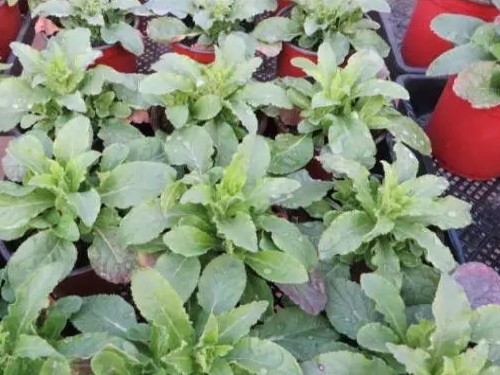
The "Fengling" series is a naturally dwarfed potted campanula. It is a variety that can bloom without undergoing low-temperature vernalization. Compared with other varieties on the market, it has more branches, a longer flowering period, and more abundant flowers. Plant height 30-35 cm. The special blue color is very eye-catching. In 2014, pink was newly introduced. Below is an introduction to the key cultivation points of potted campanula:
I. Seedling management stage
Growing in a 200-cell tray takes 5 weeks, and the germination temperature is 18-20 degrees. PH 5.8-6.2. After sowing, lightly cover with a certain amount of vermiculite and maintain high humidity. Keeping it at 20 degrees for 4 days in the germination chamber can improve the uniformity of germination. Temperature is very critical during the seedling stage and should be controlled at around 20 degrees. This can, on the one hand, avoid leggy growth and, on the other hand, avoid rosetting.
Special note: In order to prevent the seedlings from blooming prematurely, be sure to control light to within 12 hours during the seedling stage. If possible, it is recommended to cover with black film to shorten the light duration. The problem is as shown in the picture:
II. Planting management stage
When the seedlings have 3 true leaves, they can be planted out!! They can be directly planted into 10 cm, 12 cm, and 15 cm pots. It is recommended to use large pots for planting as much as possible; plants grown in large pots have a better plant shape.
For one month after potting, be sure to control the light duration to less than 12 hours to ensure sufficient vegetative growth. Control the temperature at around 20 degrees. When the root system is fully grown and the number of leaves reaches 8-10, campanula Fengling begins flower bud differentiation.
III. Pinching
If you want a rounded plant shape, when the flower spikes extend out, this is the best time for pinching. Pinching will delay the flowering time by 5-7 days, but it can better control the plant shape. When the plant fills the pot, at this stage it is recommended to spray 5000 ppm B9 once, which can effectively control the plant shape. If no pinching or B9 treatment is carried out, using it in a large flower box is also high-end, elegant, and classy.
IV. Cultivation management
Cultivation management is simple. It requires an environment that is warm in winter and cool in summer, with sufficient light and good ventilation. It is not tolerant of dry heat, and its cold hardiness is not strong. It prefers deep, fertile, well-drained neutral soil, and can also grow normally in slightly alkaline soil. Seedlings need to be transplanted once, the soil should be kept moist during the growth period, and fertilizer should be applied once every half month. In the north, it needs to overwinter in a greenhouse or be covered outdoors for cold protection. When small seedlings overwinter in summer, a certain degree of shading should be given to avoid strong sunlight.
It prefers a Mediterranean-type climate with warm, humid winters and summers without intense heat. The most suitable cultivation areas in our country are the Yunnan-Guizhou Plateau and other places in the southwest. Its cold hardiness is relatively poor, so in the north it is only suitable for overwintering indoors or in plastic greenhouses. In the vast low-heat areas of the south, growth is poorer in summer, so the planting period needs to be adjusted or watering should be used in summer to lower the temperature. It likes light and is not tolerant of shade. It does not have strict requirements for soil fertility, but it grows best in fertile, moist, well-drained sandy loam, and grows poorly in heavy clay soil. It prefers slightly acidic to slightly alkaline soil. Southern soils are mostly strongly acidic, so an appropriate amount of lime should be applied when planting to neutralize the soil. Sufficient rainfall is needed during the growth period, but the roots should avoid waterlogging, so beds should be slightly raised and attention should be paid to drainage. When planting, apply sufficient farmyard manure or calcium magnesium phosphate, lime, etc. as base fertilizer. Apply nitrogen fertilizer 2-3 times during the seedling stage, and increase the application of compound fertilizer before flowering. There are few pests and diseases, but lodging should be prevented during the flowering period.