Detailed Explanation of Silphium perfoliatum Planting Technology and Management Methods
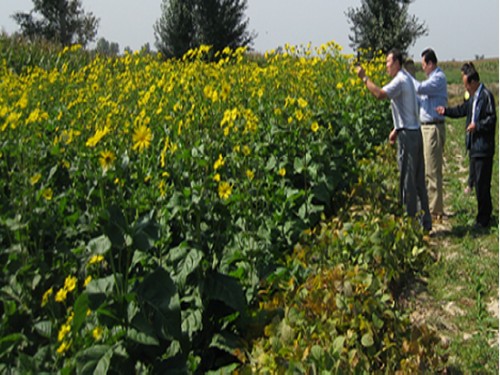
At Cuihu Wetland Park there is a beautiful flower whose posture resembles that of a chrysanthemum, with yellow blooms flowering in masses that lift the spirits. Its name is Silphium perfoliatum.
Silphium perfoliatum, also known as cup plant, compass plant, French champagne grass and so on, is a perennial herbaceous plant of the genus Silphium in the Asteraceae family, native to the moist tall-grass prairie regions of central North America. In the 18th century it was introduced from the United States to Europe as a garden ornamental plant; in the early 1950s, the former Soviet Union began researching it as a forage crop and later introduced it to Korea; in 1979 Beijing Botanical Garden introduced it to China from the Central Botanical Garden in Pyongyang, Korea. Because the bases of the opposite leaves on its stem are joined together in a cup shape, with the stem passing through between the two leaves, it is named Silphium perfoliatum.
Silphium perfoliatum has a high protein content and is rich in various amino acids, with the highest content being lysine. It is a high-yield, high-quality forage crop. It is also a high-quality green manure and a guardian of soil and water conservation. Silphium perfoliatum has tall plants and broad stems and leaves, with golden-yellow flowers. It is an ideal ornamental plant for beautification and greening and a honey-source plant, and it also has good medicinal value.
[Site selection and land preparation]
1. Site selection: Silphium perfoliatum plants are generally 2-3 m tall, with a maximum height of 3.5 m. It likes ample sunlight and moist, fertile soil with a deep soil layer, and the suitable pH is 6.5-7.5. It is not tolerant of poor, thin soil or waterlogging, so plots with fertile soil and no standing water should be selected as far as possible. Its stems are brittle and break easily, so land kept for seed production should be chosen in a relatively sheltered or screened location facing the sun.
2. Land preparation and fertilization: After leveling the ground, the soil for Silphium perfoliatum should be loose and free of large clods. Silphium perfoliatum seeds (achenes) are flat and thin, and after germination the seedlings have weak ability to push through the soil, while the root system is well developed. Before sowing, deep plowing is required and sufficient base fertilizer must be applied. Per mu, apply 2000-4000 kg of well-rotted piled barnyard manure, 60-80 kg of urea, and 30-50 kg of superphosphate, and prepare the land carefully to ensure the bed surface is level. At the same time, dig the box ditches and waist ditches well to ensure good irrigation and drainage performance in the field.
[Sowing technology]
1. Sowing period: Silphium perfoliatum can be sown throughout the year as long as the temperature reaches above 5°C, with spring sowing and autumn sowing being the most suitable. Spring sowing is more suitable from mid-February to mid-March, and autumn sowing from early September to early October.
2. Sowing method: Seedling raising and transplanting can be used, or direct sowing can be carried out. Direct sowing can be done by broadcasting or drilling.
3. Sowing rate: Silphium perfoliatum can be drilled or hill-sown, or raised as seedlings and transplanted. Generally, the sowing rate for drilling or hill sowing is about 0.2 kg per mu; for seedling raising and transplanting, 1 kg of seed can transplant 10-12 mu. The sowing depth is preferably about 2 cm.
4. Sowing: Before sowing, select the seed carefully and sun-dry the seed for 2-3 hours to promote germination. Then soak it in warm water at 30-35°C and drain it.
(1) Using the method of raising seedlings and transplanting to establish the crop: Prepare the seedbed carefully, then evenly scatter the treated seed on the seedbed, using 1 kg of seed per 10 sq m, then cover with 1-2 cm of fine soil, and spray water frequently to keep the soil surface moist. Seedbed raising can also use the seed-by-seed sowing method, that is, inserting the seeds one by one into the soil (pointed end down, the end with the notch up) until the seeds are completely covered by soil. With the seed-by-seed sowing method, the amount of seed used is the least while the germination rate is the highest. When the seedlings have grown 4 true leaves or the leaves have reached about 30 cm in length, they can be transplanted to the field for establishment. The row spacing is 50-60 cm and the plant spacing is 40-50 cm. Generally, it is suitable to maintain about 5000 effective seedlings per mu. If used for harvesting seed, the row spacing is generally required to be 150-200 cm and the plant spacing 50-60 cm.
(2) Direct seed sowing: The hill-sowing method can be used, with 3-4 seeds per hill. After the seedlings emerge completely, thin them so that 1-2 plants remain per hill. To ensure full germination, cover with soil after sowing and irrigate frequently to keep the soil moist. When the seedlings have grown 4 true leaves or the leaves have reached about 30 cm in length, thin them, and about five to six thousand plants per mu is more suitable. Drilling can also be carried out, with a row spacing of 50-60 cm and a sowing strip of 20×20 cm.
[Field management]
1. Irrigation and fertilization: Silphium perfoliatum has thick cotyledons and difficulty emerging from the soil. Before sowing, the field surface soil should be kept moist and the bed surface level. Generally, seedlings emerge 4-5 days after sowing. After the seedlings emerge completely, irrigate and water promptly and apply a quick-acting nitrogen fertilizer as a top dressing, applying 10 kg of urea per mu to promote rapid seedling growth. But at this time attention must also be paid to draining water and reducing waterlogging in the field to prevent root rot and seedling death caused by continuous standing water. Before greening up in early spring or after each cutting, carry out timely intertillage and loosening of the soil, and water and fertilize to keep water and nutrients sufficient. Leguminous green manures such as Chinese milk vetch and common vetch can also be interplanted to improve soil fertility.
2. Weed control: Generally, before plowing and sowing, non-selective herbicides such as diuron, sodium pentachlorophenate, and glyphosate can be sprayed first, and after 7-10 days plowing and sowing can be carried out. In this way, weed damage during the seedling stage of Silphium perfoliatum can be effectively controlled. After Silphium perfoliatum grows larger and taller, it can competitively suppress weed growth.
3. Pest and disease control: Silphium perfoliatum generally has no obvious pests or diseases throughout the growing period, but to prevent fungal and other pathogenic microorganisms in the soil from harming the wounds after cutting, carbendazim solution can be sprayed in advance before cutting and utilizing Silphium perfoliatum for control.
[Cutting and utilization]
Silphium perfoliatum not only has high fresh grass yield and excellent grass quality, but is also rich in various nutrients, especially high in crude protein. Generally, under conditions of sufficient water and fertilizer, when sown in spring of the same year, the first cutting is made in early June, and thereafter it is cut once every 20-30 days. In the same year, the fresh grass yield per mu can be about 3000 kg, and in the following year the fresh grass yield per mu reaches 10000-15000 kg. After each cutting, apply nitrogen fertilizer promptly as a top dressing to ensure a relatively high yield.
[Seed harvesting]
Silphium perfoliatum has a long flowering period, and the seeds mature unevenly. After the seeds mature, they also fall off very easily, so they should be harvested when the seeds are dark brown and mature but have not yet split open, and they should be collected as they mature. Its stems are tender and brittle and break easily, so great care should be taken when harvesting seeds to avoid affecting seed yield. Generally, the yield is 35-50 kg per mu, with a maximum of 75 kg.
"Silphium perfoliatum" is a perennial herbaceous plant with persistent roots in the Asteraceae family, native to Canada and the United States. It is cold-resistant and heat-tolerant; in winter its persistent roots suffer no freeze damage at -29°C, and in summer it can grow normally at 40°C. It can be planted in many regions, and its applicable range is relatively broad.
The stems of "Silphium perfoliatum" are thick and tall. During the growing period the stems are crisp, tender, and juicy, and the fresh grass yield is high. In the year of cultivation, the yield per mu is 1000-3000 kg, and in the second and third years the yield per mu can reach 10000-15000 kg at the high end.
Silphium perfoliatum has good grass quality, a large leaf volume, is tender and juicy, and is rich in nutrients (see the table below for its nutritional composition). Its protein quality is relatively good, containing 17 amino acids, with a complete range of essential amino acids for livestock, and a relatively high lysine content. It is a high-quality forage grass for feeding pigs, cattle, sheep, ostriches, and so on. It has strong regrowth ability and can be cut 4-6 times per year. The annual grass yield is generally 10000-15000 kg. Under ordinary conditions it can grow for 10-12 years, and under good cultivation management and reasonable cutting conditions, its growing period can reach 15 years or longer. It is not only suitable for large and medium-sized intensive production, but can also be planted in small scattered plots around houses.
Key points of cultivation technology:
1. Sow in spring from March to May and in autumn from August to October. The germination temperature is 10-15°C, and the suitable growing temperature is 15-30°C. Before sowing, sun-dry the seeds for 2-3 hours, then soak them in warm water at 25-30°C for 12 hours, air-dry them, then mix them evenly with moist fine sand and place them indoors at 20-25°C to germinate for 3-4 days. Sow after most of the seeds have shown white.
2. Choose a well-ventilated, sunny, fertile loam soil as the seedbed, with a bed width of 1.3-2 m, a ditch width of 0.3 m, the soil broken up fine, the bed surface level, and sufficient base fertilizer applied. Before sowing, use diluted human and animal manure as a base, applying about 1000 kg per mu of seedbed. After watering thoroughly with water and fertilizer, sow evenly with a seed spacing of 5 cm, at a sowing depth of 1.5 cm, cover with a layer of burnt mud ash and fine soil, then cover with rice straw, and spray water frequently to keep it moist. After the seedlings emerge completely, remove the cover. If autumn sowing is too late and the seedlings are small and weak, cover them with plastic film to facilitate growth the following year.
3. Silphium perfoliatum has strong fertilizer tolerance. Before transplanting, apply 2500 kg of barn manure, 50 kg of phosphate fertilizer, and 15 kg of standard nitrogen fertilizer per mu as base fertilizer. After each green cutting, apply 10 kg of standard nitrogen fertilizer per mu as a top dressing. After one year, continue applying barn manure, phosphate fertilizer, and nitrogen fertilizer to continuously supplement and maintain the fertility in the soil;
4. During the seedling period, weed promptly, and in dry conditions irrigate frequently to keep the soil moist. Because early growth is relatively slow, attention should also be paid to intertillage and weeding. To improve fertility, leguminous green manure crops such as Chinese milk vetch and common vetch can be interplanted in the Silphium perfoliatum field,
5. Silphium perfoliatum has strong disease resistance and generally has fewer pests and diseases. During the flower bud stage it is sometimes attacked by the corn borer, which can be controlled by spraying 1000-fold trichlorfon. If powdery mildew appears at the seedling stage, promptly spray Bordeaux mixture with about 0.5 degrees Baumé lime-sulfur mixture for control.
6. There are two cutting methods: one is to cut everything at once (leaving a stubble of about 125px), and the other is to cut the edges while keeping the heart leaves. The latter cutting method is better and gives a good grass yield. Cut once every 20-30 days. In the second and third years, it can be cut 8-10 times, with a fresh grass yield of more than 15000 kg per mu.
Silphium perfoliatum has a very good nutritional composition. The dry matter content is: crude protein 23.6%, crude fat 3.51%, crude fiber 26.27%, crude ash 1.87%, nitrogen-free extract 46.7%, calcium 3.33%, phosphorus 0.28%. Its digestibility is also relatively good, with a protein digestibility of 83%. Utilization methods include fresh grass, fermentation, silage, and hay.
The fresh grass of Silphium perfoliatum can be fed directly to cattle, sheep, rabbits, chickens, geese, and so on, with good palatability. At the beginning of feeding, some livestock and poultry do not like to eat it or do not eat it, so it can be made into feed cakes or blocks for feeding. Method for making hay meal: sun-dry, air-dry, or dehydrate the fresh grass and then crush it into grass meal. Generally, 5-6 jin makes 1 jin.