A Detailed Guide to Lingzhi Bonsai Cultivation Techniques and Management Methods
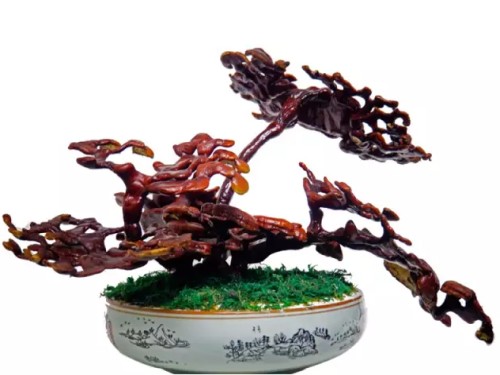
Lingzhi bonsai is a shaped handicraft that has emerged in recent years, made by processing dried mature lingzhi fruiting bodies. By using foam plastic greenhouse technology to pot living lingzhi at the growth stage, a living lingzhi bonsai is created, and just like potted flowers, you can watch the lingzhi stipe elongate. Below, the editor introduces lingzhi bonsai cultivation techniques.
Since ancient times, lingzhi has been regarded as an auspicious and noble thing, symbolizing good fortune and prosperity, auspiciousness and longevity, and also expressing people's beautiful wishes in pursuit of good fortune, wealth, peace and happiness. Lingzhi does not adapt well to cultivation in northern regions, but greenhouse bonsai cultivation gives very good results. Precisely because of lingzhi's auspicious symbolism, it has become the best choice for many people to collect and give as gifts. Lingzhi bonsai has both good ornamental value and a certain medicinal value, with good market prospects.
1. Cultivation substrate
Lingzhi is a wood-rotting fungus and is suitable for growing on substrates such as mixed sawdust and cottonseed hulls. Its culture medium formula is: mixed sawdust or cottonseed hulls 78%, wheat bran 20%, gypsum powder 1%, white sugar 1%, water content 60-62%, natural pH.
2. Cultivation season
Lingzhi is a constant-temperature, medium-to-high-temperature type fungus. Both the spawn-running temperature and the fruiting temperature are 22-28°C, and fruiting requires relatively high air humidity; therefore, in southern regions it is better to schedule fruiting for late spring and early summer. Inoculation can begin after mid-January, fruiting begins after mid-March, and potting for sale takes place in mid-April. For autumn fruiting, inoculation can be done in early August, fruiting in mid-September, and potting for sale in late September. This helps catch the two golden market cycles.
3. Greenhouse construction
The greenhouse is rebuilt from an ordinary plastic greenhouse. The outer layer is covered with shade netting to achieve a light intensity of seven parts shade and three parts sun; the middle layer is 0.5 cm thick foam plastic board, which provides insulation; the inner layer is non-toxic plastic film, which enhances moisture retention. The wooden pole frame doors at both ends are sealed with plastic film so that ventilation and light transmission can be regulated.
4. Selecting varieties
According to the different characteristics of various lingzhi varieties, different types and differently colored varieties can be selected for potted living lingzhi. Generally, varieties with many branches, relatively long stipes, small caps, slow growth and little spore powder are preferred. For example, Yuanzhi No. 6, Yuanzhi No. 9, Jingda, Shinshu, Zizhi, and others.
Lingzhi is a saprophytic fungus and is suitable for growing on dead wood. In artificial cultivation, log cultivation, sawdust cultivation or other substitute material cultivation can be used, and cultivation methods include bottle cultivation, pot cultivation, plastic bag cultivation, fungus brick cultivation, log cultivation and so on. Cultivation time is determined by natural temperature; generally April to September is suitable, and log cultivation has a very wide suitability because it can grow for several years and can be cultivated at any time. Bottle cultivation, pot cultivation and bag cultivation are all relatively fast; from cultivation to the emergence of fruiting bodies takes only about 20 d, and a complete growth cycle can be completed in about 40 d.
1. Raw material preparation
Cottonseed hulls 65%, superphosphate 3%, gypsum 2%, water content 65%; or sawdust 78%, wheat bran 20%, white sugar 1%, gypsum 1%, water content 65%.
2. Sterilization and inoculation
After mixing the above raw materials evenly, put them into a pot, with a thickness of 3-4 cun being suitable, flatten the surface of the culture medium, then seal the opening with plastic film and sterilize. Sterilization methods: high-pressure sterilization, maintaining for 1 h once the pressure reaches 115 pounds. Traditional sterilization, maintaining for 6-8 h counted from the start of boiling, then inoculating after cooling.
Disinfect the inoculation box and inoculation room by mixing and vaporizing 10 mL/m2 of formaldehyde with 6 g/m2 of potassium permanganate; inoculation can be done after 30 min. When inoculating, remove the surface layer of the raw material, then inoculate the cultured spawn into the sterilized pot. The spawn should be about the size of a fingertip; 4-5 inoculation points can be made on the surface of each pot, or the spawn can be spread over it, then seal the pot opening well and place it in the culture room for cultivation. Keep the temperature at 25-28°C, the relative humidity at 75%-80%, and pay attention to ventilation and keeping the environment clean. After 25-30 d of cultivation, the mycelium will have covered the whole pot. If fruiting bodies appear, remove the plastic film immediately. After the mycelium has grown to one half, primordia will appear on the surface of the culture medium. The primordia gradually expand and enlarge, and at this time ventilation, light, insulation and moisture retention should be strengthened in management; in about one month they will grow to maturity.
3. Cultivation and shaping
Lingzhi caps have many shapes such as round, kidney-shaped and fan-shaped; they also have ring-like, cloud-like, ridged and radiating wrinkles; the stipes are slender and may be lateral, offset or branched; artificial processing can cultivate lingzhi in many shapes. What is even more valuable is that after the fruiting body matures, the texture is hard, with a lacquer-like natural luster, and it does not rot over time, making it an extremely rare material for bonsai craftsmanship. According to the biological characteristics of lingzhi, by changing conditions such as light, temperature, water and air, effects of growth inhibition, growth promotion and shaping can be achieved.
(1) To control the formation of stipes and caps, place the culture pot with newly formed fruiting body primordia into a large glass jar with suitable temperature, humidity and light. Cover the jar opening with a piece of glass having a 1-2 cm ventilation hole, so that ventilation is poor. At this time, the fruiting body primordia in the jar only elongate the stipe and do not form a cap. When the stipe has grown to a certain length, take the culture pot out of the jar and place it outside the jar; because ventilation is good, the newly elongated stipe will quickly form a cap.
(2) Cultivation of double-layer caps: put lingzhi that has already formed a cap but has not stopped growing back into the glass jar to continue cultivation. A proliferating layer will appear under the cap and cover part of the pores, making the cap larger and thicker. If this poorly ventilated state is maintained, the edge of the proliferating layer will produce a secondary stipe and continue to elongate. If it is taken out of the glass jar and good ventilation conditions are restored, the secondary stipe will quickly grow a cap, forming lingzhi with double-layer caps.
(3) Because lingzhi has strong phototropism, during the fruiting body growth stage, shading on all four sides can make the stipe and cap grow vertically upward. If light is admitted from one side only, the stipe and cap can be made to grow toward the light. In addition, depending on the intensity of light received, the color of the fruiting body also varies in depth.
(4) To control the size of the fruiting body shape, containers of different calibers can be selected to cultivate fruiting bodies of different shapes and sizes. For example, using a small-caliber bottle as a container can form a solitary lingzhi with a long stipe; using a small flower pot as a container produces lingzhi with multiple stipes; if a plastic bag is used as the container, with more material and sufficient nutrients, large lingzhi with big caps and thick stipes can be grown.
(5) To form deformed fruiting bodies, irradiation with ultraviolet light can cause the fruiting body to deform. Wrapping with plastic paper can make the growing stipe bend, thicken, or produce an offset cap with scarring.
4. Bonsai arrangement
The lingzhi cultivated for shaping can be slightly trimmed and embellished by hand and combined with rocks, tree stumps, bamboo rhizomes, flowers and grasses to make lingzhi bonsai of various forms and brilliant colors.
Warm tips:
1. Before lingzhi begins to grow caps, there is no need to water or spray water; the spawn bag contains enough nutrients and moisture for lingzhi to grow.
2. Place the spawn bag in a dark place, avoiding direct sunlight and exposure; only weak scattered light is needed.
3. When caps begin to grow slightly, start spraying water, once in the morning and once in the evening; just moisten the caps. Do not spray water on rainy or overcast days, and do not let rain soak them.