Cultivation Techniques and Care Methods for Red Plum Bonsai
Red plum——it is a flower, a pure and beautiful flower. When the cold congeals the earth, it stubbornly opens one beautiful, pure and delicately understated bloom after another. Some are white tinged with red, some are pure white and elegant, and some are pink like rosy clouds…… The petals are smooth and translucent, as if carved from ice or polished jade. It is endlessly varied in form, brilliantly fragrant, swaying with the wind, like colorful clouds adorning the earth and gracing the lingering winter. Those tender pink stamens give off wave after wave of alluring delicate fragrance, making people forget all their unhappiness. Strolling among the plum blossoms, if you take a deep breath, the fresh fragrance fills your chest and penetrates heart and spleen, and you suddenly feel completely refreshed and joyful. "From afar I know it is not snow, for a subtle fragrance comes drifting by." That fragrance is far beyond what any other flower can match.
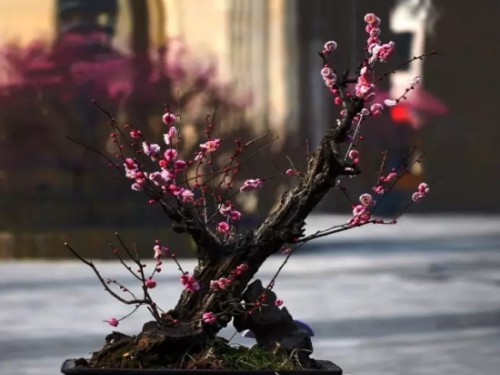
Apart from large trees planted in the ground, plum blossoms are usually grown in pots and trained as bonsai, and can even be developed into gnarled old plum specimens. Under natural conditions, plum blossoms bloom proudly in the bitter cold, with fallen petals scattering in profusion, fragrant snow forming a sea, and a delicate scent spreading far and wide. Potted or bonsai plum blossoms can serve as the main feature when in bloom, and are best displayed on their own. Potted red plum is mainly propagated by grafting, commonly using cleft grafting and bud grafting. The rootstock is wild peach, mountain peach, or apricot. The old trunk bark of apricot is red, so grafting red plum onto it gives coordinated colors of flower and bark.
1. Cleft grafting
Cleft grafting mostly uses one- or two-year-old rootstock. At the end of March (in a cold room) or the beginning of April (in the open field), cut off the upper part of the rootstock 3—5 cm above the ground. Use vigorous one-year-old branches as scions, cut them to 5—6 cm long, leaving at least 3 buds. On the outer sides of the lowest bud, cut downward diagonally on both sides into a duck-bill shape. Open a 3 cm long slit on one side of the rootstock. Insert the scion into the slit of the rootstock so that the two form a close union, then bind with plastic film tape. Or fasten tightly with polyester tape. Finally, cover the scion with a small plastic bag, tying the bag opening below the graft union, so you can check through the film at any time. Once it has survived, remove the binding material.
2. Bud grafting
Bud grafting is carried out in August and September, generally using the "T"-shaped method. First make a horizontal cut 1—1.5 cm above the bud on the scion, then from 1 cm below the bud make a flat cut forward and downward, gently peel off the wood inside the bark layer of the removed bud (in recent years, bud grafting with a little wood attached is also used) and hold it in the mouth. Make a horizontal cut on the rootstock 5 cm above the soil surface, then make a vertical cut downward from the center of the cut, forming a "T" shape, then gently peel open the bark and insert the prepared scion into the bark at the "T" opening. The grafted bud must fit tightly, with its upper end closely joined to the upper end of the "T" opening on the rootstock, and finally bind it well with plastic film strips or polyester adhesive tape. Check survival after one week; if the leaf stalk falls off at a touch and the bud point is green and plump, it indicates survival. In the spring of the following year, cut off the top of the rootstock 5—6 cm above the graft union, and the scion will sprout quickly. Afterward, pay attention to removing rootstock shoots. When repotting or planting in a pot, it can be planted somewhat deeper so that the graft union is as low as possible, and tied according to its growth to guide it into a graceful shape.
3. Soil mix
Mix 1/3 rice husk ash with 2/3 river mud, add human and animal manure and urine, stir evenly, expose to sunlight, then sift and set aside. Place tile pieces and stones at the bottom of the pot to aid drainage, then add coarser soil, then plant the plum specimen and firm the soil around the roots.
4. Watering
Do not water when potting; water once after 3~4 days; water once a day after 7~10 days; once it has survived, water 1~2 times a day from May to August. The soil should not be too wet, and waterlogging must be strictly avoided.
5. Fertilizing
Plum blossoms do not like heavy fertilizer. When new shoots grow to about 5 cm, apply once a dilute fertilizer water made of crushed bone and sesame paste to encourage robust branch growth. When leaves emerge, fertilizer water should be sufficient, generally applying a dilute liquid fertilizer once a month to promote lush branches and leaves. When branches reach 20-25 cm, fertilizer and water should be restrained. At the end of summer and beginning of autumn, apply 2 additional feedings to promote flower bud differentiation. After each fertilizing, be sure to water and loosen the soil promptly to keep the potting soil loose, which benefits root development.
6. Light
Plum blossoms like a sunny and well-ventilated environment and cannot tolerate long periods of shade. Only by giving sufficient light, so that they can carry out photosynthesis, can they obtain adequate nutrition, and thus grow robustly and produce abundant, large, brightly colored flowers.
7. Pruning
To produce more flowers, pruning can be used to encourage more branches. Potted plum requires heavier pruning than field-grown plum, and thinning cuts and heading cuts should both be emphasized, with bud thinning before flowering. Trees with strong vigor or young trees should be pruned lightly, while weak trees or old plum specimens should be pruned heavily. When pruning, pay attention to the direction of the cut; generally, for varieties with drooping branches, keep inner branches, and for varieties with upright or obliquely growing branches, keep outer buds.
8. Flowering period
To make potted plum blossoms open during the Spring Festival, the key is to grasp the timing of heating and the care measures. If heated too early, the flowers will open ahead of time; if too late, flowering will be delayed. If the flower buds are still small one week before the Spring Festival, place them in an environment of 20 to 25°C for care. If the buds open early before the Spring Festival, move the plant to a low-temperature environment and give it little sunlight, which can prolong the flowering period and keep it in bloom for about half a month.