Detailed Explanation of Organic Strawberry Planting Techniques and Concepts in Pots
What are organic strawberries? Organic strawberries refer to fruit and vegetable crops produced through a series of standardized organic farming practices, containing no chemically synthesized fertilizers or chemical compound fertilizers, unstable elements (such as radioactive elements, rare earths, etc.), various unknown or pathogenic microorganisms, heavy metals and other toxic and harmful substances, other substances of unknown nature, as well as various hormones, antibiotics, insecticides, and fungicides. They are a pure natural green food.
Organic strawberries grown in pots are perennial herbaceous plants with a short stature, unique leaf shape, white flowers and red fruit, and a sweet, aromatic flavor. They have relatively high economic and ornamental value, can purify the air and beautify the environment, and enrich people's enjoyment. The techniques for growing organic strawberries in pots are as follows:
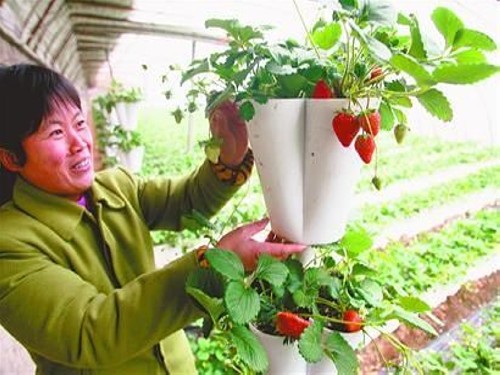
1. Container Selection
You can use a clay pot, porcelain pot, or wooden box with a diameter of 21—33 cm. The size depends on the number of plants to be planted, and the bottom of the box should have drainage holes. Before planting, the flower pot should be soaked in water.
2. Variety Selection
Generally, all cultivated varieties can be chosen, but it is best to choose everbearing strawberry varieties.
3. Nutrient Soil Preparation
Strawberries prefer sandy, well-aerated, fertile soil. Therefore, the ideal potting soil is humus soil from the surface layer of broadleaf forests. This kind of soil contains a lot of organic matter and nutrients, is loose, and has good water absorption and drainage performance, which is beneficial to strawberry growth. Nutrient soil can also be prepared artificially, with a ratio of soil, fertilizer, and sand of 1:1:1, that is, 1 part fertile garden soil, plus 1 part decomposed chicken, duck, or sheep manure, and 1 part river sand; the manure, soil, and sand should preferably all be crushed and sieved, then mixed with 2%-3% superphosphate. Before filling the pots, the prepared nutrient soil can be disinfected with a 0.3% potassium permanganate aqueous solution. If conditions permit, an appropriate amount of cake fertilizer can be added. Place some crushed bones, fish meal, hoof scraps, and eggshells at the bottom of the pot.
4. Selecting Seedlings
For planting seedlings, choose new seedlings from current-year runners, free of pests and diseases, with well-developed fibrous roots, many white absorbing roots, plump terminal buds, 3—5 leaves, short and thick petioles, and a single-plant weight of about 25 grams, of medium size and robust.
5. Planting Method
When planting, face the arched side outward so that the roots are even and the stem is upright. First put part of the nutrient soil into the pot, spread the roots out in all directions, and continue filling with soil. The planting depth should follow the principle of "roots not exposed below, crown not buried above," firm the soil, and fix the seedling in place. Do not fill the pot soil too full; keep a distance of about 3 between the soil surface and the pot rim to facilitate later earthing up. Before planting, the roots can be soaked for 1 hour in a 50×10-6 solution of naphthalene acetic acid or ABT rooting powder to increase the survival rate. Immediately after planting, water thoroughly. After the water seeps down, cover the exposed fibrous roots with soil, gently lift the seedling upward a little, and then firm it again, so that the roots and soil are closely combined and the depth is appropriate.
6. Daily Management
(1) Light
Organic strawberries grown indoors are best placed in a place with good light, so as to ensure the light needed for growth and ensure a light duration of at least 8 hours.
(2) Temperature
When growing organic strawberries, it is best to control the temperature at 20~25°C during the day and 10—15°C at night. Do not let the temperature get too high, otherwise the plants will have excessive nutrition and are prone to leggy growth.
(3) Water
In winter, indoor heating is usually available, making the air dry easily. The growth of strawberries and their fruit requires a large amount of water, so the soil should be kept moist. It is best to let tap water sit indoors for 2 or 3 days before use. Using your own rice-washing water, fermented sesame residue water, and milk water is even better.
(4) Pollination
In production, bees and wind can help complete pollination. In a greenhouse, we can use a brush or cotton swab to assist in completing this pollination work.
(5) Loosening Soil and Thinning Seedlings in Time
After the beginning of spring, timely intertillage and soil loosening should be carried out to raise the surface temperature. Intertillage is best done shallowly, and then thinning seedlings should be done in time.