Detailed Guide to Growing Honeysuckle in Containers
Honeysuckle (Lonicera japonica) is a temperate and subtropical tree species that likes sun but also tolerates shade, cold, drought and moisture. It is not demanding about soil and can adapt to both acidic and alkaline soils, but prefers loose, fertile, neutral sandy loam. It is vigorous, with a well-developed root system and strong sprouting ability; the plant is light and graceful in form, and old stumps are quaint and elegant, making it an excellent material for bonsai.
Honeysuckle is both a commonly used medicinal herb and a plant that can be grown for ornament. Its vines twine around, the winter leaves are slightly red and do not wither through the winter; yellow and white set each other off, and it blooms continuously, first white then yellow, with both color and fragrance, beautiful in both flower and leaf, in spring and summer. Honeysuckle bonsai are also quite beautiful.
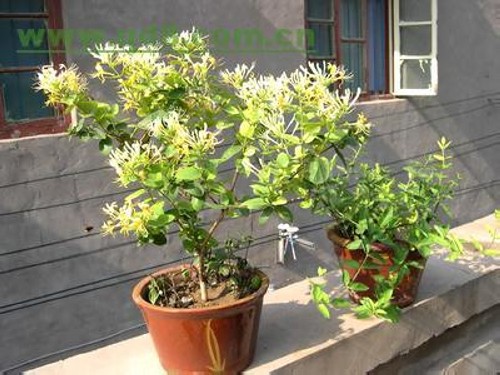
1. Soil
Honeysuckle is not demanding about soil and can be cultivated on barren hills and field banks, but sandy loam is best; a pH of 5.5-7 is suitable for honeysuckle growth.
2. Propagation
Propagate by seeds and cuttings. Cutting propagation has a high survival rate and quick returns, and is commonly used in production areas.
3. Raising seedlings
In mid to late April, choose a good pot, fill it with soil and firm it down, then water thoroughly immediately. In dry weather, water once every 2-3 days, and after 15 days it will take root and sprout, to be transplanted in the following spring.
4. Potting
Honeysuckle is not fussy about soil, but it is best to use mountain soil, or a growing medium made mainly of mountain soil with an appropriate amount of leaf mold, coal cinder ash, etc. Early spring is the best time for potting.
5. Planting out
Choose a pot, use farmyard manure as a base fertilizer, cover with a layer of fine soil after planting, firm it down and water thoroughly to settle the roots. If there is a long spell of clear weather without rain, water to keep the soil moist and ensure the transplant survives.
6. Transplanting
When the seedlings are one year old, they can be lifted and transplanted from the Spring Equinox to Grain Rain, with density depending on the soil.
7. Fertilizing
Carry out intertillage once each in early spring and early winter, to a depth of about 25 cm. Combined with intertillage and weeding, fertilize generally twice a year: the first is a sprouting fertilizer applied in spring, with timely watering after application; the second is a top dressing in early winter, and if conditions permit, an additional top dressing can be applied after each flower harvest.
8. Pruning
In the first 1-2 years after transplanting, the main task is to train the trunk; before early spring sprouting, cut off the upper branches of the trunk 15-20 cm above the ground, so that the trunk grows thick and strong and puts out many new branches. In the second year, keep 4-5 thick, strong branches and cut the rest to about 15 cm, so as to form a short shrubby plant with a thick, strong, upright trunk. Afterwards, each year in early spring, before honeysuckle sprouts, cut out the dead, old, thin and weak branches and those with poor upright ability, working from bottom to top and from inside outward.
9. Pest and disease control
Honeysuckle has relatively few pests and diseases. The main diseases are anthracnose and honeysuckle powdery mildew, and the main pest is aphids. When controlling them, note that toxic pesticides must not be used during the bud stage of honeysuckle, to prevent the honeysuckle from losing its useful value.