How to plant potted tree peonies? A detailed guide to planting techniques and methods
The tree peony is a symbol of wealth, good fortune, nobility and elegance, and cut-flower tree peonies are even more beloved than people's fondness for tree peony flowers. Fresh-cut tree peony flowers are also a variety with relatively high value and class, but not all tree peonies are suitable for cutting, so superior tree peony varieties must be carefully selected as cut-flower tree peonies. In many places in our country, tree peonies are planted to beautify the surrounding scenery, and many friends, like the editor, want to plant a beautiful pot of tree peony themselves and place it indoors to add a touch of gorgeous and noble charm.
Tree peony flowers are large, with bright and gorgeous colors. Supported by their verdant green leaves, they appear elegant and luxurious with a tender, charming posture, and their delicate fragrance makes them all the more captivating. Thus they have long enjoyed the reputation of “national beauty and heavenly fragrance” and are universally recognized as the king of flowers. Besides open-field cultivation, tree peonies can also be grown in pots for ornamental purposes. Below, we introduce the planting techniques for potted tree peonies.
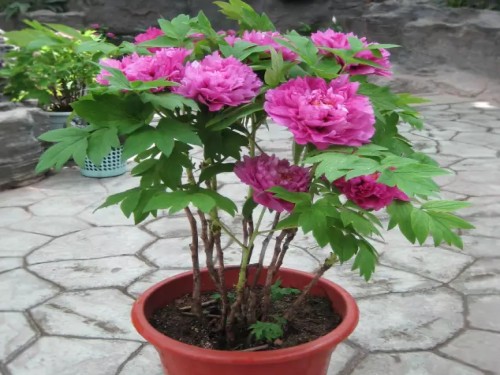
1. Seed and variety selection
The best planting season is September to October. For potted tree peonies, choose varieties with strong adaptability, early flowering and good flower form, such as Luoyang Hong, Hu Hong and Zhao Fen. For the plants, it is best to choose 3-4 year old small tree peonies grafted onto herbaceous peony rootstock, or divided seedlings with 3-5 branches.
2. Soil mixing
When potting, spread coarse sand or small stones 3-5 cm thick at the bottom of the pot to aid drainage. For the potting soil, use a mixture of yellow sandy soil and cake fertilizer, or a culture soil thoroughly mixed with fully rotted manure, garden soil and coarse sand in a 1:1:1 ratio. When filling with soil, let the root system spread out and not curl up; after covering with soil, press it down with your hands so that the roots make close contact with the soil, which makes it easier for the plant to survive.
3. Watering
The tree peony has fleshy roots and can tolerate drought slightly, but it fears waterlogging most of all, so whether watering is done properly is a key issue in the success or failure of potted tree peonies. After potting, water thoroughly once and place in a semi-shaded spot to let the seedling recover. Generally, for tree peonies brought outdoors in early spring, apply a liquid fertilizer once first, then water thoroughly, and loosen the soil after the water dries slightly. Afterwards, water according to the weather and the condition of the potting soil, at the right time and in the right amount, keeping the potting soil moist at all times, which favors the growth and flowering of tree peonies. Reasonable watering should follow the principle of watering when dry and stopping when wet; do not water heavily, and prevent water from accumulating in the pot, so as to avoid root rot and leaf drop.
4. Fertilizing
During the growth period, loosen the soil regularly and apply a compound fertilizer about every half month. Newly potted tree peonies must not be fertilized, and strong fertilizer is especially taboo, otherwise the fleshy roots will mold and rot to death. After half a year, gradually apply some light fertilizer, such as rotted chicken manure water or bean water, with a fertilizer-to-water ratio of 20%-30% being suitable. Tree peonies bloom once a year in mid to late April; before flowering, apply 1-2 additional applications of liquid fertilizer; half a month after flowering, apply another 1-2 applications of liquid fertilizer; during the dog days, apply sesame paste residue (about 40-50 grams per pot) once as a dry fertilizer to favor flower bud differentiation. To make tree peony flowers brighter, spray the leaves 2-3 times with a 0.5%-1% potassium dihydrogen phosphate solution during the flowering period.
5. Flowering period
When tree peonies are in bloom, you can set up a canopy for cover or temporarily place them indoors to avoid direct sunlight, which can prolong the flowering period. Newly potted tree peonies may not necessarily produce good flowers in the first year, but after 1-2 years of cultivation, they can bloom year after year.
6. Pruning
If the terminal bud of the main branch is a leaf bud, it should be removed to prevent excessive vegetative growth and avoid affecting flowering. After the tree peony flowers fade, carry out a shaping and pruning, promptly cutting off the faded flowers and flower stalks so that no seeds form, and keep 1-2 outer buds on the stem, which can make the plant grow vigorously and ensure flowering the following year. Be sure to promptly cut off diseased and pest-damaged branches, overlapping branches, twin branches, thin and weak branches, aged branches, inward-growing branches and excessive vegetative shoots; through thinning, heading back and removing suckers, prolong the life of the tree peony.
7. Turning the soil
In winter, dig and turn the soil layer so that the surface soil and deep soil are swapped, and turn and sun it several times in succession to make the soil loose and airy. Clear weeds and destroy insect eggs, and mix the residual parts of the applied organic fertilizer, compound fertilizer and microbial fertilizer evenly before use, to reduce pests and diseases. Pesticides mixed with Xin Gao Zhi Mo can be used promptly to prevent pests and diseases and protect the leaves.
8. Overwintering
In winter, the leaves of tree peonies stop growing and the plants enter the dormant period. Although tree peonies are relatively cold-tolerant, in cold regions such as North China, around the Start of Winter they should be moved indoors and placed in a sunny spot in the room, with the room temperature kept at around 0 degrees. They should not be moved outdoors too early the following year; wait until around Qingming before moving them out. In less cold regions, you can choose a sheltered spot and bury the flower pot in the soil with the pot surface level with the ground, to maintain the moisture and temperature of the potting soil and also ensure the tree peony overwinters safely.