How to cultivate a potted kumquat tree? A complete analysis of the key technical points
While visiting a botanical garden, I happened to come across several potted kumquat trees placed at the entrance, with small kumquats hanging all over the little trees, looking very festive and making people want to reach out and touch these little oranges. Just imagine if you could grow a few of these potted kumquat trees at home, enjoying the scenery in spring and summer, and in autumn you could even taste the sweet-and-sour little kumquats - it really is a delightful thing. So how do you grow a potted kumquat tree, and what are the cultivation techniques for potted kumquat trees?
Seeing how beautiful and lovely potted kumquat trees are, growing them well actually takes real effort. Below, the editor will introduce the cultivation techniques for potted kumquat trees to everyone.
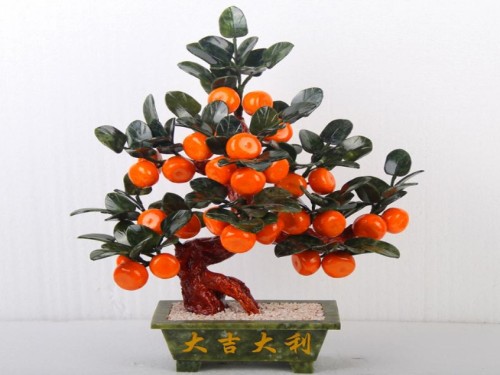
1. Choosing a container
Containers for potted fruit trees are mainly round, which helps the root system spread evenly in all directions. At the same time, the container needs good water permeability and air permeability to ensure the root system's oxygen needs for growth and to prevent water accumulation in the container from causing root rot. Among containers of various materials, unglazed clay pots are most suitable for growing fruit trees. When using containers of other materials, to overcome the disadvantage of poor air permeability, you can lay 5 cm of coarse sand at the bottom of the pot, place a layer of new tiles along the inner wall, and then fill with soil and plant the tree.
2. Preparing the potting soil
The potting soil suitable for fruit tree growth is generally neutral (pH 4.5-7.5), humus-rich sandy loam or sandy soil. When mixing, use 4 parts matured garden soil, 2 parts river sand, and 1 part plant ash, mix thoroughly, crush finely and sieve. The culture soil should be disinfected before use, such as by boiling disinfection, baking disinfection, or chemical disinfection (sprinkling in 1.5% formalin).
3. Fertilizer and water management
Since the root system of a fruit tree can only absorb nutrients from the pot, the organic fertilizer in the pot alone is far from enough to meet the needs of fruit tree growth and development, so fertilizer and water management must be emphasized during the growing period. Fertilization should be mainly organic fertilizer, with reasonable combined application of chemical fertilizer. When potting, mix in decomposed organic fertilizer; apply a quick-acting nitrogen fertilizer once before budding, appropriately combined with phosphate fertilizer, watering about 1 kg of fertilizer solution per plant to promote neat budding and flowering; during the fruit-setting period after flowers fade, carry out foliar topdressing, using 0.3% monopotassium phosphate plus 0.3% urea, spraying once every 15 days, for 2 consecutive sprays, to promote young fruit enlargement and new shoot growth. Apply phosphate and potassium fertilizer 20-30 days before harvest, applying 40-60 grams of monopotassium phosphate per pot, then water thoroughly, which can increase fruit size and improve quality. After fruit harvest, apply a ternary compound fertilizer once more and water. Before leaf fall in autumn, apply decomposed farmyard manure as base fertilizer. During the dormant period, strictly control watering, to the extent that the potting soil does not become too dry.
4. Repotting
Since the nutrients in the potting soil are absorbed by the fruit tree or leached away by frequent watering, repotting is needed every 2-3 years to replace with new nutrient soil. After turning the soil ball out upside down, cut away old roots 2-3 cm thick around the potting soil, mix organic fertilizer with nutrient soil evenly and fill the bottom, then put it back into the pot with the soil ball, add more fertilized soil around to fill, and water thoroughly once.
5. Care
The kumquat tree likes sunlight and is suitable for growing in fertile, loose, slightly acidic, well-drained sandy soil. It is relatively cold-tolerant; ground-planted kumquats can withstand low temperatures of minus 2-3°C. Potted kumquats should be moved outdoors in early spring in the first ten days of April (after Qingming), then pruned. According to the principle of "light pruning for strong branches, heavy pruning for weak branches," cut off overlapping branches, dead and old branches, crossing branches, and diseased and pest-infested branches, to save nutrients, improve ventilation and light penetration, promote new branch growth, and make the branches and leaves appropriately dense and the tree shape beautiful and well-proportioned.
In early May, when the plant begins to sprout leaves and send out branches, it is advisable to apply a dilute fertilizer solution once every 10-12 days, starting relatively dilute and gradually increasing in concentration. By early June when flowers and leaves are luxuriant, water and fertilizer consumption is high, so fertilizer and water should be applied frequently, and the plant should be pinched back to concentrate nutrients for promoting flowers and preserving fruit. Due to the limitations of the flower pot, soil and nutrients can hardly satisfy the natural growth of the kumquat tree, so when potting, necessary pruning and fruit thinning must be carried out. In addition to applying more fertilizer and water normally, during the fruit-setting period after flowering, some fruits should be removed, keeping just a few for ornamental purposes.
Potted kumquats should be deliberately cultivated to bear more autumn fruit for appreciation during the Spring Festival. In July-August before autumn flowering, apply sufficient fertilizer to increase the fruit-setting rate. At full bloom, water and fertilizer should be slightly reduced; when the fruit grows to the size of a bead, apply frequently again. If the plant is not growing vigorously, foliar fertilization must be carried out, and liquid fertilizer must be applied until winter stops.