Methods and Technical Key Points for Growing Cucumbers in Balcony Containers
Loving greenery and longing to get close to nature is the wish of every gardening enthusiast, and I believe everyone has their own beloved potted plants. We love the grandness of foliage plants, the brilliance of flowering plants, and the rustic elegance of bonsai…… Actually, besides these potted plants grown for their flowers and leaves, there is another kind of green plant that can bring us just as much joy, and that is potted vegetables and fruits.
For growing cucumbers in containers, let's first cover seed germination and seedling raising methods. Generally, sow in early spring from January to March, and in summer and autumn from June to August. In winter, if there is heating indoors, you can sow year-round. For spring sowing, use seed soaking and germination followed by seedling raising, or direct sowing with plastic film mulch. For summer and autumn, either soaked-seed direct sowing or dry-seed direct sowing is fine.
Seed soaking and germination is commonly used in cucumber sowing. Scald the seeds with 50-55°C warm boiled water for 10 minutes to disinfect, stirring constantly to prevent scalding. Then soak in about 30°C warm water for 4-6 hours, rub clean, scoop out and drain, and keep moist for germination in a 28-30°C incubator or a warm place. They generally sprout within 3 days. It is especially worth noting that once they sprout, they must be sown. Place the seeds flat, and cover with soil to a depth twice the seed diameter, generally half a cm, because the volume in the pot is limited. The nutrient soil must be rich in organic matter and nutrients. There are several nutrient soil formulas below for reference:
(1) Take 60% fertile sandy loam field soil (vegetable field soil that has never grown cucurbit crops), 20% dried manure, and 20% decomposed barnyard manure, and add 200 grams of carbendazim per cubic meter of culture soil.
(2) 50% fertile field soil, 40% pen manure, 10% stove ash, and add 1.5 kg of diammonium phosphate, 0.5 kg of potassium sulfate, and 200 grams of carbendazim per cubic meter.
(3) 40% fertile field soil, 30% peat soil, 20% decomposed horse manure, 10% decomposed chicken manure, and add 200 grams of carbendazim per cubic meter. After the nutrient soil is prepared, put it into the bottom and around the sides of the pot, leaving a certain space in the middle so that seedlings with a soil ball can be planted in when transplanting.
Today let me introduce container-grown cucumbers:
1. Seed selection
You can go to a seed shop to buy varieties suitable for container growing.
2. Sowing
Because they are grown indoors, you can sow at any time. When sowing, first soak the seeds in warm water overnight, then dibble the soaked seeds into prepared fertile, loose soil at a moderate spacing, not too crowded; finally gently cover the seeds with about two cm of soil. Place the pot in a warm place with sunlight and keep the soil moist.
3. Thinning seedlings
After the seedlings emerge, thin them reasonably according to the size of the pot. Generally, when they grow to about 1 leaf and 1 heart, they can be thinned after 15-17 days. If you have other pots, you can also transplant them.
4. Management
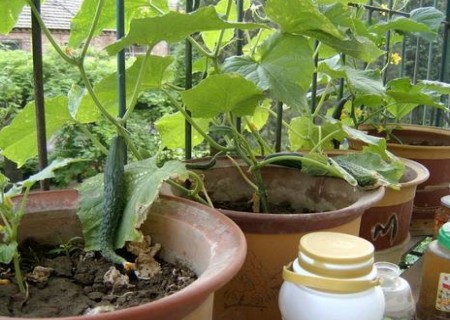
The remaining seedlings grow very quickly, so fertilizer and water must be supplied in time, applying thin fertilizer frequently. It is best to use your own decomposed cake fertilizer water and other organic fertilizers. Throughout the growing period, keep the soil moist and provide plenty of sunlight. When the cucumber seedlings grow to about four or five cm above the ground, they begin to grow vines and bloom. At this time, it is even more important to ensure water supply. If the weather is hot, you can water once in the morning and once in the evening, so that more cucumbers can form. While strengthening fertilizer and water, do not forget to set up a support for the cucumbers so the vines can climb.
If they grow very fast, you can use pinching to stop them from growing upward too quickly, which can also encourage more fruit set. The timing of pinching must be well controlled and must not be too early, otherwise too few cucumbers will form.
Give your balcony a different kind of green. Believe it: container growing makes life better!