A Complete Guide to the Pot Cultivation Techniques of Yellow Sophora
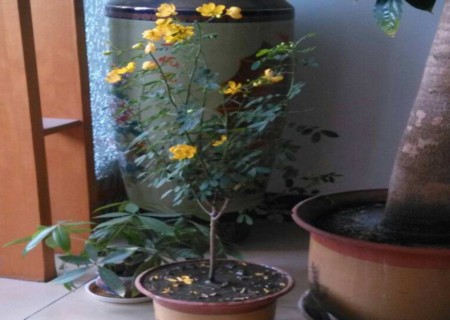
Yellow sophora, also known as yellow-podded sophora or golden-flowered sophora, is a plant in the genus Senna of the Fabaceae family. It was bred by hybridizing China's traditional Chinese scholar tree with the American golden-edged yellow sophora and the two-podded sophora. This tree grows fast, has a long flowering period, abundant and brightly colored flowers, strong growth vigor, and few pests and diseases. It is a rare flowering shrub of high ornamental value during the flower-scarce seasons of autumn and winter, and it can also be grown in pots or trained as a bonsai.
It begins flowering every year in August, with buds like golden beans and flowers like golden butterflies. It grows vigorously, with luxuriant branches and leaves, and a large number of bright flowers. The flower color (duck egg yolk yellow) is golden yellow, hence its laudatory name "treasure-gathering golden tree." When frost arrives, its enthusiasm does not fade; the leaves fall but the flowers do not, filling the gap of having no ornamental flowering trees in early winter. It is not spring scenery, yet it surpasses spring scenery, with quite a refined appeal. Yellow sophora is evergreen in the subtropics and is suited to open-ground planting in areas south of the Great Wall with temperatures above minus 17 degrees.
[Propagation Methods]
In East China, because winter temperatures are low, yellow sophora cannot set seed, so cutting propagation can be used. The most commonly used methods are hardwood cutting and softwood cutting. Hardwood cutting uses the more heavily lignified branches cut back hard in winter as cuttings, inserted into a peat soil substrate at a spacing of 6cm×6cm. This is generally done in December, and the seedlings are transplanted from the end of March to early April the following year. Softwood cutting is done from June to August, using the semi-lignified branches left over from pruning and shaping as cuttings, inserted at 6cm×6cm into a seedbed with perlite and vermiculite as the substrate.
Yellow sophora has strong root-suckering ability, so root cuttings can also be used. Root cutting is generally done in early spring, selecting root cuttings about 10cm long and inserting them vertically at a spacing of 10cm×10cm. After insertion, cover with a thin layer of soil, then cover with grass or plastic film. Transplant when the seedlings reach 15cm in height.
[Cultivation Key Points]
When planting, remove the top of the plant, and apply decomposed organic fertilizer in the planting hole, mixing it evenly with the soil. After planting, water thoroughly. After the plant establishes, apply light fertilizer frequently to promote lateral branch growth. Thereafter, fertilize 4 times a year. It grows rapidly in warm areas. To keep the tree's form graceful, proper pruning should be carried out, but do not prune excessively or prune hard, as this may hinder growth. During the flowering period, remove faded inflorescences at any time to encourage new branches to sprout and produce new inflorescences, so that it keeps blooming over a long period. In cold areas, it can be grown in pots in winter and kept in a greenhouse to overwinter.
[Pot Cultivation Management]
1. Insert cuttings and truncate the trunk for potting at the right time. In late winter and early spring, before the leaf buds of yellow sophora begin to swell, take branch or root cuttings and truncate the trunk for potting. Because yellow sophora is at this time in a state of accumulating nutrients and semi-dormancy, this is the key to successful potting and to increasing the survival rate.
2. Pay attention to shading and water frequently. In particular, strengthen management after the first sprouting to prevent dehydration and wilting. Recognize that only after the second flush of new shoots does the plant truly count as established.
3. After potting, yellow sophora should first be placed in a cool place, then after about 10 days gradually moved to a spot with ample sunlight for normal management.
4. Prune rationally, control excessive branch length, and encourage lateral buds to sprout. When the branches of yellow sophora grow to about 20cm, pruning should be carried out, generally 1-2 times, combined with bending and shaping to keep the crown complete and graceful.
5. Fertilize rationally. Control fertilizer and water at the right time. Carry out seedling hardening in August-September, when branch growth slows, which helps store nutrients and promote flower bud differentiation. Overlong branches should not be pruned; instead, use methods such as bending and tying.
6. For potted yellow sophora, when it is moved to a sunny place after potting, apply a light fertilizer once to stimulate and strengthen the buds. During subsequent growth, apply compound fertilizer twice a month, and when pruning, apply an additional light fertilizer once. Fertilizer at this stage should mainly contain N and K. From late July to mid-August, fertilizer should mainly be P fertilizer, while N and K fertilizer should be applied sparingly or not at all.