Rose Potted Planting Methods and Key Technical Points
Roses are loved by people not only for their spirit, which people admire, but also because every part of them is treasure. Roses are flowers that girls love to receive. They not only symbolize passionate love, but can also be very “practical”: dried rose flowers can be brewed as tea and can also be used to make pastries. According to relevant research: as early as the Tang Dynasty there was the legend of the monk Cijing of Cuiping Mountain planting roses, and by the Ming Dynasty there were already stories of using roses to brew wine.
Roses are the embodiment of love and beauty and are deeply loved by people. If you grow a pot of roses at home, it will certainly add luster to your home. Roses are actually very easy to grow, simple to manage, and highly adaptable, tolerant of cold and drought, making them very suitable for home cultivation. Below is an introduction to the potting and planting methods for potted roses.
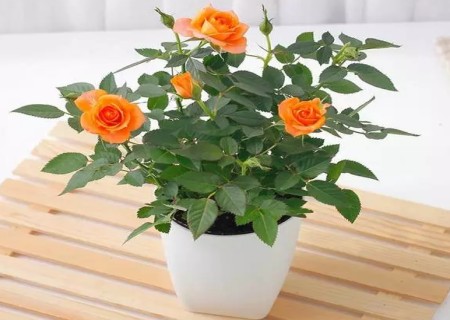
1. Flower Pot Preparation
Roses are shrubs and have relatively strong tillering ability, so when choosing a flower pot, it should be larger than the pots used for ordinary flowers. The pot diameter is generally between 35 cm and 40 cm. For larger plant forms, the pot should be even larger.
2. Soil Preparation
Prepare according to the following proportions: garden soil (or field soil) 1/3, grass ash soil 1/4, humus soil 1/4 to 1/5, organic fertilizer 1/5 to 1/6, superphosphate 1/20. You can also mix 70% garbage soil with 30% river sand; 60% dry river mud with 40% honeycomb coal cinders; or 70% vegetable garden soil, 20% honeycomb coal cinders, and 10% river sand. The nutrient soil prepared in this way is loose, fertile, well-drained, and well-aerated, while also having good water- and fertilizer-retention capacity.
3. Seedling Selection
For roses to be potted, choose those with a relatively good plant form, more branches, vigorous growth, and no pests or diseases.
4. Potting Techniques
Potting is best done after leaf fall in early winter or before sprouting in early spring. When planting, make sure the root system is spread out. After potting, the soil should be pressed firm, with the soil 3 cm to 4 cm below the pot rim. The first watering must be thorough.
5. Watering Methods
Watering is one of the basic tasks in growing flowers, but it is often also a cause of plants easily dying. Watering should be done according to weather conditions. In hot summer, water once a day, and also observe the potting soil: water thoroughly once as soon as it dries. Too wet can easily cause root rot. Replace the potting soil once every year. When changing pots, cut off the encircling roots at the bottom of the pot, which can help produce more flowers, larger flowers, and more colorful flowers.
6. Fertilization Methods
Roses like fertilizer. After potted roses have established themselves, apply 1 application of decomposed organic liquid fertilizer every 10 days. During the flower bud formation stage, apply some liquid fertilizer containing phosphorus and potassium; or use a convenient and sanitary compound fertilizer, because compound fertilizer contains various elements and has a good nitrogen, phosphorus, and potassium ratio. Apply about 20 grams per plant each time (the amount must not be too much). Use an iron tool to loosen the potting soil around the edge of the pot to a depth of about 10 cm, then apply the fertilizer, and cover it with soil.
7. Repotting Methods
Repot once a year, either in spring or after autumn. When repotting, cut off some old roots, keep more fibrous roots, and divide overly dense and overly vigorous clumps. At the same time, apply base fertilizer.
8. Pruning Techniques
Rose pruning is divided into dormant-season pruning and growing-season pruning. Normally no pruning is needed; for old plants, just prune away overly dense branches, faded branches, and pest- or disease-damaged branches. As roses bloom, pick them as soon as they fade; after picking, they will bloom again, otherwise they will bloom only once. For roses to grow well and bloom more, pruning is very important. Generally, during overwintering, cut off all branches about 10 cm above ground level so they can overwinter smoothly.
9. Pest and Disease Control
Common rose diseases mainly include: rust disease, powdery mildew, brown spot disease, etc. Before and during disease occurrence, diseased buds can be removed and deeply buried to reduce the spread and expansion of pathogens, or spray with triadimefon, chlorothalonil, or thiram. The main pests include: red spider mites, aphids, bagworms, and scarab beetles, etc. Adults can be manually killed or sprayed with dichlorvos, phoxim, dimethoate, monocrotophos, etc.
Tips:
In ancient Greek mythology, the rose combines love and beauty, being both the embodiment of the goddess of beauty and infused with the blood of the god of love. It can be said that worldwide, the rose is a universal language used to express love. Every Valentine's Day, roses become even more valuable and are the darling between lovers and couples.