How to Plant Hyacinth Bulbs? A Detailed Guide to Planting Methods
Hyacinth is a perennial herbaceous bulbous plant, and it is also the most fragrant of all flowering plants, with diverse flower colors such as white, red, blue, and purple, earning it the reputation of the "five-colored narcissus." Plant a hyacinth in late autumn or early winter, and around the Spring Festival you can enjoy hyacinths in a variety of colors.
If planting in soil, put some bottom soil in the pot, then cover with 10 cm-15 cm of soil on top, and place it in a shady spot, keeping the soil moist, but do not let the soil stay constantly soggy. After 7-8 weeks, when the shoots have grown to more than 10 cm, remove the covering soil to let sunlight reach them. Generally, plant in October-November, and they will bloom in February-March.
If growing in water, immerse the bulb so that only its base touches the water, then place it in a dark place and cover the bottle with a black plastic bag. After about 20-plus days of sprouting in a completely dark environment, remove the black plastic bag. Once roots have grown, do not let the water reach the hyacinth bulb, so the roots can breathe and get air. Then place it outdoors to receive sunlight, starting with 1-2 hours per day, gradually increasing to 7-8 hours. In most cases, under good weather conditions, it will bloom by the Spring Festival.
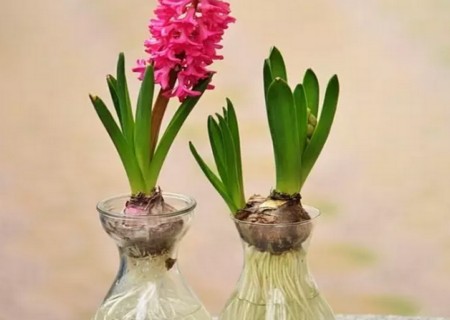
For most flower enthusiasts, water-cultured hyacinths are more favored. Water-cultured hyacinths not only look clean and hygienic, but in theory only need a little water top-up, eliminating the confusion of how much to water. So today we mainly introduce the water culture method for hyacinths; if you want the soil culture method, you can leave a comment at the end of the article.
1. Selecting Bulbs
The outer skin of hyacinths is purple, white, etc. Flower enthusiasts can judge the future flower color based on the skin color, though for some hybrid varieties the skin color is hard to judge, so you should consult the flower shop owner. When selecting bulbs, choose ones with large bulbs, a robust appearance, and intact outer skin.
2. Rooting Treatment
Soak the purchased bulbs in carbendazim for sterilization, and the outer skin can be appropriately peeled off. Then place them into a prepared culture bottle (as shown in the picture), with the water level just touching the roots. Once ready, shade the bottle from light, then place it in a cool, dry place for about 20 days and roots will grow. At this point, you can remove the shading and move it to a sunny spot.
3. Temperature and Sunlight
Hyacinths prefer sun and are cold-tolerant. They can be placed on a windowsill to receive about 5 hours of light per day. Plants have the characteristic of growing toward light, so be careful not to always let them receive light from one direction. The optimal temperature for hyacinth sprouting is 5-10 degrees, the suitable temperature for leaf growth is 5-15 degrees, and 15-20 is ideal for the flowering period.
4. Water and Fertilizer
Mineral water is best for the water culture solution; if using tap water, it should be left to sit for 2—3 days. After rooting, it is recommended to replace the culture solution every 10 days, though you can also determine the timing based on the water quality. When changing the water, try not to pull the roots out completely, to avoid damaging the hyacinth's roots when putting them back. Some friends suggest using a soft tube to change the water, which is a good method. To prevent algae from growing in the water, you can put some charcoal granules in the bottle. If you have a dedicated hyacinth water culture solution, that's best, but if not, plain water works fine too.
5. Flower Stem Treatment
In principle, a hyacinth bulb that has already bloomed can continue to be grown to bloom again the next year. However, a second planting will produce very small flowers because the bulb has too few nutrients, so for most flower enthusiasts, it is recommended not to replant a bulb that has already bloomed.
In addition, let us introduce the related matters of soil-cultured hyacinth pot planting.
1. When to plant?
Start planting in October-December when the temperature drops below 10°C.
2. Where to plant?
Well-drained, loose soil with a pH of 6-7. Choose a pot with holes at the bottom; generally a 160# pot can hold 3 bulbs. Or plant directly in a courtyard in a sunny or semi-shaded spot.
3. How to plant?
Plant with the shoot tip facing up, covering the bulb with 2-5 cm of soil. After planting, place the whole pot in a cool place to encourage root growth. Once the leaves have unfolded, move it to a sunny or semi-shaded spot for normal care. For courtyard planting, space the bulbs 10 cm apart and cover with 5-10 cm of soil.
4. How to care for them?
Water thoroughly after planting, then water when the soil looks dry. Once the leaves grow above the soil surface, you can appropriately use a special bulb fertilizer.
5. How to handle them after flowering?
After the flowers fade, cut off the flower stem, apply extra special fertilizer, and care for them as usual. Once the leaves wither, lift the bulbs out, clean them, select the large bulbs, and store them in a dry, cool, ventilated place until replanting in September-December.