How do you care for a potted magnolia so it grows well?
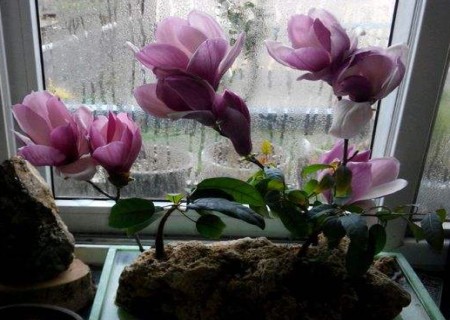
The magnolia flower looks very much like a lotus. When the magnolia is in full bloom, the petals spread out in all directions, and the whole tree is covered with flowers and leaves, a mass of green and white, with excellent ornamental value. The waves of delicate fragrance given off by the magnolia refresh the heart and mind, and can also purify the air in the courtyard. Although the magnolia is beautiful, its flowering period is brief, so when it blooms it seems all the more splendid, facing the frost and cold without flinching in the least.
Magnolia is an early-spring flowering tree species with both color and fragrance. When planting, you must pick the right moment: neither too early nor too late. The most suitable time is 10 days before bud break in early spring, or after the flowers fade and before the leaves unfold. When transplanting, regardless of the size of the sapling, the roots must be kept with a ball of soil, and care should be taken to damage the root system as little as possible, so as to ensure survival. Before planting, fully decomposed organic fertilizer should be applied in the hole as a base fertilizer. After planting, firm the soil and water thoroughly in good time. The specific techniques are as follows:
1. Raising seedlings
When sowing, choose a pot of the same width and height, and at least twice the size of the magnolia tree's root system. A ceramic pot is heavy, but provides stability on windy days if you plan to keep the container outdoors all or part of the year. Choose a container with good drainage. After the sown seedlings emerge, in the midsummer season of years 1 to 2, appropriate shading is needed; after winter begins, cold protection is also needed in northern regions.
2. Transplanting
The best transplanting time is before bud break, or just after the flowers fade and before the leaves unfold. When the seedlings emerge and grow 2 to 3 true leaves, the survival rate is relatively high, reaching over 95%. Transplanting work should be done on cloudy and rainy days, watering once each morning and evening every day, and providing appropriate shade when the sunlight is too strong. According to the climate conditions of Jigongshan, transplanting is generally more effective in early to mid-May. Do not damage the root system when transplanting; large seedlings should be planted with a soil ball, in a large hole, with deep fertilization. Planting appropriately deep can suppress suckering and benefit growth.
3. Watering
The magnolia's root system is made up of fleshy roots and is not tolerant of waterlogging, so during the flowering and growing period the soil should be kept slightly moist. Summer is the magnolia's growing season; high temperatures and drought not only affect vegetative growth but can also cause flower buds to shrink and drop, affecting the next year's flowering. Therefore, irrigation to preserve soil moisture should be taken seriously, especially in key scenic areas, where the soil should be kept constantly moist. After autumn begins, watering should be reduced to delay the magnolia's rooting, promote the ripening of the branches, and help it overwinter. In winter, generally no watering is done; water only once when the soil is too dry.
4. Fertilizing
Besides paying attention to base fertilizer, phosphorus fertilizer should be applied somewhat more generously in acidic soil. Topdressing before and after flowering is especially important: the former promotes a full burst of bloom, the latter benefits bud formation. The topdressing periods are late February and May. Magnolia relatively likes fertilizer, but dislikes heavy fertilizer; during the growing period, applying fertilizer twice is generally enough to benefit flower bud differentiation and promote growth. One application is in early spring, and another in May to June. Fully decomposed organic fertilizer is mostly used. Newly planted saplings need not be fertilized; wait until after leaf fall or the following spring to fertilize.
5. Pruning
The pruning period should be chosen after flowering and before vigorous bud break. Diseased and dead branches, overly dense branches, redundant branches, parallel branches and water sprouts should be cut away, and suckers should be removed at any time in ordinary care. When pruning, medium and short branches shorter than 15 cm are generally not cut; long branches are cut short to 12 cm to 15 cm. The cut should be smooth and slightly slanted, and the cut should be less than 5 mm from the bud. Because the magnolia's branches and trunk have poor healing ability, pruning is mostly not carried out except where absolutely necessary.
The magnolia's branches and trunk have poor wound-healing ability, so pruning is generally not carried out. However, for the sake of a reasonable tree shape, water sprouts, dead branches, diseased and pest-damaged branches, and branches that spoil the tree's appearance should still be cut away in the early stage of leaf unfolding. In addition, after the flowers fade, cut off the fruit clusters to avoid consuming nutrients and affecting the next year's flowering.
To grow potted magnolias well, you also need to master the following techniques in care:
1. For potted magnolias, the potting soil is generally a neutral sandy loam, and the pot should be changed once every 2 years; when changing the pot, add some decomposed organic fertilizer as a base fertilizer.
2. Apply topdressing once each year 3 weeks before flowering and once in late autumn.
3. Prune once each year after the flowers fade and once after the buds appear. The pruning after flowering only requires cutting off the upper part of the flowering branches; the pruning when buds appear mainly cuts away long branches and excess flower buds. After pruning, the wounds should be sealed and bound with adhesive tape to help the wounds heal and prevent infection by disease.
4. When overwintering, bury the plant together with its pot in a sunny spot outdoors, or place it in a sunny spot indoors. If the room temperature is kept at around 10°C, it can even bloom 3 weeks earlier.