How to plant lily bulbs? Potted planting method illustrated
The lily is a perennial herbaceous plant; its flowers are ornamental and its underground bulbs are edible. As early as the 4th century AD, its edible and medicinal value was discovered. The lily gets its name because its scales overlap and close together, and the lily also symbolizes a harmonious union lasting a hundred years; moreover, lily flowers are elegant in color and delicately fragrant, making them a favorite flower for growing indoors at home.
The ornamental value of the lily is beyond doubt, and its nutritional, medicinal and edible value is also very popular; it is honored as the "king of vegetables." Among the people, on every festive occasion, there is the custom of giving lilies to one another, or making lilies into cakes and the like to entertain guests.
1. Getting to know lily bulbs
The lily bulbs in the picture below are imported from the Netherlands and arrived around March; their quality is quite good. Sometimes some flower lovers buy all kinds of defective lily bulbs on Taobao, and can only make do with planting them.
2. How large and deep a pot is needed for planting lily bulbs
Generally speaking, lilies are not so strict about pots; the popular 2-gallon pot will do, and of course other pots are fine too. It is best not to use a pot that is too small or too shallow, because lilies need to be planted deep; if planted too shallow, the result may be a bit worse. However, I have also tried shallow planting with about 2 cm of soil cover, and the growth was still OK, so flower lovers need not worry too much about a little difference here or there. If I had to give a planting depth, my personal suggestion is to cover with about 5 cm of soil.
3. How many lily bulbs can be planted in one pot
One is fine, three is also fine; crowding does not have much effect. Likewise, there is no standard; it depends entirely on personal attitude, haha!
4. Choosing the soil
I have used two kinds of soil to plant lilies, one is sandy soil and the other is nutrient soil. The conclusion is that lilies in sandy soil are relatively thinner and smaller, but they can basically meet the needs of flowering, so I think lilies are not demanding about soil. Flower lovers who have the means can treat them better, and those who do not need not fuss over it.
5. The planting process
1) Trimming the roots at the base of the bulb
Trim the poor roots below the bulb; cut off any rotten roots or poor roots! Note that you should only trim the poor roots!
2) Disinfecting the bulb
Rinse the trimmed bulb with water, then place it in an 800-1000 times diluted carbendazim solution to soak and disinfect for half an hour.
3) The bottom of the flower pot
To ensure drainage, place a layer of broken-up plastic foam at the bottom of the flower pot; everyone should have this at home. Broken tiles or tree bark will also do. Make the flower pot as large as possible, with a depth of more than 15 cm.
4) Adding soil
Put soil into the flower pot, about 10 cm is enough. Choose soft, acidic soil, because it is convenient. I used seedling substrate soil.
5) Placing the bulbs
If you have the means, add 5-10 g of compound fertilizer to the bottom soil and mix it evenly. I did not add fertilizer. Place the disinfected bulbs into the flower pot; note that the three bulbs should face each other at the bottom, placed at an angle of about 60 degrees. If placed at an angle, once the lilies grow tall their leaves will not all be crowded together; the spacing is a bit larger and there is more space. It is just like three people: stretching outward is more comfortable than stretching inward.
6) Covering with soil
Add soil into the pot to cover the bulbs. To let the bulbs sprout smoothly, leave the tips of the sprouts about 0.5 cm above the soil surface. Remember not to fill the soil all the way to the rim of the pot; as the plant grows taller, we will still need to add soil later to ensure the lily grows more stem roots, and this point is crucial in the process of potting lilies.
7) Watering
After planting, water thoroughly. Place in a cool place to promote growth and root development.
6. Daily care
Lilies actually look gorgeous, but they belong to the beginner type of flowers; after planting, there is basically no need to manage them. Water when the soil is dry, and that is OK! Of course, here I must remind flower lovers: do not think about watering them every day; better dry than wet! Also, do not fiddle with them every day; find a place with sufficient light, and then do not move them around; just water when they lack water, and that is OK!
7. Care after flowering
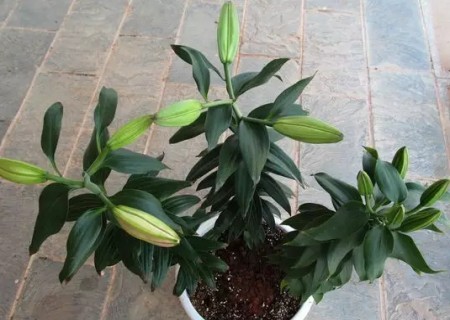
After the lily flowers (they can also be cut for flowers), just continue normal care. In winter the stems will naturally wither, and the bulbs do not need to be dug out; leave them in the pot, and they will sprout on their own in early spring the next year. In winter, just give water occasionally. The picture below shows one of the lilies grown last year; this one was an experiment in nutrient soil.