How to Dwarf a Potted Lily? A Detailed Guide to Practical Techniques
Lilies are deeply loved by everyone, and many flower enthusiasts are experts at growing and caring for them, but some folks merely admire them from afar and have never even dared to try growing them. So, I hope these growing tips can be shared with experts and fellow beginners alike.
Lilies have large, colorful flowers and graceful forms, and are one of the five famous cut flowers. In recent years, potted lilies have quietly risen in popularity, filling the gaps left by cut-flower lilies. High-quality potted flowers require a dwarf, sturdy, compact plant form, thick stems, and abundant leaves and flowers. Currently, most white lily varieties grow to a height of 60-120cm. If planted in pots, stems that are too tall tend to lean and break, are inconvenient to move, and after the lower leaves yellow and drop off, the plant looks sparse and straggly, giving a poor overall ornamental effect.
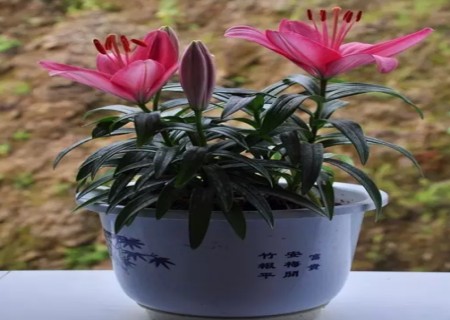
However, there are very few dwarf lily varieties. Carrying out appropriate dwarfing when growing them in pots, and adjusting plant height as needed, can greatly enhance their ornamental value, meet different market demands, and improve economic returns. Below, I will introduce the dwarfing techniques for potted lilies to all you potted-plant enthusiasts.
1. Growing substrate
Potted lilies require a substrate with good permeability, medium fertility, good moisture retention, no stray microbes, and no high salt content. The soil pH for Asiatic lilies is 6-7, and for Oriental lilies it is 5.5-6.5. Substrate composition: 50% peat soil + 30% nursery soil + 20% perlite (or coarse river sand) + a small amount of rice husk ash.
2. Bulb selection
Bulbs of different sizes are all suitable for potting. Choose flower pots of different sizes and the number of bulbs per pot according to bulb size. Generally, a 10-12cm pot holds 1 bulb with a circumference of 14-18cm, giving 4-8 flowers per pot; a 12-17cm pot can hold 3 bulbs with a circumference of 12-16cm, giving 6-15 flowers per pot; a 19-25cm pot can hold 3-5 bulbs with a circumference of 12-18cm, and a pot with 5 bulbs can produce around 25 flowers. For potted lilies, choose plump, uniform, disease-free bulbs.
3. Bulb treatment
Before planting, remove any bulbs contaminated by pathogens, and soak them in an 800-fold dilution of 75% chlorothalonil wettable powder for 30 minutes or an 800-fold dilution of 70% thiophanate-methyl for 1 hour. Lift them out, let them dry, and then plant them in pots.
2. Planting process
First place a layer of larger soil clods at the bottom of the pot, then spread 1-2cm of the prepared substrate, place the bulb in, and let the basal roots spread out and lie flat (be careful not to cut off the basal roots; you may remove dead old roots). For one bulb per pot, place the bulb in the middle of the pot with the sprout facing up; for multiple bulbs per pot, arrange them evenly with the sprouts facing slightly toward the pot wall (to avoid the sprouts crowding in the middle after emerging). Then cover the bulb with 6-8cm of soil (for winter planting) or 8-10cm (for summer planting), because during the growth period lilies mainly rely on stem roots to absorb water and nutrients, so the soil cover must not be too shallow, otherwise the adventitious roots at the stem nodes will not develop well, ultimately affecting the lily's growth and making it prone to lodging. After covering with soil, press it down slightly, place the pots in a shade shed, arrange them neatly at certain intervals, not too densely, and water thoroughly once.
3. Dwarfing treatment
When the sprouts of potted lilies emerge 5-10cm above the soil, apply paclobutrazol to the soil. Experiments show that 150mg/L paclobutrazol can control lily height at 20-25cm; 100mg/L paclobutrazol can control lily height at 25-30cm; 50mg/L can control lily height at around 35cm. As long as you grasp the right timing of application, a single application is enough to achieve the effect. Applying paclobutrazol can dwarf potted lilies, make the plant form compact, deepen leaf color, and reduce yellowing of the lower leaves. It has no effect on the number or size of flowers and leaves, and can noticeably improve the ornamental effect of potted lilies.
Lilies are highly adaptable and not demanding about soil quality, growing best in a cool, dry environment with plenty of sunlight. However, lily plants are relatively tall, generally around 70cm to 120cm, and when the plant is too tall the lower part often becomes bare, making the whole plant look uncoordinated and reducing its ornamental value. Dwarf cultivation of lilies should follow the principle of "three selections and three treatments," introduced below.
1. Selection and treatment of bulbs
Lilies are generally planted in autumn. Choose plump, full, disease- and pest-free healthy bulbs. Before planting, soak them in a 2% formalin solution for 15 minutes or in an 800-fold dilution of 70% thiophanate-methyl for one hour, then take them out, let them dry, and plant.
2. Selection and treatment of substrate
Choose a slightly acidic sandy loam with good permeability, strong fertility, good water retention, and no stray microbes or weed seeds. It can be made from two parts fertile soil, two parts fine sand, and one part peat soil, with a small amount of phosphate fertilizer added. The substrate can be sterilized by sun exposure, chemical fumigation, or dry-frying in a pan to kill pathogens and weed seeds.
3. Selection and treatment of flower pots
Choose clay pots with strong breathability and holes in the bottom. To improve the ornamental look, you can slip them inside plastic or porcelain pots. New pots should be soaked in an 800-fold dilution of 75% chlorothalonil wettable powder for 30 minutes to kill pathogens and remove alkalinity.
In addition, before planting lilies, place some tile pieces at the bottom of the pot, then add a layer of soil clods, spread 4cm to 6cm of the prepared substrate, plant the bulb in the pot, and cover with 5cm to 8cm of soil. Never make it too shallow, otherwise the plant will easily lodge. After covering with soil, press it down slightly, place it in a cool spot, and water thoroughly once.
After planting, five points also need attention:
1. Dwarfing. When lily sprouts emerge 6cm to 10cm above the soil, apply an appropriate amount of paclobutrazol to the soil to control the lily's height and achieve dwarfing.
2. Light. Lilies love light, and insufficient light easily causes spindly growth and poor flowering. If you want lilies to bloom around Spring Festival, choose day-neutral lilies and supplement light appropriately, so the plants become dwarfed, the flower colors vivid, and the leaves deep green.
3. Temperature. The suitable growing temperature for lilies is 10°C to 25°C, but from planting until emergence, keep the temperature low, preferably not exceeding 13°C. After emergence, raise the temperature appropriately, keeping it around 22°C during the day. Different lily types require different nighttime temperatures, so treat them differently and place them separately.
4. Water. Lilies need more water during the growing and flowering periods. Keep the pot soil moist, but avoid waterlogging to prevent root rot. If the air is too dry, sprinkle water on the leaves and ground to keep relative humidity at around 70%.
5. Fertilizer. Start topdressing when the leaves on the stem unfold, combining soil application with foliar application, applying once every 10 to 15 days. Apply light fertilizer frequently, and avoid heavy fertilizer. In the early stage, mainly use nitrogen fertilizer; after budding, mainly use phosphorus and potassium fertilizer.