Perilla Can Be Grown in Pots: A Detailed Guide to Growing Perilla in Containers
Perilla is a unique delicacy on the dining table and also a famous medicinal herb passed down for thousands of years. The small purple leaves contain remarkable effects. "Whole perilla" refers to the three traditional Chinese medicines: perilla leaf, perilla stem, and perilla seed. Because they all come from the plant perilla (Perilla frutescens) of the Lamiaceae family and are often used together in clinical practice, they are sometimes collectively referred to as “whole perilla”.
Perilla leaves are rich in carotene, vitamin C, and more, which can enhance the body's immune function. Their leaves have the effects of inducing sweat and releasing the exterior, dispelling cold, and regulating qi, and have preventive and therapeutic effects on wind-cold colds, fever, cough, and other conditions. Traditional Chinese medicine holds that perilla leaf is pungent in flavor and warm in nature, enters the lung and spleen meridians, and has the functions of releasing the exterior and dispelling cold, and moving qi and relaxing the middle. Perilla is pungent, aromatic, and warm-dispersing; it enters the lung and moves to the exterior to disperse wind-cold, and can also move through the spleen to move blood and relax the middle, making it especially suitable for externally contracted wind-cold with internal dampness stagnation.
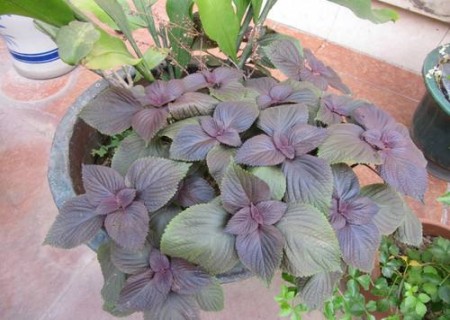
Curled-leaf perilla, also known as huihui perilla or cockscomb perilla, is suitable for cultivation in warm regions and has broad adaptability, but it does not grow well in cold places. So, how do you grow perilla in pots? Below is an introduction to the methods for growing perilla in containers.
[Growing Environment]
Temperature: Prefers a warm climate. The suitable germination temperature is 18°C~23°C, and seedlings can tolerate low temperatures of 1°C~2°C.
Light: Prefers a sunny, well-lit environment.
Soil: Not particular about soil, but grows well in fertile, well-drained loam.
Water: Prefers moisture and is not drought-tolerant. During the growing period, the soil should be kept moist, especially in the mid-to-late growth stage when the plants are larger; do not let them lack water, otherwise the stems and leaves become coarse and hard, with more fiber and poor quality.
Fertilizer: During the growing period, apply urea fertilizer 3-4 times with water according to growth vigor. Apply more organic fertilizer.
[Cultivation Management]
Cultivation time: Spring, summer, and autumn; in the south, they can be grown in pots all year round.
Cultivation containers: Various flower pots, wooden boxes, etc.
Propagation methods: Perilla can be direct-sown or raised as seedlings and transplanted; for home pot cultivation, cuttings can also be used.
Soil selection: Perilla is highly adaptable and not strict about soil. It grows well in well-drained sandy loam, loam, and clay loam, in front of and behind houses, beside ditches and field edges, and in fertile soil. It can also be planted under young fruit trees.
Sowing method: Put potting soil into the pot, level it, water thoroughly, scatter the seeds evenly on the soil surface, cover with a thin layer of soil, and pay attention to keeping warmth and moisture. They will germinate and emerge in 7-10 days. Thin the seedlings in time, and finally set the plant spacing at about 15-20 cm.
Cuttings method: Take tender shoots from older plants, let them dry slightly, leave about 4 leaves per plant, insert them directly into the pot at the final planting spacing, water thoroughly, keep moist and provide appropriate shade, and after they recover from transplanting, normal care can begin.
Fertilizer and water management: Summer is the period of vigorous growth for perilla. Perilla has very strong branching ability; the average number of branches per plant reaches 25-30, the number of leaves reaches 300-400, and the number of flowers reaches as many as 3,500. Therefore, during the peak growth period there must be sufficient water, and quick-acting fertilizer should be applied 2-3 times, combined with spraying nutrient solution on the leaves.
Pruning and pinching: Perilla has strong branching ability. During the growing period, pay attention to promptly removing branched shoots to help ventilation, light penetration, and rapid growth of the plant. Generally, leave 3 pairs of leaves for forking and pinching.
Harvesting stems and leaves: For home cultivation, tender stems and leaves can be harvested at any time. If harvesting tender leaves for eating, they can be picked whenever the leaves have grown to a certain size, and the tops where flower bud differentiation has occurred should be removed at any time so they do not bloom, maintaining vigorous growth of stems and leaves. If grown for ornamental purposes, some stems and leaves should be appropriately removed to reduce nutrient consumption by stems and leaves.
Growing perilla in pots does not require too many complicated techniques. Just master the relevant growing steps above, and you can grow perilla that is both attractive and delicious, with powerful benefits.