How do you grow potted Madagascar periwinkle? What uses can it be put to?
I saw plenty of them as a child, lots and lots of them, and someone once told me it was called "nail flower" - pick one and it stinks. Sure enough, most of the dogbane family are no good. Although I've seen lots and lots of them, I've only ever seen them properly planted in a landscaped bed once, in the middle of the long staircase at Huguangyan, where among a stretch of purple-pink Madagascar periwinkles golden shrub balls were planted one by one. It sounds lovely, but it still causes aesthetic fatigue.
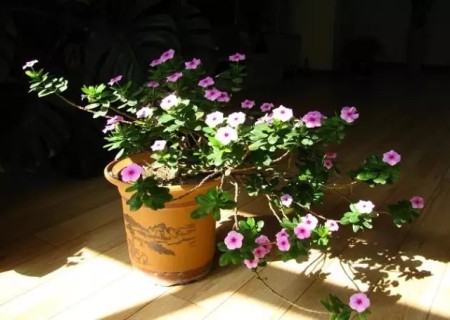
On the young tips of Madagascar periwinkle, each time a leaf grows, two flowers emerge from the leaf axil, so the plant produces an especially large number of flowers, its flowering period is especially long, and its blooms are lush and full of vitality. And because it flowers without interruption from spring to autumn, it has earned the lovely name "daily spring," and precisely for this reason it is deeply loved and sought after by flower enthusiasts.
What we're introducing to you today is Madagascar periwinkle, also known as golden marigold grass, four-season spring, daily new, wild goose head red, thirty-thousand flowers, daily spring, spring-day flower, four-season plum, five-petal plum, wild goose coming red, blooms every day, and so on. It belongs to the trailing class of flowers and grasses, twining or climbing over trees and rocks. Once it starts growing, it multiplies very quickly, and the whole courtyard will be full of it. Let's take a look at how to grow potted Madagascar periwinkle!
1. Propagation
Madagascar periwinkle is mostly grown from seed, though it can also be propagated by cuttings, but the growth is not as good as from seed. The seeds of Madagascar periwinkle should be collected as they ripen. The suitable germination temperature is 20-25°C. Sowing is best done between March and May, and it is mostly grown as an annual. Cuttings are mostly taken between April and July, but this method is usually not used.
2. Transplanting
If you grow seedlings in plug trays, they should be transplanted into pots when they have grown 2-3 pairs of true leaves. Use a 12 cm diameter nutrient pot and pot them up in one go, with no need for a further repotting. If you sow seeds in an open seedling tray, it is best to prick out the seedlings once into 72-cell or 128-cell trays when they have 1-2 pairs of true leaves, and then transplant them into pots.
3. Watering
Madagascar periwinkle dislikes moisture and fears waterlogging, so it should not be watered too much; standing water easily causes root rot, which then affects growth. When overwintering indoors, watering should be controlled even more strictly, and it is best kept dry, otherwise it is prone to cold damage. If grown in the open ground, take care with drainage during midsummer rain showers, so that standing water does not kill the plant.
4. Fertilizing
Madagascar periwinkle is not particularly demanding about fertilizer; applying fertilizer about once every ten days during the growing period is enough, and you can alternate between compound fertilizer and liquid fertilizer. For potted Madagascar periwinkle, a layer of base fertilizer should be spread at the bottom of the pot to ensure the plant has enough nutrients for growth.
5. Pruning
Madagascar periwinkle is a perennial herbaceous plant and is quite suitable for potting, but when potted it must be pruned carefully; the plant should not be allowed to grow too tall, which would spoil its decorative and ornamental effect. Usually, after the plant has established itself in the pot, it should be pinched back several times so that it branches more and blooms more, and after flowering the spent flowers must also be cut off.
6. Pinching back
Madagascar periwinkle does not have to be pinched back, but to achieve a good plant shape it needs to be pinched back once or twice. The first time is at 3-4 pairs of true leaves; the second time, leave 1-2 pairs of true leaves on the new shoots.
Now let's take a look at what uses Madagascar periwinkle has!
1. In the high temperatures of summer, the Warrior series Madagascar periwinkle still puts on a striking show; its varied colors accent the edges of hard paving, bringing a touch of freshness to the scorching summer days.
2. Madagascar periwinkle performs extremely well in all kinds of containers.
3. In roadside flower beds, we can always see them, unafraid of the heat.
4. Its uniform growth and brilliant flower colors make it the obvious choice for ground cover.
5. Madagascar periwinkle can also be used in flower border combinations.
6. How Madagascar periwinkle performs in the courtyard. It can be planted in masses, combined with other flowers, or grown in flower pots - the forms of use are many and varied.
7. Its rich colors and compact plant shape make it perform exceptionally well on flower stands.