What are the potting and planting methods for Schefflera arboricola?
Schefflera arboricola, also known as the dwarf umbrella tree, can tolerate low-light conditions and prefers partial shade, making it very suitable as an indoor plant and one of the most popular indoor plants in the world, with relatively high ornamental value. Its plant form is graceful, and it has strong adaptability, making it an excellent potted plant that can be placed on a balcony for viewing all year round, but it should not be placed in places with harsh sunlight. It can also be arranged in the living room, study, or even the bedroom, presenting a natural and harmonious green environment.
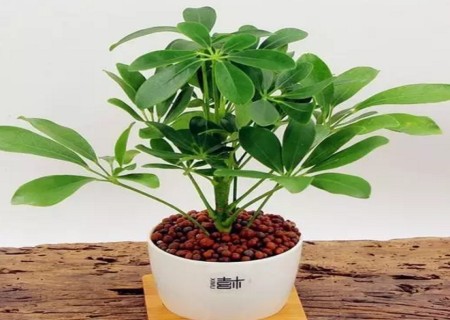
Schefflera arboricola has the effect of absorbing nicotine and other harmful substances. It is especially suitable for planting in households with smokers. It can bring fresh air to smoking households; its leaves can absorb the nicotine and other harmful substances released when cigarettes burn, and through photosynthesis convert them into substances the plant itself needs. In addition, Schefflera arboricola can reduce formaldehyde concentration by 9 milligrams per hour, so after home renovation, placing a Schefflera arboricola is more suitable than anything else.
Next, the editor will introduce the household potting and planting methods for Schefflera arboricola.
1. Soil mixing
The planting soil for Schefflera arboricola requires deep, loose, and fertile soil. For household potting, generally leaf mold or peat soil and garden soil are used, mixed evenly with 1/4 river sand or perlite. To ensure the soil is fertile, a small amount of cake fertilizer can be added to the soil as a base fertilizer.
2. Potting
Choose a healthy young seedling with a well-developed and complete root system, and plant it in the pot in late autumn or before sprouting in spring.
3. Planting in place
Before planting, place a layer of tile fragments at the bottom of the container, add a small amount of nutrient soil, and after placing the plant in the flower pot, add a small amount of soil so the roots bind closely with the soil. Then water thoroughly and compact the soil. After the newly potted plant is planted in place, it should first be placed in partial shade for a week, then gradually moved to a sunny spot for normal care.
4. Watering
If Schefflera arboricola is maintained in a plastic flower pot, attention should be paid to timely drainage. When watering, water promptly before the soil dries out completely, keeping the soil moist at all times. When the weather is dry, spray around the plant, and during the plum rain season pay attention to rain protection to avoid water accumulation in the pot. The amount of watering varies with the season; in summer it needs more water. Water once a day to keep the pot soil moist. In spring and autumn, water once every 3-4 days. If there is too much water or waterlogging, it easily causes root rot.
5. Fertilizing
During the summer growing period, fertilize once a week. A compound fertilizer with equal amounts of nitrogen, phosphorus, and potassium can be applied after loosening the soil. From May to September, apply 20% cake fertilizer water twice a month. For variegated varieties, if there is too much nitrogen fertilizer and the light is weak, the patches on the leaves will become less obvious.
6. Pruning
Schefflera arboricola grows relatively quickly and easily sprouts leggy branches. Once it becomes a mature plant, it needs frequent shaping and pruning to keep the plant form neat and beautiful. Schefflera arboricola maintained for many years has perennial old branches, and when the plant form becomes too large, heavy pruning can be carried out each year when new buds sprout, in combination with repotting, cutting off branches, leaves, and old roots.
7. Repotting
Schefflera arboricola needs to be repotted once every spring. If a plastic pot is used, note that the soil should be slightly looser. The pot soil is prepared with peat soil, leaf mold, and perlite plus a small amount of base fertilizer, and fine sandy soil can also be used for potting. Before new buds sprout each spring, it should be repotted, removing part of the old soil and using new soil for potting. When perennial old plants appear too large for indoor cultivation, pruning can be carried out in combination with repotting.