How to plant narcissus bulbs? A detailed guide to growing them in pots
As a gardening enthusiast who loves growing flowers but only has a north-facing balcony that gets no sunlight for 24 hours, I was almost in despair. Many of the plants I like are not suitable for growing on a north-facing balcony, but how would I know the result without trying? Maybe a miracle will happen. So this autumn
The quality of the narcissus bulb determines the number and quality of the flowers, as well as how many blooms there are and whether the fragrance is rich. To grow a good pot of narcissus, choosing the narcissus bulb is key. When selecting narcissus bulbs, you can specifically do so from four aspects: shape, color, pressing, and asking about the pack.
2. Observe the color: from the outside, a high-quality narcissus bulb is dark brown, with the covering intact, bright and vivid in color, and free of rot and pests.
3. Press it: pressing is the main method for selecting and identifying how many flower scapes a narcissus has. You can hold the bulb between your thumb and index finger and press slightly hard. If it feels columnar in outline, elastic, and relatively firm, it is a good flower bulb.
4. Ask about the pack: narcissus is generally packaged in bamboo baskets of the same size, with four packaging specifications of 20, 30, 40, and 50 bulbs per basket, commonly known as 20-pack, 30-pack, 40-pack, and 50-pack. The fewer the number in each basket, the larger the individual bulbs.
When it comes to narcissus, everyone should be more than familiar with it. Zhu Xi once described narcissus this way: “Where does the fairy in the water come from, with green sleeves, a yellow crown, and white jade blossoms.”
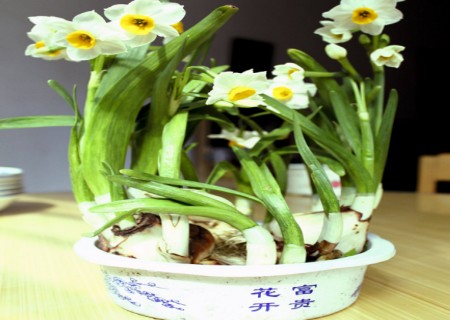
Step 1: Remove the brown covering from the outside of the narcissus bulb, make a vertical cut between the buds on the upper part of the narcissus bulb, cutting through 3-4 layers of scales, then make a horizontal cut on each side. Be very careful not to damage the flower buds. Step 2: Soak it in water for 24 hours. At this time, a lot of mucus will seep out around the flower buds. This mucus will affect the growth of the narcissus, so it must be cleaned off thoroughly. Step 3: Place it in a sunny spot during the day, keep the temperature above 15°C, pour out the water in the pot at night, and add water again the next morning for cultivation. After more than 20 days, you can see the flower buds growing out. Step 3: Then our fairy in the water will turn out like this! Notes:
1. Change the clean water once a day, otherwise the water quality will be unclean and affect the growth of the narcissus. Narcissus bulbs contain a large amount of nutrients, so the fertilizing step can be omitted; just changing the water frequently is enough.
2. Ripe fruit must not be placed next to the narcissus plant. Gases such as ethylene released by various fruits will accelerate the withering of the flowers and shorten the flowering period.
3. If the phenomenon of “dumb flowers” appears, you can look for the cause in the water quality, sunlight, and water-changing behavior. It may be that the narcissus roots and flower stems were accidentally injured when changing the water.
Time: 2019-05-24Clicks: