Detailed Guide to Growing Four-Season Osmanthus Trees
The "Four-Season Osmanthus" that has newly emerged in recent years has become a rising star in the osmanthus family. It breaks the norm of ordinary osmanthus varieties, which bloom only once a year, by blooming 4 times each year in February, May, August and November respectively, with each seasonal blooming period usually lasting more than 20 days. The flowers it produces are dense, with yellow-white petals evenly distributed along the branches, and the floral fragrance is also relatively long-lasting. The scent is rich and pleasant, and the flowers can be used as a spice for brewing tea and making cakes and pastries.
Four-Season Osmanthus is an excellent variety of osmanthus, blooming in all four seasons and spreading fragrance in all four seasons. Its fragrance is rich in summer and autumn, and faint in spring and winter. Grown year-round, it can both beautify the environment and be used as medicine. Its roots, stewed with meat, are taken to treat toothache and sore throat caused by deficient fire. It can be cultivated on balconies or in courtyards. How do you grow a Four-Season Osmanthus tree in a pot? Below is an introduction to the growing techniques for Four-Season Osmanthus trees.
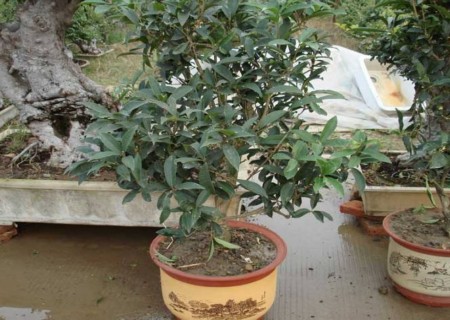
1. Soil mixing
The growing medium can be made by mixing 4 parts humus soil, 3 parts sandy soil, and 3 parts dried decomposed barnyard manure, with a small amount of fish scales, bone meal, etc. added; or 5 parts mountain soil, 3 parts leaf mold, and 2 parts sandy soil mixed and prepared before use. To overcome the alkalinity of the soil and water, during the growing period, spray once about every half month with a 0.1%-0.2% ferrous sulfate solution, which makes the branches and leaves a deep green and also benefits growth.
2. Transplanting
After transplanting, wrap the trunk with straw rope or film to retain moisture until the tree survives. Because the bark of the osmanthus tree is relatively thin, water is easily lost through the bark. Doing this can, first, avoid direct strong light and dry hot wind, reducing water evaporation, and second, protect the tree's internal moisture before new roots grow.
3. Watering
Generally, water once every 2-3 days in spring; in summer, when temperatures are high and evaporation is great, and it is exactly the stage of osmanthus development and flower bud differentiation, water once a day; in early to mid-September, the potting soil needs to remain moist, otherwise it is not easy to bloom. However, during the blooming period, do not water heavily, to prevent flowers from dropping. In rainy weather, drain promptly to prevent waterlogging and root rot. Usually, it is best to maintain a moisture content of about 50% in the potting soil.
4. Fertilizing
From April to May, apply fertilizer about once every half month; from June to July, apply fertilizer once every 7-10 days. Apply the last time in early August. In this way, the osmanthus will not only grow luxuriantly, but also bloom abundantly and fragrantly. You can use decomposed cake fertilizer water, chicken, duck and pigeon manure, fish scale water, superphosphate, bone meal, etc. If fertilization is insufficient, there will be few branches, the plant will be weak, new shoots will grow poorly, flower buds will be few, blooming will be sparse and not fragrant, or it may even fail to bloom, seriously affecting the ornamental effect.
5. Pruning
To make it bloom abundantly and have lush foliage, and to maintain the physiological balance between reproductive growth and vegetative growth, proper shaping and pruning must be carried out. Before transplanting, in order to reduce water evaporation, some of the luxuriant branches and leaves of the osmanthus seedling can be appropriately cut off; in order to stimulate rooting, some overly long roots can also be cut, but do not damage the main root.
6. Repotting
After early spring of the second year, the osmanthus should be moved into a slightly larger flower pot. First place 3 cm of nutrient soil at the bottom of the large pot, add two bottle caps of compound fertilizer and spread it evenly; then lay the osmanthus on its side, cut off the roots outside the drainage hole at the bottom of the pot, shake it lightly a few times, and pull the osmanthus out together with the soil ball, being careful not to let it break apart, place it into the large pot, adding soil while pressing it lightly, and water