Detailed Guide to Potted Mulberry Tree Planting Techniques and Management Methods
The fruit of the mulberry tree is the mulberry I often picked and ate as a child. Their shelf life is very short, and they are basically not sold on the market. However, we can plant them in flower pots. They do not necessarily have to be planted in front of the yard; planting them on a balcony or terrace is also very good, as long as there is plenty of sunlight.
When growing mulberry trees in the city, there is not such a large piece of land for you to plant them, so you can only use flower pots. For potted planting, we need to use a very large pot, because mulberry trees will grow relatively large. Potted mulberry trees need to be selected from dwarf varieties, and they also need to be pruned frequently to control the plant shape. You can directly buy cuttings-raised seedlings to plant; you cannot grow them from seed.
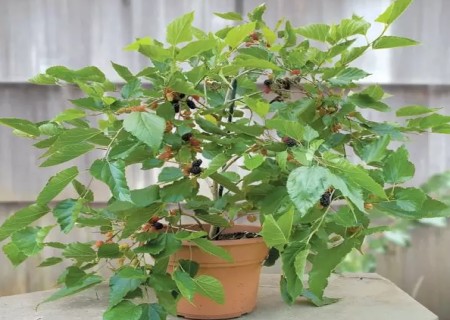
The main propagation methods for mulberry trees include seeding, cuttings, root division, and grafting, or you can buy seedlings and plant them directly.
Planting time: December to March of the following year
Variety: Mainly the Nongsang series.
Seedling selection and treatment: Separate the seedlings by size and plant them separately. Before planting, cut off withered roots and overly long roots, and soak them briefly in mud slurry, which can improve the survival rate.
I. Preparation before transplanting
1. Potted mulberry trees need a ceramic pot of about 20 liters with good drainage. However, as the cutting seedlings grow, they need to be repotted every year. The potting soil should be loose, fertile, and well-draining. The soil can be slightly acidic or neutral.
2. Apply sufficient base fertilizer. Fully decomposed pig and cattle manure and miscellaneous soil manure are required as base fertilizer. Combine with deep plowing to bury the organic fertilizer deeply in the soil.
II. Planting
1. Planting period: Generally, planting in winter and early spring is better, requiring the soil temperature to remain stable at around 10—12°C.
2. Seedling selection and treatment: Vigorous seedlings of improved mulberry varieties should be selected, free of diseases and pests. When planting mulberry in summer and autumn, try not to damage the roots when lifting the seedlings, and preserve the root system of the mulberry seedlings as much as possible. When planting mulberry in winter and spring, the overly long main roots should be lightly pruned to encourage more lateral roots. Before planting, dip the roots in mud slurry mixed with phosphate fertilizer to help rooting and survival.
3. Planting method: Bury the roots of the mulberry seedlings into the soil along the mulberry row line, cover with soil and lift gently so the roots spread out, then tread firmly and add a layer of loose soil, requiring the soil to cover 3 cm above the root crown. Water thoroughly to settle the roots. Within 2 days after planting, prune the plant, leaving a plant height of 10—20 cm, and cut off the shoot tips to achieve a uniform height.
III. Management after planting
1. Mulching: Cover the soil with rice straw or weeds to retain water and prevent drought, reduce plant water loss, suppress weed growth, prevent soil compaction, and enrich the soil.
2. Water in time to prevent drought and drain excess water: In the first few months after planting, watering thoroughly once the potting soil dries out is necessary, keeping the soil slightly moist but not wet. After the mulberry tree grows steadily, watering should be controlled appropriately, and in winter basically very little watering is needed. Maintaining suitable soil moisture is key to the survival and growth of new mulberry trees. Water in time when the soil is dry, and drain promptly during rainy periods.
3. Loosening soil and weeding: After a certain period, especially after rain, the soil tends to become compacted. Loosen the soil while weeding to help the mulberry roots grow.
4. Fertilizing: After new mulberry sprouts and leaves open, apply manure water or urea water fertilizer once. Afterward, according to the growth of the new mulberry, apply additional fertilizer 1—2 times. At the young tree stage, the amount of fertilizer applied each time should not be too much; it should be given in small amounts and more frequently. During the growing season, appropriately apply a balanced fertilizer, giving diluted liquid fertilizer or organic fertilizer once every 1~2 weeks. When planting, spread a layer of decomposed organic fertilizer at the bottom of the pot to ensure the mulberry tree has enough nutrients.
Warm tips:
Another thing to note is to avoid frequent watering. The potting soil must not become waterlogged, otherwise root rot can easily occur. Overwatering can also easily trigger various fungal infections or attract pests. Ripe mulberries turn dark red, purple, or black. At this time they are at their best; just pick them directly, wash them clean, and eat them. They generally ripen from late spring to late summer.
Notes on field planting:
1. Field planting: The seedlings should be upright and the roots spread out, planted shallowly and firmed. It is best for the graft union to be about 10 cm below the soil surface. Water thoroughly to settle the roots and cover with plastic film.
2. Trunk pruning: After transplanting, cut off the seedling trunk 5-7 cun above the ground. For winter planting, prune in spring; for spring planting, prune as you plant. The cut should be smooth.
3. Bud thinning: When new buds grow to 4-5 cun, carry out bud thinning. For each plant, select and keep 2-3 mulberry buds that are strong and reasonably oriented to develop into vigorous branches.
4. Pinching: For those with only one bud, when the bud grows to 4-6 cun, pinch it off to promote branching and earlier orchard formation.
5. Gap filling: After mulberry buds sprout, check in time and replant promptly where plants have not survived.
6. Drainage and irrigation: Water during drought and drain water during rainy days to improve the survival rate.
7. Strengthen weeding and fertilizing: Shallow plow and weed in time. After bud thinning and pinching, apply 10-15 kg of urea per mu, or irrigate with biogas slurry, human manure, and urine, etc. The fertilization amount should be controlled at 1/3 of that for a mature mulberry orchard.
8. Intertillage and weeding: Carry out intertillage once every year after sericulture ends. Weeding is generally carried out 2-3 times per year according to weed growth conditions.