How to grow and care for potted coral bells (Heuchera)
Coral bells (Heuchera) were introduced not long ago, so relatively few people grow them and there is a lack of care experience summarized by enthusiasts. Many flower lovers want to know how to grow coral bells. Coral bells belong to the genus Heuchera in the family Saxifragaceae and are also called coral bells; they are perennial cold-tolerant, shade-tolerant herbaceous flowers, very well suited to growing in semi-shaded environments.
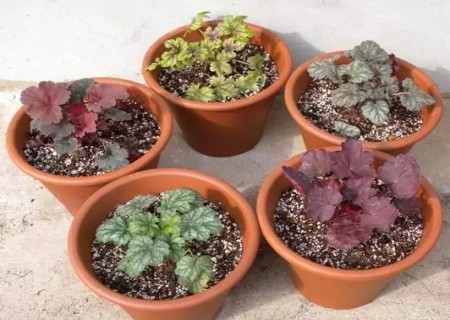
Coral bells are a new and excellent groundcover plant. In recent years they have been used in flower borders and garden landscapes, with good ornamental characteristics and landscape effects. Because coral bells have beautiful leaf colors and unique leaf shapes, they have gradually become favored by many growers. Seedlings grow slowly, but once established they grow vigorously. They are a rare colorful-leaved shade groundcover plant, suitable for planting in masses under trees to create an excellent shade groundcover landscape, and also suitable for dotting different themed flower borders to enhance the richness of color. They can also be grown in pots for ornamental display.
1. Sowing
The suitable germination temperature is 15-20 degrees. Sow from early March to early May, or from late September to late October. Place moist nutrient soil or small-grain akadama soil flat in a container, sow the seeds on top of the soil and keep the soil moist. Thin the seedlings appropriately; when the plants grow to 5-10cm, begin transplanting them into the ground or into pots.
2. Planting out
March-April, or September-November is the best time. For pot cultivation, first use a pot with a diameter of 12-15cm. Choose soil with a balance of drainage and water retention for planting out. For ground planting, choose a site without direct sunlight and keep a plant spacing of 20-30cm.
3. Soil mix
Coral bells like soil that has both drainage and water retention. What we use at home is: peat soil + perlite (2:1 ratio), with Osmocote slow-release fertilizer added. For ground planting, one week before planting out, first dig a 30cm deep hole in the yard and mix leaf mold into it for later use.
4. Watering
After the soil surface dries, water thoroughly. The larger the plant, the more drought-tolerant it is, but during the seedling stage you need to watch out for lack of water. However, since they dislike highly humid environments, in summer watering should be adjusted to the cooler times of morning or evening.
5. Fertilizing
Apply slow-release fertilizer once each in March-April and September-November. Do not fertilize during the high summer heat or when growing outdoors in winter. During the same periods, liquid fertilizer can also be used once every 10-15 days instead.
6. Pruning
If spent flowers or dead leaves are not dealt with, they can easily cause the plant to rot, or lead to pests and diseases. Remove spent flowers from the stem base, and clear away dead leaves promptly as well.
7. Transplanting
Coral bells are very easy to grow. Whether the light conditions are full sun or partial shade, whether the growing soil is slightly moist or slightly dry, whether humidity is high or low, they can all grow well. Even so, you should still note that during cultivation they prefer semi-shaded, cooler environments, and direct strong afternoon sunlight should be avoided.
Notes on growing coral bells:
1. Grow in a sunny spot in winter; they are cold-tolerant and can grow at temperatures above -15°C.
2. Grow in semi-shade in summer; avoid direct strong light.
3. Soil and fertilizer: plant out in well-drained soil and add slow-release fertilizer. Apply appropriate fertilizer during the growing period.
4. Watering: follow the principle of “water when dry, stop when wet”. Water after the soil surface dries. Since they dislike being too moist, watering can be appropriately controlled in summer.
5. Plant coral bells on a slope. This is because they like well-drained substrates. Although they can tolerate short periods of high fertilizer content or high pH, coral bells grow more vigorously in well-drained, low-fertilizer soilless substrates.
6. Coral bells can also be propagated by leaf cuttings, and it is very simple; not only is propagation fast, but multiple plants can be propagated at one time.