How to Plant and Care for Potted Roses
Roses are messengers of love and bearers of affection. Every girl loves to receive roses from someone dear to her; it is not only an expression of love, but also a joyful experience. So roses often play an important role in our lives. If you cannot express your admiration in words, then you can let roses help you convey your love. Not only is it romantic, but it is also so heartwarming!
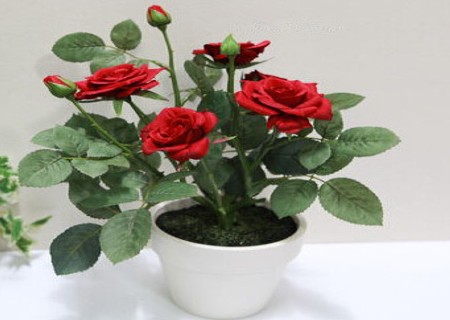
Roses win praise from many people for their beauty and fragrance, and red roses in particular are deeply loved by everyone. Whether a potted rose survives depends on mastering the planting method. So how do you plant potted roses? Today the editor will share with you the planting methods for potted roses.
1. Preparing the potting soil
Potted roses like loose soil with good drainage. Here the editor recommends a few soil mix options for you: mix 7 parts garbage soil with 3 parts river sand; mix 6 parts dry river sand with 4 parts honeycomb coal cinders; mix 7 parts vegetable garden soil, 2 parts honeycomb coal cinders and 1 part river sand. These are all good soil mix options.
2. Potting time
The best time to pot and transplant rose seedlings is after leaf fall in early winter or before bud break in early spring, because for most potted flowering plants this season gives a much higher survival rate than other seasons, and roses are no exception.
3. Transplanting process
Roses are usually propagated by cuttings. After about 1 month they grow into new young plants, and after one year they can be transplanted. When transplanting, first loosen the soil around the young plant, taking care not to damage the roots, then lift it out together with some of the old soil and plant it into a new pot. Rose seedlings with old soil around the roots survive more easily.
4. Watering at the right time
Watering is the tool growers use most often in their care routine, and it must be decided according to how dry or moist the potting soil is. The usual principle is "water when dry, and water thoroughly when you do," but avoid waterlogging in the pot, otherwise it will cause root rot and affect growth.
5. Fertilizing in moderation
Since the nutrients in potting soil are limited after all, you need to supplement the potted plant with some nutrients at the appropriate time, generally by base fertilizer and top dressing, and a compound fertilizer with a fairly scientific and reasonable nitrogen-phosphorus-potassium ratio is usually chosen. When fertilizing, first loosen the soil, then bury the fertilizer in the potting soil and cover it with soil. After that, water enough to dissolve and dilute the fertilizer, which helps the plant absorb it fully.
6. Pruning and shaping
To keep potted roses in good form, we need to prune them regularly, mainly by cutting out overly dense branches, spent flowering branches and diseased, weak or pest-infested branches. This keeps the plant in a graceful shape while also letting it bloom more and produce high-quality flowers. Deadheading is also very important; if spent flowers are not properly removed, the plant will often bloom only once.
7. Repotting at the right time
Potted roses generally need to be repotted and given fresh soil once a year, and the roots should be properly trimmed when repotting, cutting away more of the tangled, circling mass of roots. This favors the plant's growth, and the flowers it produces are more vivid and larger, with higher quality.
Notes:
1. The best time to plant potted roses is after leaf fall in early winter or before bud break in early spring.
2. Water and fertilizer management is very important. Watering should be decided according to the weather conditions and how dry or moist the potting soil is; fertilizing is generally done about every 10 days after the plant has settled in, applying a dilute, fully decomposed organic liquid fertilizer.
3. Once the plant enters dormancy, prune it at the right time, and after the flowers fade, remove the spent blooms promptly. This ensures more luxuriant growth and also prolongs the flowering period. (Author: Xiaoshu 2017-08-10 23:00)