How to plant a potted rubber tree? A complete guide to the planting method
The rubber tree has broad, thick leaves that are attractive and glossy; the terminal buds are mostly red, and after the stipules split open they look like red tassels, making it quite distinctive and charming as a home potted plant, and it is a foliage plant very well suited to indoor growing. In some earlier articles, I introduced the cultivation and management measures for potted rubber trees, but kept forgetting to tell you how to plant and grow them. Today I will fill in that gap for you.
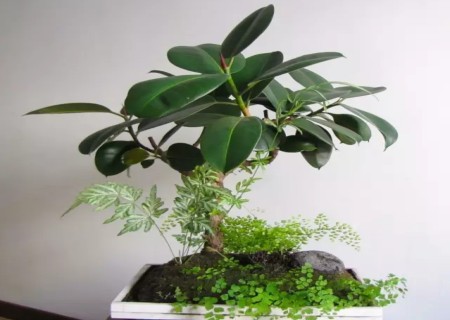
Home potted rubber trees are generally propagated by cuttings, and cuttings can be taken in spring, summer and autumn. After the cuttings are done, they need to go through cultivation and management, and once the young plants grow steadily they can be potted and transplanted. Of course, the propagation and cultivation process is very important, and care and management cannot be careless either; only in this way can we grow our potted rubber trees well. Today, I will explain the process of growing rubber trees at home.
1. Propagation by cuttings
The rubber tree has quite a few propagation methods, but since it is grown as a home potted plant, cuttings are generally used, and it is best to complete the cuttings between April and September each year. First we need to select strong 1-year-old branches from a mature plant as cuttings. If taking cuttings in autumn, it is best to choose strong branches of the current year as cuttings; only the middle leaves need to be kept on the cutting, and it is recommended to cut the leaves in half to reduce water evaporation. Then insert them diagonally into the soil.
2. Raising the seedlings
After the cuttings are done, the next step is the process of raising the seedlings, until they grow into young plants and are then potted and transplanted. As long as the growing environment is suitable, the rubber tree grows very fast; it is recommended to repot once a year during the seedling stage, and after about 2-3 years, once it has grown into a small tree, it can be grown in a pot. During the seedling-raising period, pay attention to water and fertilizer management to ensure the seedlings have enough nutrients for normal growth, and at the same time, after the seedlings grow steadily, appropriately increase light to promote photosynthesis. Once the plant grows to about 1.5 m, it is ready for potting.
3. Transplanting process
When preparing the potting soil, based on the plant's growth characteristics, it is recommended to use a fertile and loose soil mix, generally prepared with leaf mold : garden soil : river sand in a 1:1:1 ratio. But to increase nutrients, a small amount of base fertilizer can be added to the potting soil as a bottom dressing. Once the soil is mixed, transplanting can be carried out. The transplanting process is basically the same as for most potted plants, so I will not go into detail here.
4. Care and management
The care and management of the rubber tree after transplanting mainly involves water, fertilizer and pruning management. In addition to daily watering, generally keep up 1-2 topdressings per month after transplanting, mainly with dilute liquid fertilizer or compound fertilizer. Since the rubber tree is not cold-tolerant, in winter the ambient temperature needs to be kept above 10°C for normal growth. In summer, take shading measures to avoid direct sunlight, and in winter it is recommended to let it receive sufficient light. But in order to control the plant's growth height and achieve dwarfing, while also making its shape look fuller, in the growing season, besides pinching out the growing tips, it also needs frequent timely pruning later on. (Author: Xiaoshu 21:37)