What are the planting methods and precautions for staghorn sumac?
Staghorn sumac, also known as deerhorn lacquer, is a small tree of the Anacardiaceae family. Its fruit clusters appear in bright red, with flattened spherical fruits bearing red hairs, producing clusters of fruit in the shape of a torch, and it can serve as a landscape tree species. This plant reproduces quickly, at a rate unmatched by many tree species, possessing both unique excellent characteristics and potential harmfulness.
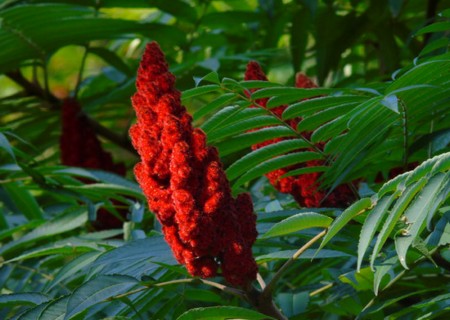
Staghorn sumac has tenacious vitality, likes light, and has strong tolerance to cold, water, salt and alkali, drought, and poor soil. It also adapts strongly to soil, and mostly grows in sandy soil or gravelly soil. So how is staghorn sumac planted? Below, the editor will tell you about the precautions for planting staghorn sumac:
1. Propagation methods
Staghorn sumac can be propagated by sowing, root cuttings, and root suckers. Propagation by sowing requires seed soaking and germination promotion in advance; propagation by root cuttings mostly uses lateral roots of more than 1 cm in size cut into lengths of about 20 cm as cuttings for rooting; root sucker propagation uses root sucker seedlings sprouting around the staghorn sumac for propagation, and before use the root suckers and excess lateral branches need to be cut off.
2. Water and fertilizer management
After the staghorn sumac seedlings emerge, watering needs to be kept up once every 10 days, and after one month it can be extended to once a month; during the seedling cultivation period, urea fertilizer is generally applied 2 times, usually together with watering. After entering July, seedling raking should be carried out, while water and fertilizer should be stopped, and overly vigorous branches should be properly pruned to promote lignification.
3. Thinning and filling in seedlings
Usually, staghorn sumac needs thinning and filling in of seedlings during April-May in spring, when the seedlings grow to about 3 cm in height and have spread out 3-4 true leaves. This is done 2-3 times in succession, and when the seedlings grow to about 10 cm in height, the final seedlings can be set.
4. Loosening soil and weeding
After the staghorn sumac seedlings have basically grown in evenly, corresponding treatment should be carried out in a timely manner according to soil compaction and weed growth. Loosening soil and weeding should be done about once every 1-2 weeks, and can only be stopped at the end of July.
5. Timely transplanting
Transplanting of staghorn sumac seedlings is mostly completed from late autumn after leaf fall to before sprouting the following spring. Seedlings with straight stems and well-spread roots should be selected for transplanting, and after planting, support stakes should be added promptly.
Precautions:
1. Sowing propagation requires seed soaking and germination promotion, and it is recommended to soak the seeds in boiling water at 85°C.
2. During the process of cultivating seedlings, soil loosening and weeding should be done promptly to avoid affecting seedling growth.
3. When the seedlings grow into large saplings, support stakes should be set up promptly to prevent strong winds from blowing them over or even breaking them.
4. Although there are not many pests and diseases that can attack staghorn sumac, timely prevention and control treatment is still needed.