How to grow the showy evening primrose? A detailed guide to planting methods
I remember the first time I saw the showy evening primrose; it was just like this——scattered among the wild grasses, with the showy evening primrose growing everywhere. The flower colors range from white to pink, forming a bright scenic sight beside the teaching building. Naturally, this attracts people's favor, and taking group photos as keepsakes is the first choice for graduating students, as if sitting together amid a sea of flowers, accompanied by the language of flowers, stirring endless reverie.
The flowers of the showy evening primrose are very beautiful, opening at night with a pleasant fragrance, suitable for embellishing night scenes, and very suitable for use in courtyards and flower beds. Used in combination with other landscaping materials, it can be used for courtyard border plantings or as accents among rockery stones, and is also suitable as a large-area groundcover flower. The showy evening primrose is a low-growing groundcover plant with strong growth, very drought-tolerant, and a wide range of adaptability. The flowering period is from April to October, with bright pink flowers, large flower diameter, and abundant blooms. It has a very strong ability to self-sow and reproduce. It can be used for large-area landscape arrangements and can also be cultivated as a flower bed flower.
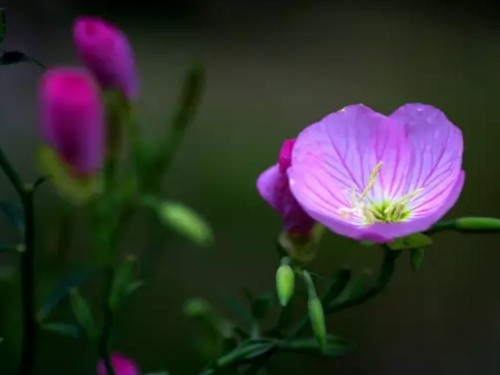
The showy evening primrose can be sown and cultivated directly in the open field, or produced and sold by nurseries as a groundcover plant. It can be sown in spring, summer, and autumn. It can also be sown in protected areas in winter and then transplanted. It opens every evening and withers by nearly noon the next day. It is not tolerant of severe cold, and in the Jiangnan region it can overwinter in the open field in a sheltered spot. The showy evening primrose can be propagated by autumn sowing; it likes light, is cold-tolerant, and dislikes waterlogging.
[Soil preparation]
Choose loose, well-drained land, deep plow it, sun-dry for 15~20 days, then break up the clods and rake it level, making beds 1.5 m wide. Before deep plowing, apply farmyard manure, stable manure, cake fertilizer, etc. as base fertilizer, then sow seeds or transplant seedlings for planting.
[Sowing]
Evening primrose is usually propagated by seed. In the north, sow in spring; in areas south of the Huai River, sow in autumn or raise seedlings in spring. When sowing, the soil should be raked fine and level, the seeds scattered on the surface of the bed, lightly raked with a rake, and covered with a thin layer of soil. The seeds are small, so the soil must not be too thick, otherwise it will affect seed germination and growth. After sowing, the soil must be kept moist. About 10~15 days after sowing, the evening primrose seeds will germinate into seedlings.
Evening primrose seeds are often sown in autumn after mid-to-late September: disinfect the sowing medium. The best method is to put it in a pot and heat it while stirring, so that any pests and diseases are killed by the heat. Soak the seeds in warm water (at a temperature similar to face-washing water) for 3~10 hours, until the seeds absorb water and swell. For very common seeds that germinate easily, this step can be skipped.
For tiny seeds that are difficult to pick up with hands or other tools, moisten one end of a toothpick with water, stick the seeds one by one onto the surface of the medium, cover with medium 1 cm thick, then place the sowing pot into water, with the water depth at 1/2~2/3 of the pot's height, allowing the water to slowly soak upward.
For larger seeds that can be picked up with hands or other tools, place the evening primrose seeds directly into the medium and sow them in spots at a spacing of 3×3 cm. After sowing, cover with medium to a thickness 2~3 times that of the seeds. After sowing, use a sprayer or a fine-hole watering can to moisten the sowing medium. Later, when the pot soil is slightly dry, water again, still taking care not to water too forcefully, so as not to wash the seeds up.
Management after sowing evening primrose seeds: after autumn sowing, when encountering a cold wave and low temperatures, you can wrap the flower pot in plastic film to help keep it warm and moist; after the seedlings emerge, promptly uncover the film, and let the seedlings receive sunlight before 9:30 every morning or after 3:30 in the afternoon, otherwise the seedlings will grow very weak; after most of the seeds have sprouted, appropriate thinning is needed: pull out the diseased and unhealthy seedlings so that the remaining seedlings have a certain amount of space between them; when most of the seedlings have grown 3 or more leaves, they can be transplanted into pots.
[Management]
Before the second pair of true leaves unfolds, showy evening primrose seedlings look very similar to weed seedlings, so intertillage weeding cannot be done; it can only be carried out after the second pair of true leaves has unfolded. When they grow into rosette-shaped seedlings, they can be thinned and fixed in place or transplanted. The plant and row spacing is 65 cm×65 cm. When the plants reach 30 cm tall, earth up around the plants to prevent lodging due to height. After transplanting or fixing the seedlings, apply one topdressing of manure or urea to promote growth during the seedling stage, and apply a second topdressing at the early bud stage to promote flowering and seed setting.
[Pest and disease control]
After being infected with rot disease, the roots of the showy evening primrose gradually discolor and rot, the leaves wilt and dry up, and eventually the whole plant dies. Control methods: use 1% lime water, or 50% thiophanate-methyl 1500-fold solution, or 75% chlorothalonil 1000-fold solution for drenching.
[Harvesting and processing]
The showy evening primrose has an indeterminate inflorescence, and the fruits mature successively. Generally, when half of the inflorescence has matured, it can be harvested. When harvesting, use pruning shears or a knife to cut (mow) off the inflorescence, or pull up the whole plant, sun-dry it, press it with a roller or beat it with a stick, remove all fruit shells and impurities, and store it in a cool, dry place.