How to grow baby's breath so it bursts into a full pot? A complete guide to care techniques
As a garden flowering plant, baby's breath (Gypsophila) has many branches and compact blooms, making it easy to grow into a bursting pot, and baby's breath in full bloom looks like a big flower ball, very beautiful. When grown as a potted plant, how do you grow baby's breath so it bursts into a full pot? Today, the editor will share with you how to grow potted baby's breath into a bursting pot.
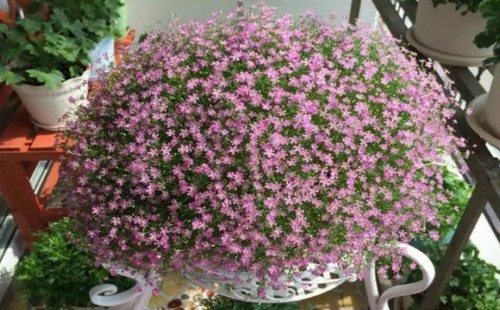
If you want to grow potted baby's breath into a bursting pot, whether in terms of planting or care management, you need to proceed strictly according to scientific standards, and you must not rush blindly or be too impatient. To achieve the goal of a bursting pot of baby's breath, scientific cultivation is usually carried out from the following aspects.
I. Seed selection and sowing
We use sowing to propagate baby's breath seedlings. First, you must select suitable seeds, which often plays an important role in achieving a bursting pot.
1. Choosing a variety
To make potted baby's breath achieve a bursting pot, seed selection is very important. Usually choose the "Garden Bride" or "Gypsy" varieties. After all, we are not using it to make cut flowers and choosing tall baby's breath, but growing it as a potted plant, so a relatively short variety is needed.
2. Sowing time
Varieties such as "Garden Bride" and "Gypsy" have strong cold tolerance, and can often be planted outdoors even in relatively cold places, but because they are not heat-tolerant, autumn sowing is generally chosen to propagate seedlings. Of course, whether it is suitable for sowing mainly depends on whether the temperature environment is appropriate. If the temperature conditions are met, sowing can usually be done even in spring or winter.
3. Seedling medium
Baby's breath is not very strict about soil quality. Ordinary loam is usually fine, as long as the particles are relatively fine and it is soft and breathable. Of course, other relatively high-quality substrates can also be used for sowing and cultivation.
After sowing, the next thing to do is wait quietly for the seeds to germinate. Of course, care management is needed during this period, especially keeping the substrate at a relatively suitable moisture level. If conditions are suitable, normal germination usually occurs in 3-4 days.
II. Temporary planting and final planting
During growth, baby's breath seedlings need to go through the processes of temporary planting and final planting. This will better promote root development in the seedlings, make the roots grow more robust, and also make care management easier for the owner. Usually, strong and relatively large seedlings are selected and transplanted into flower pots for final planting.
1. Choosing a flower pot
The flower pot chosen for final planting should be decided according to the placement environment and personal preference, but the principle for choosing a pot should be that the size is appropriate, permeability is good, and the normal growth of the seedlings is not affected. For potted baby's breath seedlings, it is usually enough to choose a flower pot with a diameter of just over 10 cm, which neither takes up space nor fails to ensure the seedlings have enough room to grow.
2. Choosing soil
Because we choose dwarf varieties of baby's breath, it is not strict about soil, and it is relatively drought-tolerant and tolerant of poor soil, as long as the soil has good permeability and is fertile and loose. But usually using soft soil containing a large amount of humus often has a very good promoting effect on plant growth.
3. Adding base fertilizer
For the final planting of baby's breath, there is no strict standard for choosing base fertilizer. It is usually recommended to bury some decomposed organic fertilizer, such as poultry manure. But if an appropriate amount of slow-release fertilizer can be mixed into the middle layer of soil, the plant growth effect is often better. The amount of fertilizer taken in should not be too much, otherwise it will not only cause waste, but also bring the risk of burning the seedlings. The principle for applying base fertilizer is "less rather than more," because even if the amount of base fertilizer is too small, topdressing can still be done later during care management.
After all the above preparations are ready, we can then move the seedlings for final planting in pots.
III. Watering and fertilizing
Baby's breath seedlings need relatively more water during the growth period, so after pinching, they usually still need to be provided with sufficient water and nutrients, and watering should only be appropriately controlled after the plant sends out flower buds and the petals have formed. Because enough nutrients were buried in the pot as base fertilizer during final planting, in principle no further topdressing is needed during the growing season. But if less base fertilizer was applied when potting, topdressing can be considered as appropriate, though it is necessary to "apply thin fertilizer frequently."
IV. Pinching and pruning
Usually 1 week after final planting in the pot, we can pinch the plant in time, and when the plant's branches grow to the edge of the pot, we can take the opportunity to pinch it again. But pinching also needs to be decided according to the shape effect conceived by the owner. Through reasonable pinching, try as much as possible to prompt the plant to grow according to your own plan. But as for Gypsy, it itself has fairly good branching ability, so basically there is no need to deliberately pinch it, and it can often still form a relatively good shape.