What month is best for sowing common flowering plants?
Different flowering plants often have different blooming periods, and some even differ greatly; some bloom all year round, some bloom for only a quarter of the year, and some bloom for just a few days or even less. So nature is truly magical: even the blooming time is often not fixed to a certain period, let alone opening in rigid uniformity. To a large extent, this determines the time for seed setting after flowering, seed maturation and harvest, and especially for flowering plants with strong self-seeding ability, the time for sowing and propagation often differs as well. So in which month are common flowering plants sown?
For most flowering plants, although the time of flowering and seed setting is not the same and may even differ greatly, the sowing time is mostly roughly the same, generally concentrated in spring and autumn. After all, for the seeds of most flowering plants, these two seasons often provide a more suitable temperature environment, so they are more conducive to seed germination. However, there are still many flowering plants in nature that can be sown not only in spring and autumn, but even in summer or winter, when temperatures are either high or low.
However, for common ornamental flowering plants, sowing is generally done in spring and summer, and the sowing time can span more than half a year; that is, from January to June, as long as temperature and humidity are suitable, they often sprout relatively easily after sowing and successfully produce seedlings. Typical examples include marigold, zinnia, cockscomb, China aster and French marigold. Because of their strong propagation ability by sowing and strong adaptability to the environment, as long as the growing environment is not particularly harsh, it is generally fairly easy to raise seedlings from them.
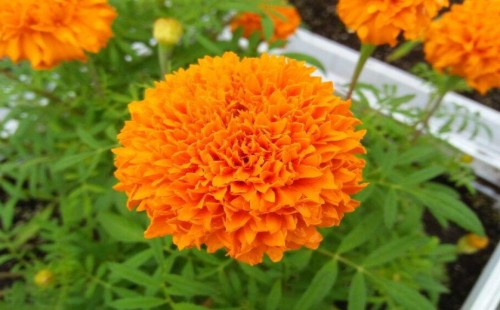
For flowering greenery such as marigold, sowing is mostly done in spring and summer, and by the time autumn arrives it is often in bloom, with its opened petals mostly golden yellow. So in autumn marigold can bring a patch of golden yellow, very bright and dazzling, making it very suitable for autumn viewing. At the same time, it also brings a touch of vitality to the leaf-shedding autumn, making the fading autumn no longer so lonely. Autumn is also exactly the harvest season, and what we flower growers often harvest is an excellent ornamental effect, which is often quite consistent with the theme of autumn.
Cockscomb is also suitable for sowing and propagation in spring and summer, and it likewise blooms in autumn, with bright red flowers presenting a beautiful fan shape. The green flower stems support the large red fan-shaped flowers, just like the fiery red cockscomb on top of a rooster's head, passionate and generous, both vivid and lively, showing a scene of vigorous vitality. And if it can be grown as a potted plant, it is quite charming to view as well!
But zinnia, as a flowering green plant, is mostly sown in spring, and generally blooms after summer arrives, with the flowering period lasting until October in autumn. Although zinnia is very beautiful when in bloom and highly ornamental, it also looks rather delicate, and compared with crape myrtle, it seems much inferior. But its flowering period is indeed very long and its ornamental period lasting, which shows that its vitality is also quite tenacious, not as delicate as it looks when in bloom.
Different flowering plants each have their own growth habits; there may be certain commonalities among them, but their differences are often more prominent, and some even differ considerably. However, no matter which kind of flowering plant it is, before planting we should understand its growth habits in advance and become familiar with its growing environment, especially for sowing and propagation, because only planting at the appropriate time can ensure smooth germination, survival and growth. And as long as the later care and management work is done well, we can often witness and enjoy its blooming elegance as scheduled.