How to grow rose rootstock (Rosa multiflora) for grafting roses
Generally, the Rosa multiflora stumps we dig up from the wild are oddly shaped, and when we plant them in flower pots, many roots are usually exposed above the pot surface, because their root systems are simply too long and too developed. Even if we use deeper gallon pots, their roots can still reach the bottom of the pot.
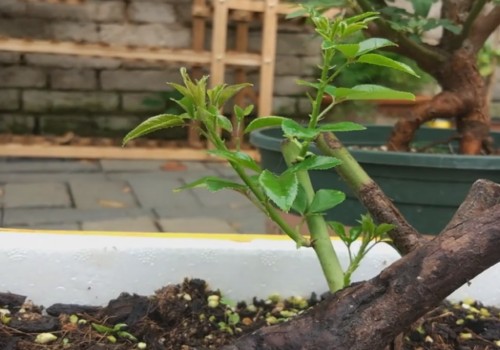
Moreover, Rosa multiflora stumps generally have few fibrous roots, fine roots, or lateral roots, and are mostly made up of sturdy taproots. So transplanting them into flower pots makes it fairly difficult for them to survive. If we want them to survive smoothly, we usually need to master three key aspects:
1. Use rooting agent scientifically
Since Rosa multiflora stumps generally have no lateral roots, relying only on old roots makes it fairly difficult for them to survive. So before potting, we must soak them in a rooting agent. And do not buy too cheap a rooting agent; buy a better one. The cheap ones cost just 1-2 yuan for a small bottle, while good ones cost 8-10 yuan for a small bottle.
Also, we need to soak the old roots in the rooting agent for a long time; we cannot simply give them a quick dip. The concentration of the rooting solution must also be controlled well; generally, adding 10 drops of rooting agent to every 500 ml of clean water is suitable. After stirring the solution evenly, soak the old roots of the Rosa multiflora stump in it; generally, they need to be soaked for 20-30 minutes before planting.
And before planting, the substrate needs to be sterilized in advance. You can use potassium permanganate, hymexazol, or Di'ai, and then pot and plant. If a relatively large part of the stump is exposed to the air, it is recommended to cover it with a bag, or spray it once with an anti-transpirant, then place the pot in a shaded place for care and wait quietly for it to sprout.
2. Apply water-soluble fertilizer in time
For old stumps, the plant's own vitality is simply not enough, so once leaves have been grown, we need to fertilize them in time. But ordinary compound fertilizer cannot be used for fertilizing, because compound fertilizer has relatively strong fertility and can easily burn the roots. It is generally recommended to use water-soluble fertilizer, mix it at a lower concentration, and dilute it with water at a ratio of 1500-2000 times before watering.
3. Prevent old stumps from growing root nodules
Since old stumps easily grow root nodules, once a stump grows root nodules, not to mention grafting roses to cultivate bonsai, even its growth will become a problem. Therefore, we also need to use some beneficial microbial preparations for the old stump, so as to prevent or inhibit the growth of root nodules.
But using this kind of microbial preparation also requires controlling the concentration well. After diluting it with water in a scientific ratio, water the stump once every month. In this way, more beneficial microorganisms will grow in the potting soil, and these beneficial microorganisms will inhibit the breeding of rhizobia or oncogenic Agrobacterium, thereby reducing or avoiding the appearance of root nodules.
If we grow the old Rosa multiflora stump well, it can absolutely be used as a rootstock, and then we can graft roses at the appropriate time. The above is the process shared by the editor for growing and caring for the rootstock before grafting roses.