How to choose a pot and repot a creeping juniper bonsai? A detailed guide to the method
The creeping juniper has emerald-green foliage, winding and creeping, and is worth viewing in all four seasons. The ornamental effect is at its best in spring when tender green new branches and leaves emerge. During the growing season, it should not be kept indoors for long periods. The creeping juniper is easy to shape and can be made into a horizontally spreading symmetrical bonsai, placed in a courtyard or reception room for appreciation.
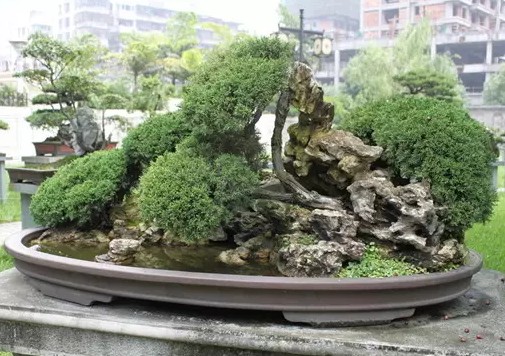
Choosing a pot:
Different pots should be chosen according to different styles. For the cascade style, a purple clay tall cylindrical pot is suitable, and the main root should be left somewhat longer to bear the pull of most of the branches and leaves hanging down outside the pot; for the curved-trunk style, an oval purple clay pot or glazed ceramic pot can be used; for the slanting-trunk and lying-trunk styles, a rectangular shallow purple clay pot is best, to show off the graceful posture of the trunk.
The creeping juniper has lush foliage and relatively long hanging lower branches, which makes the trunk look too thin and not attractive enough. Place a fairly elegant rock of a certain height behind the trunk. This rock not only makes up for the defect of the rather thin trunk, but also gives the impression that the creeping juniper seems to grow on a steep cliff, fearless in the face of danger, displaying the momentum of “rock and flying waterfall”.
Repotting:
Small seedlings that have survived from cuttings are divided and planted in pots in the second spring. After about 3 years of cultivation they can be used for miniature bonsai, and after about 5 years of cultivation they can be used for small bonsai. According to the form of the small tree, preliminary shaping should be done during cultivation. When buying a potted creeping juniper with a tree age of more than 10 years, observe the tree and then conceive the composition, cut off branches not needed for the design, plant it in relatively fertile cultivation soil, and carry out preliminary wiring and shaping while cultivating. Generally, after 2 to 3 years of cultivation, a medium-to-large bonsai can be made.