An Analysis of the Coexistence of Traditional Penjing and Folk-Art Penjing
The author of "Record of the Plum Blossom Sanatorium" even called excessively styled plum trunks “diseased plums,” removed their bindings, and replanted them to grow anew. Although this was not the author's original intent, it does reveal from one angle that what literati through the ages admired was the “natural-style” penjing rich in cultural flavor and artistic atmosphere. The Ming and Qing dynasties were an era of highly developed penjing in our country. Were not the penjing specifically described in their major penjing monographs precisely the “natural-style” penjing that we inherit today?
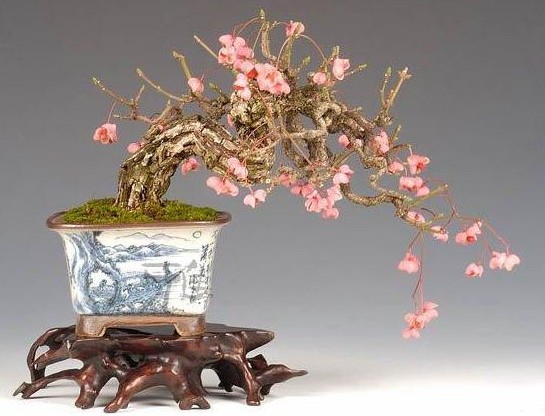
From this it can be seen that “natural-style” penjing is the orthodoxy of Chinese penjing art and the tradition of Chinese penjing art. Today our penjing art creation inherits this fine tradition, and only thus has the development of Chinese penjing art achieved unprecedented success.
By the Qing dynasty and the Republic of China period, folk penjing rose in our country, such as the various patterned or so-called formal-style penjing of Nantong, Yangzhou, Suzhou, Huizhou, Sichuan, and other places. This type of penjing truly belongs to folk art, and it possesses all the characteristics of folk art.
Yet for nearly half a century, we have developed a mistaken understanding of this, believing that this is the tradition of Chinese penjing art. Thus we loudly proclaim “inherit the tradition,” while in essence we take the elegant traditional literati penjing art and instead inherit the tradition of folk art. This is a great error. On this point, the historical facts of penjing in our country are clearly distinct.
Our country's penjing artworks, like painting and poetry, belong to culture and art, so penjing works can be deeply integrated into Chinese painting, poetry, and literary works, whereas patterned penjing cannot reach this realm. But how then do we explain the penjing situation of that period? I think it may be because at that time Chinese penjing presented a state in which literati traditional penjing and folk-art penjing coexisted, and developed simultaneously on two different levels and along two different threads.
This article is excerpted from the first draft of "Zhejiang Penjing," intending to offer a modest spur to induce others to come forward with valuable contributions and to clarify the source and set the course right. Discussion and advice are welcome.