What types of pots are used for bonsai? Follow these principles when choosing a pot
Bonsai pots mainly come in two types: trunk-style pots and landscape pots. Trunk-style pots have a drainage hole at the bottom, while landscape pots do not. There are many pot styles. According to the different materials used for bonsai pots, they can be further divided into the following types:
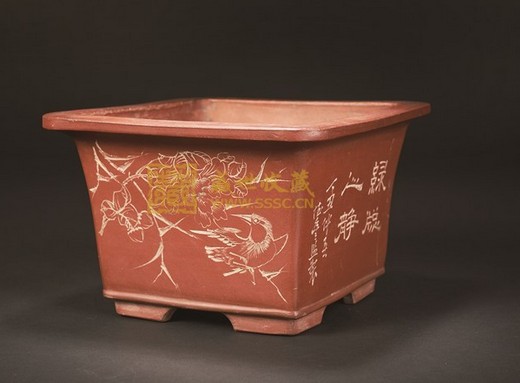
1. Zisha (purple clay) pots: mainly produced in Yixing, Jiangsu Province, and other places. The texture is fine and tough, with good breathability and a simple, antique style. At present, they are mainly available in many shapes such as round, square, octagonal and various figurative forms. They can be used both for making trunk-style bonsai and for making landscape bonsai.
2. Glazed ceramic pots: mainly produced in Shiwan, Guangdong. The texture is loose, with good breathability and a plain, elegant style, but the color is relatively dark, so they are less often used in landscape bonsai.
3. Porcelain pots: produced in Jingdezhen, Jiangxi, Tangshan, Hebei, and Boshan, Shandong, and other places. Fine, hard and gorgeous, but with poor breathability. They are generally used as cachepots or as pots for landscape bonsai.
4. Stone pots: produced in Dali, Yunnan, and Qingdao, Shandong, and other places. They are made from natural stone materials, such as white marble, marble or granite carved and chiseled into shape. They are suitable for making shallow landscape pots or for making wall-hanging bonsai.
5. Cement pots: produced everywhere. Using white cement as the main raw material, they are characterized by being cheap, solid and durable. They are mostly used for large landscape bonsai.
6. Clay tile pots: produced everywhere. They are characterized by being rough and having good breathability. Therefore, they are suitable for use in the early stages, such as for growing tree stock.
7. Bamboo and wood pots: produced in Jiangxi and other places. Made from bamboo and wood as raw materials, they are plain and unadorned, with a natural and simple style. Common ones include bamboo pots, tree-trunk pots and board-basket pots. They are often used for making trunk-style bonsai or wall-hanging bonsai.
8. Plastic pots: made of plastic, with many types and colors. They are characterized by being gorgeous, non-breathable and prone to aging, but they are cheap and can be made into various shapes at will, so they are relatively popular.
9. Copper pots: cast from copper. They are relatively common in Japan.
How should pots be used for bonsai?
1. The colors must be coordinated.
The colors of the pot and the scenery should have a certain contrast while also harmonizing with each other. In general, the color of the pot is best kept plain and elegant, so that it can play a supporting role and avoid overshadowing the main subject. Landscape bonsai usually use white pots, but care must be taken that they are not the same color as the rocks. Tree bonsai should be chosen according to the color of the main trunk; flowering and fruiting types are suitable for glazed colored ceramic pots, while pine and cypress types are suitable for zisha ceramic pots.
2. The style must match.
The style of the pot and the content of the scenery should match in tone. If the tree's posture is twisted and winding, the outline of the pot should mainly consist of curved lines, such as round or oval; if the tree's posture is vigorous and upright, the lines of the pot should be straight and rigid, such as diamond-shaped or square. Upright trees are suitable for low-footed pots, while horizontally slanting and elegant trees are suitable for high-footed pots. Landscape bonsai generally use rectangular or oval water-bottom pots. For mountain scenery made with axe-cut stone, a slightly narrower pot can be used; for mountain scenery made with sand-accumulated stone, a wider pot is suitable; for high-distance mountain scenery, a narrower pot is suitable; for flat-distance mountain scenery, a wider pot is suitable.
3. The size must be appropriate.
The size of the pot should match the scenery it contains; being too large or too small is not good. If the pot is too large, it stores too much water, which not only makes the inside of the pot look empty, but also easily causes the plants to grow leggy, affects the styling, and may even cause root rot and death; if the pot is too small, the bonsai will look top-heavy, lack a sense of stability, and have an insufficient supply of water and nutrients, affecting the growth of the plants in the pot. Generally, for short and sturdy trees, the mouth diameter of the pot used must be no smaller than the range of the tree crown; for combined planting styles, the pot should be slightly larger to show a certain amount of space. When using a shallow pot, the mouth diameter should be larger; when using a deep pot, the mouth diameter should be smaller. The mouth diameter of a landscape bonsai pot should not be large, otherwise the mountain peaks will look short and small, and not majestic; but it should not be too small either, as being too small will make the scenery look bloated.
4. The depth must be appropriate.
If the pot used for tree bonsai is too deep, the trees in the pot will appear low and short, but if the pot used for trees with thick trunks is too shallow, it will give an unstable feeling and make planting difficult. The water-bottom pots used for landscape bonsai should all be very shallow, in order to show the height and grandeur of the mountain peaks, the twists and undulations of the mountain streams and slopes, and the boats and bridges in the water; if the pot is too deep, it will obscure the scenery.
5. The texture must be suitable.
Pine and cypress bonsai are suitable for zisha ceramic pots; miscellaneous tree types generally use glazed ceramic pots. Miniature bonsai are suitable for glazed or ceramic pots; extra-large ones can use cement pots; landscape bonsai are suitable for carved stone pots, followed by glazed ceramic pots; water-and-land bonsai are suitable for zisha ceramic pots or carved stone pots.