How to appreciate bonsai? Master these methods to savour the beauty of bonsai
Everyone knows a good bonsai is beautiful, but how do you appreciate it? As a work of art, appreciating bonsai is not a simple matter. It requires the viewer to have a certain level of thought, cultural and artistic cultivation, and life experience. As the saying goes: “the layman watches the excitement, the expert watches the craft.” Of course, the level of artistic cultivation is relative; to improve it, one needs to constantly accumulate aesthetic experience and also train through practice. Appreciating bonsai is in fact the aesthetic appreciation of bonsai. The beauty of bonsai is mainly reflected in the following aspects:
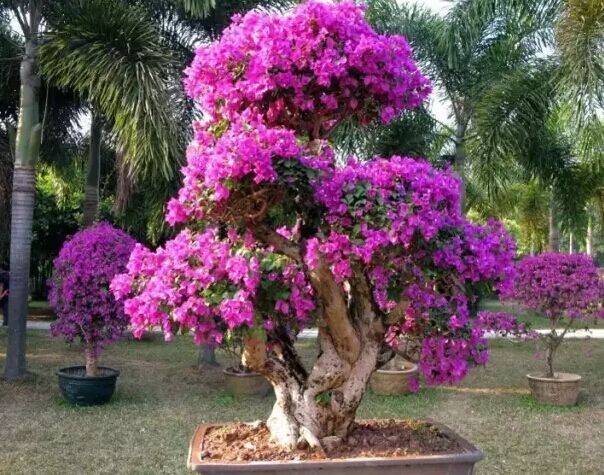
1. Natural beauty
Bonsai uses natural trees and rocks as its main materials, and among these the plants also have the characteristic of life, so natural beauty is an important aspect of the beauty of bonsai.
The natural beauty of trees includes the beauty of the roots, trunk, branches and leaves, flowers and fruit, and the overall posture, as well as the beauty of colour as the seasons change.
Roots:
Some tree roots are slightly exposed above the soil, giving a feeling of solidity; there are also those with raised roots exposed above the soil, with the imposing air of a dragon coiled and a tiger crouching; some have several roots joined together, forming a connected-root style; and some are rooted in stone crevices, carrying the mood of “biting firmly into the green mountain and never letting go.” Thus in bonsai there are artistic forms such as the “raised-root style,” “connected-root style” and “rock-attached style,” in which the roots are the main object of appreciation.
Trunk:
Although the main trunk of a tree has undergone artistic processing, it still possesses natural tree momentum and spirit. For example, a straight trunk is rigid and upright, while a curved trunk is ancient and full of variety, each with its own characteristics. The bark may be old or young, some rough, some smooth; for example, the bark of the black pine is covered with scales, while bamboo plants are smooth and many-jointed, each rich in charm. The colour of the trunk also varies: there is black, greyish brown, yellowish brown, emerald green, purplish black and so on. In addition, some half-withered trunks, contrasted with flourishing branches and leaves, can give a feeling of “a withered tree meeting spring.”
Leaves:
Leaf shape differs with the tree species. There are needle-like, scale-like, ovate, fan-shaped, palm-shaped and melon-seed-shaped leaves, as well as unusually shaped leaves. Leaf texture may be hard or soft, thick or thin, leathery or papery. Leaf colour is even more richly varied: there is dark green, light green, yellow-green, red, variegated edging, variegated leaves and so on.
Flowers and fruit:
The form and colour of flowers are the most changeable. In flowering bonsai, common ones include azalea, broom, pomegranate flower, plum blossom and so on, truly in a thousand postures and a hundred attitudes. Fruit-bearing bonsai also come in many forms, such as firethorn fruit, tungfei fruit, Elaeagnus fruit and Buddha's hand fruit. The colour of the fruit is also very rich: there is golden yellow, red, purplish red, yellow-green and so on.
2. Overall beauty
The form and colour of each part of a tree bonsai - roots, trunk, branches and leaves, flowers and fruit - are organically combined to form the overall beauty of the tree scene.
(1) The beauty of seasonal change. The form and colour of bonsai plants change with the four seasons. For example, in spring new buds spit out green, in summer branches are luxuriant and leaves abundant, in autumn fruit hangs heavy, and in winter branches and trunk are rugged and vigorous. As the tree ages, it gradually reveals an ancient posture. Watching the growth process of trees and their changes through the four seasons is full of great interest for appreciation.
(2) The natural beauty of rocks. The natural beauty of rocks mainly refers to their texture, shape and colour.
Texture: Rocks can be divided into hard and soft types. For example, Yingde stone and petrified wood are hard in texture, while sandy accumulation stone, sea-mother stone and pumice are loose in texture, and the landscape scenes they express differ from one another.
Shape: The natural shapes of rocks include outer form and texture lines. As for outer form: there are peak-shaped ones, such as axe-cut stone; layered ones, such as thousand-layer stone; rounded ones, such as cobblestone; and jagged ones, such as Yingde stone. As for texture lines, there is axe-cut texture, such as axe-cut stone; tangled-firewood texture, such as reed-pipe stone; folded-belt texture, such as thousand-layer stone; and there are also those with interlaced texture lines, such as Yingde stone.
Colour: Stone bamboo shoot stone is mostly bluish grey, petrified wood is mostly yellowish brown, axe-cut stone is mostly dark grey, and Xuan stone is mostly pure white. In bonsai expression, each has its strengths. For example, stone bamboo shoot stone is used to express spring mountains, and Xuan stone to express winter mountains, both being fairly suitable.
3. Picturesque beauty
Although the modelling of Chinese bonsai draws on natural landscapes and trees, it does not mechanically imitate each specific blade of grass, tree, mountain or stream; rather, it highly summarises and distils the scenery of nature's mountains, waters and trees, and carries out artistic processing, turning them into a varied yet unified layout with primary and secondary elements, foils, gathering and scattering, density and sparseness, contrast and echo, striving to reach an artistic realm that condenses the scenery of nature. The beauty produced after such natural scenery has undergone artistic processing is picturesque beauty.
Picturesque beauty is an important aspect of the beauty of bonsai; usually, judging whether the modelling art of a bonsai is good or bad takes picturesque beauty as one of the criteria. The picturesque beauty of bonsai can be expressed through different modelling styles. Chinese bonsai has many varied modelling styles and stylistic schools. Mastering this aesthetic knowledge helps one appreciate the picturesque beauty of bonsai.
To express picturesque beauty, various artistic techniques must be used, such as distinguishing primary from secondary, appropriate density and sparseness, mutual generation of the substantial and the insubstantial, mutual use of the skilful and the clumsy, seeing the extraordinary in the ordinary, and hiding within the revealed, and so on. It must also be realised through certain technical methods, such as the cultivation and pruning of trees, training and shaping, and the carving, layout and joining of rocks, and so on. Therefore, in order to further understand the picturesque beauty of bonsai, it is best to have some understanding of the relevant artistic and technical methods.
4. Beauty of artistic conception
As a work of art, bonsai must not only possess picturesque beauty but also express a profound artistic conception, that is, it must enable people, while appreciating it, not only to see the scene but also to be inspired by the scene to beautiful feelings, beautiful aspirations and beautiful ideals, thereby producing rich associations and receiving feelings beyond the scene, reaching a state where the scene ends but the meaning is endless.
The beauty of artistic conception has a very strong power to move people. It makes bonsai works thought-provoking and endowed with a charm that never grows tiresome however often they are viewed. Because the creator of a bonsai has already melted his or her feelings into the constructed scene during the creative process, when the viewer enters this realm of beautiful feelings, aspirations and ideals, he or she can achieve a resonance of thought and feeling with the bonsai's creator.
Artistic conception is the highest realm of bonsai art. It is built on the foundation of picturesque beauty, and the two permeate each other and are hard to separate. Artistic conception is sometimes also expressed with the help of inscriptions and poems on the bonsai, so appreciating bonsai also requires a certain literary cultivation.
In the creation of bonsai, the hardest thing to express is the beauty of artistic conception, and in the appreciation of bonsai, what most requires aesthetic level is also the beauty of artistic conception. Take a pine bonsai as an example: when we see its new leaves and old trunk, we are only appreciating its natural beauty. But when we see its upright trunk and rugged branches and leaves, we then appreciate its picturesque beauty. That is, from the pine's rugged and upright posture we associate its character of “fearing no storm and remaining unyielding,” and are thereby spiritually encouraged - only then have we appreciated its beauty of artistic conception. In particular, water-and-land bonsai are rich in content and varied in scenery, and can better embody the beauty of artistic conception with its poetic and painterly quality. Associations produced in response to bonsai works vary from person to person and carry some subjective element, being determined by factors such as the viewer's level of thought, artistic cultivation and life experience. The depth of a bonsai's artistic conception does not depend entirely on the number of scenery elements or the size of the scene. Sometimes, in a bonsai with very simple scenery and a very small scene, a profound artistic conception can also be expressed. For example, a water-and-land bonsai with several clumps of Acorus growing on sandy accumulation stone, placed in a water basin and further dotted with a few small duck ornaments, can make the viewer associate the famous line “when the spring river warms, the ducks are the first to know,” thus letting people feel the arrival of spring and a rich flavour of life.