What artistic principles should be followed in bonsai creation
In the process of making bonsai, certain artistic principles should be followed. Only in this way can bonsai possess endless artistic charm.
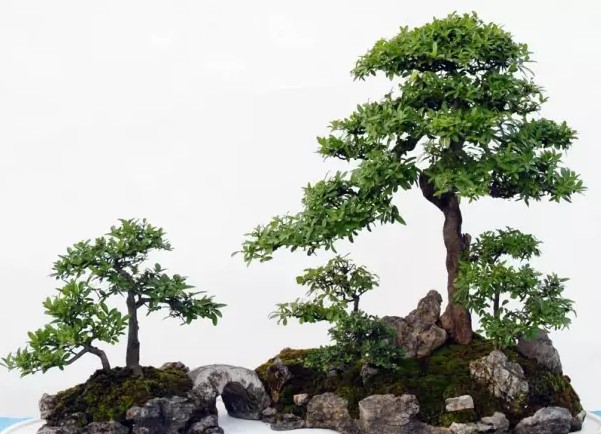
1. Learn from nature, treat materials according to their properties
Bonsai expresses scenes of the natural world, so it must conform to nature and follow natural laws. Moreover, the materials used in bonsai, such as plants, mountains, stones, water, soil, etc., should all have certain natural forms and colors. Plants in particular also possess the characteristics of life. Therefore, when making bonsai, different materials should be treated according to their different properties. For example, pines and cypresses (Pinus and Cupressus) are suitable for expressing a style of antique ruggedness; if they are used to express a graceful and charming demeanor, it will fail.
2. Clear distinction between primary and secondary
In any work of art, the parts cannot be equal to one another. There must be a primary and a secondary. When creating bonsai, certain means must be adopted to highlight the main subject in order to enhance its appeal.
To highlight the main subject, one must first determine the main subject's volume, position and shape, and then consider how the accompanying elements should be arranged. Only in this way can overall harmony and unity be better achieved. In addition, the position of the main subject is also very important. Generally speaking, the main subject should not be placed in the exact center of the pot, nor at the edge of the pot, but should be slightly biased to one side, placed at the visual center of gravity.
The main subject can also be highlighted through contrasts in volume, color, texture and other aspects. For example, a small tree that is not very tall can be made to appear tall by placing a small horse as an accessory. In terms of color, using a color with higher purity and greater brightness for the main subject, and a slightly grayer color for the accessory to set off the main subject, can play a supporting role for the main subject. In addition, the principles of perspective, such as near objects appearing large and far objects appearing small, and near objects appearing clear and far objects appearing blurry, can also be used to highlight the main subject.
3. Mutual generation of the void and the solid, appropriate density
In bonsai creation, the void and the solid are a pair of contradictions that are both opposed and unified. The solid gives people something to rely on; the void gives people imagination. The void and the solid are very commonly applied in bonsai. For example, in landscape bonsai, mountains are solid and water is void. Through the combination of mountains and water, such as changes in the water bank line, the goal of mutual generation of the void and the solid is achieved. As for the mountain stones themselves, the mountain is a solid body. To make it more void, we carve caves in the mountain to lead in waterfalls and plant trees. As for the water body, water is a void body. To make it more solid, small stones or boats and rafts can be placed in the water.
In bonsai creation, the combination of the void and the solid also means that the various elements of the bonsai cannot be distributed evenly. They must be arranged with rhythm and cadence. Changes in sparsity and density are used to express the void and the solid.
4. Mutual gazing and response
In bonsai, each element, such as trees, mountain stones, water surfaces and dry land, whether primary or secondary, void or solid, gathered or scattered, does not exist in isolation. Therefore, when creating, each component must have a certain response to the others, making them an organic whole. Mutual gazing and response are embodied in many aspects of bonsai. For example, in the direction of the dynamic tendency of the scenery, and in all aspects such as type, form, line, color, texture, void and solid, sparsity and density, and lightness and heaviness, an overall sense of unity through mutual gazing and response must be achieved. For example, when making landscape bonsai, if the main peak is mainly composed of rigid straight lines, then the accompanying peaks should also have rigid straight lines responding to it. Another example is that if a certain color is dominant in the main scenery, then that color is also needed in the accompanying scenery, so that an overall sense of unity can be achieved.
5. Concealment within exposure
The ancients said, “The more the scenery is concealed, the greater the realm; the more the scenery is exposed, the smaller the realm.” Therefore, in bonsai creation, appropriately concealing a part can express a very large realm within a very small range, and can arouse people's endless imagination, so as to achieve the deeper meaning of creation. For landscape bonsai, concealment within exposure means making the peaks obscure one another, so as to enrich the layers and increase the depth of the scene. If one wants to express the deep seclusion of woods, then attention should be paid to the interlacing and obscuring of tree trunks front and back, with both exposure and concealment. Having both exposure and concealment is an important technique for expressing the artistic conception of bonsai, and attention should be paid to its application.
6. Mutual use of the ingenious and the clumsy
The ingenious means cleverness; the clumsy refers to simplicity and unadorned clumsiness, elegant clumsiness. Both the ingenious and the clumsy can give people a sense of beauty. In tree bonsai, the more ancient and clumsy the tree's posture, the more it can give people a sense of beauty. For example, plum blossom (Prunus mume): the flowers themselves are nimble and elegant, so the main trunk must be rugged and antique in order to embody its rich charm. In landscape bonsai, if the mountain is majestic and deep, then the trees on the mountain must be exquisite, forming a contrast with the antique clumsiness of the mountain.
7. The “three distances” method
The “three distances” method is a basic theory of Chinese painting art. According to the height of a person's viewpoint, it can be divided into looking up for high distance, looking down for deep distance, and looking level for flat distance. In bonsai making, one should strive to express the “three distances.”
The high-distance method can express the towering and upright momentum of the main peak. When creating a high-distance landscape bonsai, the main peak should be high and steep, and its position should be toward the back, gradually becoming smaller from bottom to top. The accompanying peaks are in front of or to the left and right of the main peak, and should be low in front and high in back, uneven in height. The texture strokes of the mountain stones should be relatively clear, and the water surface should be relatively small.
The deep-distance method is used to express the beautiful scenery of overlapping peaks and repeated mountains and waters. Generally, near mountains and far mountains must be combined in an interlaced way, so the relationship between “exposure” and “concealment” must be handled well, giving the entire bonsai a sense of deep seclusion. Generally, the texture strokes of near mountains should be clear, while the texture strokes of far mountains gradually become plain, and the size of the water surface should be moderate.
The flat-distance method expresses a typical water-town atmosphere, pursuing a realm that is sometimes bright and sometimes dark, vague and ethereal. In flat-distance landscape bonsai, the peaks are usually low and gentle, the mountain forms stretch horizontally and continuously, the texture strokes are plain, the water bank line is winding, the water surface is broad, and there is more blank space.
8. Appropriate proportions
In Chinese painting theory, there is the theory of “a zhang for mountains, a chi for trees, a cun for horses, and a fen for people,” which reflects the proportional relationships among the various scenes in bonsai making. Reasonably handling the proportional relationships among the scenes can express vast scenery within a tiny pot, achieving the effect of seeing the large within the small. For example, using a fist-sized small stone to represent a mountain peak, if the scene is set alone, it appears too short and small; if a figure sculpture the size of a soybean can be placed beside it, then the stone will feel as tall as a mountain, upright and verdant.
9. Emotion lodged in the scenery
Bonsai is an art of expressing emotion through scenery. An excellent bonsai can not only reproduce the beauty of nature, but also arouse emotional resonance in the viewer. Therefore, when making bonsai, every mountain and every water, every tree and every blade of grass should be infused with the author's thoughts and feelings and condense the author's emotions, so that viewers can not only see the scenery in the pot, but also appreciate the emotion within the scenery.