What characteristics should an outstanding bonsai work possess?
The artistic pursuit of Chinese bonsai is elegance and refinement, valuing both form and spirit, with great emphasis on subtle beauty, hazy beauty, and profound artistic conception. It stresses using the concrete scene to set off the virtual scene, combining the virtual and the real; it stresses layers and depth of field, so as to turn the finite into the infinite and the bounded into the unbounded, something that can only be sensed but not put into words, captivating and stirring the imagination, with endless meaning and inexhaustible aftertaste. What characteristics, then, should an outstanding bonsai work possess?
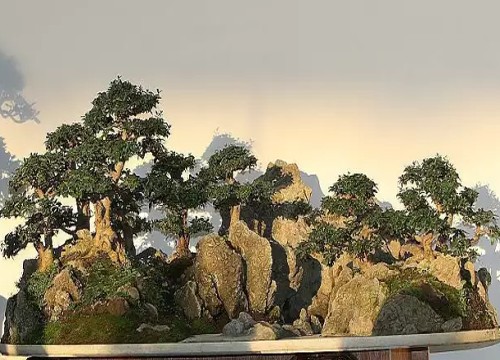
Chinese bonsai has always been known for its poetic and painterly quality, and outstanding works are thought-provoking and give much food for thought. The excellent works at successive bonsai art exhibitions have fully embodied the artistic creation principle of "flexibly applying artistic dialectics, handling well all kinds of contradictions in the modeling of scenery, and achieving both diversity and unity."
Outstanding bonsai works have strong expressive force and can make appropriate use of blank space, using the virtual in place of the real, so that viewers have room for free imagination. The arrangement of scenery in these bonsai can be appropriately spaced, sparse enough for a horse to gallop through, dense enough that not even wind can pass. In terms of rhythm, through changes in the rules of height, undulation, density and opening and closing, a kind of "rhythm" can be expressed, so as to convey people's psychological feelings and enhance the expressive force of the work.
Graceful bonsai works have very strict requirements for the posture of the bonsai, avoiding excessive steadiness and emphasizing the direction of momentum; that is, consciously arranging dynamic momentum so as to achieve "dynamic and static setting each other off," making the work appear vivid and full of momentum.
In outstanding bonsai works, the form or color of the scenery has lightness and heaviness, and at the same time can form an asymmetrical balance; this is "light and heavy balancing each other." The proportions of the scenery in the bonsai must be arranged so that they mutually "look back and echo each other," so that they can be organically combined together.
In the modeling of graceful bonsai, the branches and trunks are sometimes thick and sometimes thin, with fineness seen within thickness, with prominent focus, sharp contrast, and both form and spirit, able to embody "the more the scenery is hidden, the greater the realm; the more the scenery is exposed, the smaller the realm." The scenery in outstanding bonsai works can embody "concealment within exposure," so as to arouse rich associations in viewers, thereby helping to recreate the artistic conception. Bonsai art can be neither too ordinary nor too bizarre. Too ordinary and it lacks interest; too bizarre and it loses naturalness. Only by achieving "the extraordinary within the ordinary" can it be considered first-rate.
Outstanding bonsai works can embody softness within strength and strength within softness, so as to achieve "strength and softness complementing each other." Ingenuity and clumsiness are in a dialectical relationship. In bonsai art, ingenuity is certainly a kind of beauty, but clumsiness is also a kind of beauty; neither can be missing, so one should achieve "ingenuity and clumsiness used together." In nature, withering and flourishing coexist. In bonsai, too, "contrast between withering and flourishing" is often used to symbolize the struggle between life and death, and from this to reveal the vitality of life.
Outstanding bonsai works can express a great realm within a small pot, can adopt the laws of perspective, and achieve near things large and far things small, near things clear and far things blurry. They can also embody a regular scattered-point perspective (that is, the viewpoint can move according to a certain rule), and can express an extremely broad range of scenery. This is especially true of landscape bonsai.
In outstanding bonsai works, the volume and scale of the various scenes will be handled reasonably with "appropriate proportions," which can both accord with natural reason and play a role in contrast and foil, enabling the work to achieve the artistic effect of seeing the great within the small and seeking the far from the near.
In short, outstanding bonsai works can let viewers, through every mountain and every stream, every blade of grass and every tree in the pot, feel the author's thoughts and feelings and aesthetic attainments, thereby enabling viewers to be moved by the scene and to produce infinite associations from limited scenery.