An outstanding bonsai work better reflects the true meaning of life
“A small bridge over flowing water, slanting; deep in the distance, a home. A distant path, the woodcutter returns late; fallen flowers drift unintentionally.” This is the artistic conception of bonsai. Living long in the city, one often hears the roar of cars and sees reinforced concrete before the eyes, yet knows not that a peach blossom spring beyond the world exists. In contemporary times, the appreciation of bonsai does not seem to be as deeply rooted in people's hearts as the tea ceremony or incense ceremony. Yet a beautiful bonsai work better reflects the true meaning of life——“follow the nature of things, accord with the naturalness of things, without contrivance or artifice.”
The art of bonsai has a long history
China has long been known as the “Mother of World Gardens” and is the founding country of the art of bonsai.
“The origin of bonsai is very early in terms of physical objects, roughly 7000 years ago, on the fourth cultural layer of the Hemudu site.” Ao Kun, associate professor at the School of History of Nankai University, said in an interview with reporters, “According to archaeological discoveries, two pieces of pottery are engraved with potted plant patterns. One potted plant has five leaves, but it is not known exactly what kind of plant it is; the other has three leaves. This is an engraved pattern on pottery, not a physical object, but it shows that potted plants had already appeared at that time.”
A Han tomb in Wangdu, Hebei, once unearthed a mural from the Eastern Han period, on which there is a flower pot with 6 branches of red flowers. The flower pot has a rolled rim, basically the same as our flower pots today, and there is a square stand beneath the pot. This shows that by then it had developed from potted plants to ornamental use for cultivating temperament.
There are many works in Song dynasty paintings that reflect potted plants. Ao Kun told reporters that Wang Shipeng's “Record of the Rock Pine” in the Song dynasty contains this record: “A countryman brought a rock pine to Meixi. Of unusual substance and growing in clusters, rooted in a fist-sized stone, luxuriant yet not solitary, dense yet not tall, with cypress leaves and juniper body but pine bearing, hiding the meaning of towering to the sky and covering the earth within a handful, it is also an extraordinary one among plants and trees.”
During the Wanli period of the Ming dynasty, Tu Long's “Remaining Matters of the Examination Studio” had a special section called “Notes on Potted Play”, which was a systematic sorting of potted plants. Coincidentally, the “Treatise on Superfluous Things” by the great connoisseur of the same era, Wen Zhenheng, also had a special chapter——the chapter on literary play—which also discussed bonsai.
The “Occasional Record of Bonsai” from the Jiaqing period of the Qing dynasty is a book specifically about bonsai and was revered by later generations.
Silent poetry, three-dimensional painting
Although bonsai is small, it is a miniature great landscape, a great scene, seeking to reproduce the divine appearance of nature within a small pot. It lodges meaning in hills, valleys, forests, and springs, with unique craftsmanship, expressing people's aspiration toward the spirit of nature. Precisely because of this, bonsai is called “silent poetry, three-dimensional painting.”
Chinese bonsai is mainly divided into several major categories such as tree bonsai, landscape bonsai, tree-and-stone bonsai, and miniature bonsai.
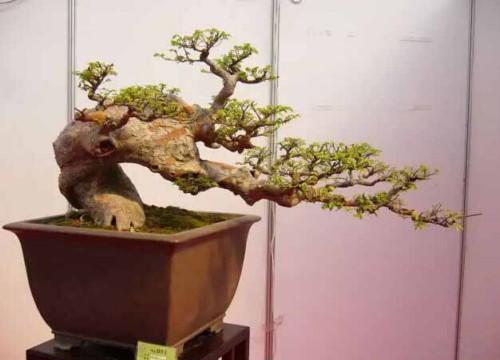
Tree bonsai uses woody plants as the main material. Through artistic processing such as pruning, wiring, and shaping, as well as careful cultivation, it reproduces the plant landscapes of nature.