Four taboos to remember when making and caring for forest-style bonsai
Among bonsai there is a special form of presentation called the forest style. This form of bonsai cleverly combines mountains, stones and trees to fully reveal the beauty of a forest, like a beautiful landscape painting. But in the process of making and caring for forest bonsai, there are "four taboos" to observe.
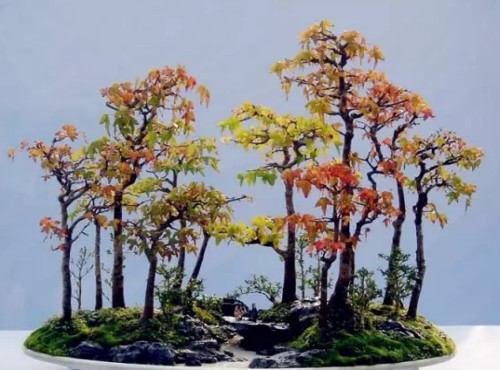
First taboo: one-size-fits-all:
The materials used for forest-style bonsai are generally small-leaved shrubs, such as porcupine's-egg (Damnacanthus indicus), Japanese bush cherry (Sageretia thea), Scotch broom (Caragana), and snowbush (Serissa japonica). When potting these small-leaved tree species, the sizes must be matched appropriately, and variation should be sought. Among the many stumps, it is best not to have similar sizes and similar heights, otherwise the landscape will inevitably be dull, lacking vitality, and certainly without any charming wildness to speak of.
Second taboo: dense with no ventilation:
Several trees in a forest-style bonsai form a forest, and this forest is not like a primeval forest. If it is dense with no ventilation, it will affect the viewing effect. The several stumps should advance and retreat, yield and give way, so that the density of space varies, with compact places where not even a needle can be inserted, and open places where a horse can gallop or a boat can sail. In this way, ups and downs and changes arise in the composition, and only then will the resulting landscape produce artistic charm.
Third taboo: deep pots and large vessels:
Forest-style bonsai should display the wildness of a forest and the scenery of open country, so it is not suitable to choose deep pots and large vessels. If the pot is deep, the trees appear small, and the space displayed is relatively narrow. If the pot is shallow, the trees appear tall, and the space becomes relatively large, giving a more profound visual effect. Moreover, using a shallow pot for planting also allows stones to be placed on the mounded soil slopes, making the base undulate and the picture more vivid and lively.
Fourth taboo: no pruning:
Forest-style stump bonsai often arrange several trees into one scene, and besides their own unique shapes, these trees also have a harmonious relationship with one another, thus forming a complete composition. In addition, most of these small-leaved shrubs are fast-growing species with strong sprouting ability. If they are not pruned for a long time, branches often grow wildly and become tangled, and trimming them later requires considerable effort. Therefore, only by paying attention to pruning at all times can their ornamental value be guaranteed.