How to create bonsai with a profound artistic conception
Bonsai, like poetry, painting and garden art, originates from nature and from life; they simply take different forms of expression. They interpenetrate and learn from one another. Poetry and painting often draw their subjects from gardens and bonsai, while the creation of gardens and bonsai emphasizes being rich in poetic and pictorial charm. Therefore, the conception and the layout and shaping of bonsai are invariably influenced and inspired by poetry and painting, and many outstanding bonsai works were created by absorbing the expressive techniques of painting.
But bonsai differs from poetry, painting and gardens in that it is subject to many objective limitations. Poetry uses the form of words to express people's feelings, describe things and praise the beautiful rivers and mountains of the motherland; it is not limited by space. Painting can use the edge and corner of the picture to sketch half a peak, suggesting ranges of mountains stretching on, whereas bonsai has no edge or corner to rely on and can only be made into a complete peak, so it is limited by space. Although gardens are also limited by actual space, the space available to them is far greater than that of bonsai. The art of bonsai uses the pot as paper and plants, rocks and stones to paint a three-dimensional picture, using the expressive techniques of bonsai art to condense the vast world into a small pot.
The art of bonsai has many schools and diverse styles, and there are also some differences in shaping and layout. But "all changes remain within the same fundamentals": although their forms and styles differ, they all follow certain common laws and basic principles. As long as you master these laws and principles and then apply them correctly in combination with your own artistic talent, you will be able to do things with ease in bonsai artistic creation, "one method, ten thousand forms".
Bonsai shaping has the following basic principles; they are interrelated yet relatively independent, so only by combining them organically and applying them flexibly in creative practice can you achieve an ideal shape and make your bonsai creation a success.
Conception precedes the brush. Conception means the idea; before putting pen to paper in writing an article, one first decides what to write and how to write it. The conception of bonsai creation, that is, the theme of the bonsai, is what one wants to express and how to express it. Whether a bonsai work succeeds is directly related to the quality of its conception. With a vulgar conception, one certainly cannot create a bonsai of novel shape and poetic and pictorial charm. Fang Xun, a poet and painter of the Qianlong period of the Qing Dynasty, said in "On Painting from the Mountain Quiet Dwelling": "In painting, one must first conceive the idea in order to fix the positions; if the idea is extraordinary, it will be extraordinary; if the idea is lofty, it will be lofty; if the idea is far-reaching, it will be far-reaching; if the idea is deep, it will be deep; if the idea is deviant, it will be deviant; if the idea is commonplace, it will be commonplace; if the idea is vulgar, it will be vulgar." This makes very good sense.
Some people confuse the conception of bonsai with its artistic conception, but in fact these are two different concepts. In general terms, the conception is the theme the bonsai is meant to express, while the artistic conception of a bonsai refers to an artistic realm produced when the scene and the feeling of a bonsai artwork blend together and communicate with the viewer's emotions and knowledge. It is not the concrete outward form of the bonsai. The artistic conception of a bonsai is like the ideological content of a literary work, but it is not as obvious as that of a literary work; it is inner and implicit, and the viewer must use their own knowledge to think and associate in order to appreciate its beauty.
For example, when people see a five-needle pine bonsai with a short, thick trunk and luxuriant branches and leaves named "Aspiration Does Not Depend on Age", it makes them think of how, in the long river of human history, many spirited young people have achieved moving and heroic deeds for their country and nation, thereby arousing in people the lofty ambition to devote themselves to the motherland and revitalize China. This kind of association and imagination, in which scene and feeling blend, is the artistic conception.
The conception of bonsai generally arises in two ways. One is that the author's feelings are stirred by the outside world, or inspired by some thing, giving rise to the motive for creation.
For example, when you tour Mount Huangshan and see the world-famous pines in all their myriad forms, such as the Guest-Greeting Pine and the Hanging Pine, their tenacious vitality moves you deeply, and so you want to reproduce the wonderful natural scenery in the form of a bonsai; this gives rise to the desire to create, and on the basis of this desire you form your conception and then select materials for creation. The other situation is "seeing the tree and feelings arise", or "seeing the object and the idea arises". For example, when you dig up a good tree stump, or when relatives or friends give you a tree material, your experience in bonsai creation keeps you from hastily taking up the shears; instead you look at it from left and right, size it up from top to bottom, and weigh it repeatedly, and when the tree before your eyes and the image stored in your mind, that is, the shape of the tree, combine, the design is complete and the conception has arisen. The former can be called "selecting material according to the idea", while the latter is "forming the idea according to the material". Formal styles are mostly "selecting material according to the idea", while natural styles are mostly "forming the idea according to the material".
One is that after touring famous mountains and great rivers, scenic spots and historic sites within the country, you are deeply moved by the magnificent scenery of the motherland's beautiful rivers and mountains and develop a desire to create, wanting to reproduce the natural scenery you saw, or you are inspired to create after seeing something that left a deep impression, and then choose appropriate materials to make a bonsai to express your feelings.
Bonsai can beautify the environment and give people enjoyment of beauty. So what exactly is beauty? Generally speaking, something truly beautiful must, on the one hand, accord with nature and, on the other hand, be consistent with the ideal; neither can be lacking. The reason bonsai becomes a wonderful work of art is that it can combine natural beauty and artistic beauty into one. Therefore, to understand the beauty of natural flowers and trees and of landscape, one should first learn from nature.
Famous poets and painters certainly have many factors behind their success, but they share one common characteristic: they go deep into reality, experience life, and master a great deal of first-hand material.
A bonsai work, from conception to creation, is not produced by imagining things out of thin air and working behind closed doors; it is the comprehensive product of the author's life practice, artistic cultivation, literary level and production skills. Therefore, bonsai creators are required to "travel ten thousand miles", to go into life to observe and experience, to understand nature, and to discover the beauty that exists in the natural world. As Comrade Mao Zedong pointed out in "Talks at the Yan'an Forum on Literature and Art": "In the life of the people there exist in abundance the raw materials of literature and art... they are the only source of all literature and art, inexhaustible and never used up."
Bonsai creators should also draw nourishment from painting, literature, sculpture, horticulture and poetry, and learn from the strengths of others' bonsai works. As a bonsai creator, one needs both rich life practice and extensive theoretical knowledge. One should accumulate much and release little, have a fully formed plan in mind, "store" a large number of tree forms in the mind, hold within one's breast ten thousand miles of rivers and mountains, famous mountains and great rivers, scenic spots and historic sites, and the magnificent scenes of nature, and only then proceed to conception, design, composition and creation. As long as one can do this, bonsai works with novel conceptions and both spirit and form will stand out from your hands.
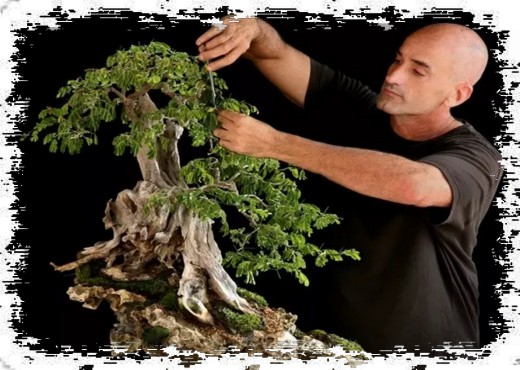
In the process of bonsai creation, attention should be paid to bringing out the strengths of the bonsai material and avoiding its weaknesses. Generally speaking, the tree material used to make bonsai is full of branches and leaves. After seeing the material, an experienced bonsai creator generally will not immediately start pruning; instead, they first find the strengths of the material and form a design, and when a suitable bonsai shape pattern has been thought through, they then start sawing, pruning and wiring. Make full use of the beautiful natural shape already present in the bonsai material, and at the same time remove the defective or superfluous parts; if they cannot be removed, then take the beautiful and pleasing part as the viewing side and place the defective or less attractive part at the back. Conceive and shape the bonsai material in this way to achieve the goal of fostering strengths and avoiding weaknesses.
When doing final shaping and pruning of a tree bonsai, some cut away most of the branches and trunk, leaving only a relatively short section of trunk and 3 to 5 branches; this is the concrete application of "seeking simplicity within complexity" in the shaping of tree bonsai.
The simplicity spoken of in "seeking simplicity within complexity" is not the goal but the means. This is not simplification, nor is simpler always better; rather, it is using the few to overcome the many, using simplicity to overcome complexity. For example, in landscape bonsai, making the accompanying peaks appropriately simple can instead set off the main peak. When making bonsai, one should handle things flexibly according to the specific situation: simplify when it should be simple, elaborate when it should be elaborate.
Nothing in the universe exists in isolation; all things are interconnected. As for large and small, only by comparing the two can their size become apparent, that is, without the large the small cannot be shown, and without the small the large cannot be shown. Seeing the large in the small: the small is the means, not the goal; the small is the form, the large is the content, expressing the grandeur of the subject through the small object. This is so not only for bonsai; painting, photography, sculpture and other arts also all use the artistic technique of seeing the large in the small in creation. The ancients said, "With a picture of a foot, depict scenery of a thousand miles", which means using a small picture to express the majesty and grandeur of nature, achieving in artistic creation the effect of "a thousand miles" through "a foot". In tree bonsai, one can often see shapes with one tall and one short, one large and one small, one straight and one slanting. Generally speaking, the tall, large and straight tree is the subject and the short, small and slanting tree is the object; the two differ not only in stature but also in temperament, shape and so on, and the purpose is "using the subordinate to set off the principal". The object is a foil; in order to highlight the subject, attention should be paid to making "the guest not overpower the host" and to "the guest following the host".
The small in bonsai art is not truly small, but "seeing the large in the small"; what is called large is not simply large, but containing the large within the small. A few small trees, planted in a rectangular pot in orderly but uneven heights, seen from a distance look like a whole forest appearing before your eyes. This is where the charm of the bonsai art of "seeing the large in the small" lies.