Detailed Explanation of the Principal and Subordinate Relationship in Bonsai Creation
Principal and subordinate, also called “primary and secondary”, “main feature (guest)”, “partial and complete”, etc., is one of the important principles of formal beauty. In any work of art, the relationships among the parts cannot be equal; there must inevitably be a distinction between principal and subordinate.
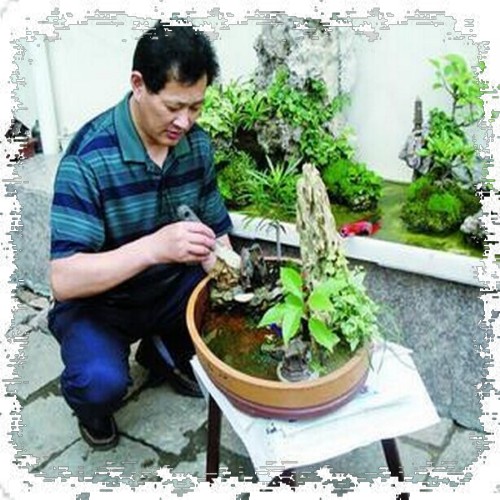
In bonsai creation, the subject and the object must also be emphasized, so the guest and host must be clearly distinguished and arranged with pleasing variation. For example, in a landscape bonsai, how should the guest-host relationship be handled? The main mountain and the surrounding mountains should be like the relationship between grandfather and grandchildren, or father and sons: the main mountain is the ancestral mountain, dignified and majestic, looking about with affection, while the surrounding mountains are like descendants, respectful and obedient, not acting each in their own way. The main mountain and the guest mountains should differ considerably in height and volume, so as to achieve the effect of many stars surrounding the moon.
Which scenery should serve as the subject?
Mountains, water, trees and rocks can all serve as the subject. For example, Su Dongpo's “Double Rocks” and Lu You's “Old Study Hut: On the Completion of the Artificial Rockery, Rain Fell Without Stopping for a Whole Month” and other bonsai all take mountains as the subject; “Sailing Among Ten Thousand Mountains” and “Only the Long River Flows to the Horizon” take water as the subject. In the stump bonsai of Lingnan bonsai or Guangxi bonsai, the double-trunk or multi-trunk styles have a distinction between host and guest, while other forms such as the cascade style have the tree as host and the stone in the soil as guest; conversely, if it is a landscape bonsai, then the rock is the host and the trees growing among the rocks are the guests; as for the formal upright stump style, the tree is the host and the accompanying elements are the guests.
Forest-style bonsai also takes trees as the subject; the stones in the pot may symbolize mountain ridges by design, or may serve as strange rocks (strange rocks can also be the subject). When expressing a forest scene, several trees form a clump, and likewise must be arranged with pleasing variation and a clear distinction between guest and host. For example, in a clump of three trees, the first tree is the host tree, and the second and third trees are guest trees.
What is a host tree? Shen Shuyang wrote in A New Discussion of the Grammar of Chinese Painting: “The one whose root is at the lower part is the host tree? The host is the near tree. If the host tree leans, the guest tree is upright; if the host tree is upright, then the guest tree may not lean in the opposite direction……The host tree mostly leans, so as to yield to the uprightness of the guest tree.” In shaping the host tree of a bonsai, not only should its posture be taller than the guest trees, but its height and form should also surpass those of the guest trees, so that the main scene stands out. As for the isolated-peak style landscape bonsai, it seems that only the subject appears and there is no guest. But in terms of its internal structure, there is still a distinction between principal and subordinate, such as the difference between the trunk and the side branches of a tree. Therefore, the guest elements in these works can still be felt and filled in through the viewer's imagination.