What are the design techniques for bonsai creation?
Some say that the aesthetic characteristics of Chinese bonsai art lie in "seeking elegance and rising above the commonplace," in emphasizing subtlety and artistic conception, in using the substantial to set off the insubstantial and combining the two, and in emphasizing layers and depth of scene, so as to achieve "turning the finite into the infinite" and "turning the bounded into the unbounded," captivating the viewer, inspiring endless reverie, and leaving an inexhaustible aftertaste. But to sum it up more concisely, the aesthetic characteristics of Chinese bonsai art are, first, seeing the great in the small, that is, famous mountains and great rivers or ancient trees and rare flowers are all gathered into a single pot, using superb artistic technique to evoke nature; second, maintaining their vitality, infusing them with a vivid sense of life.
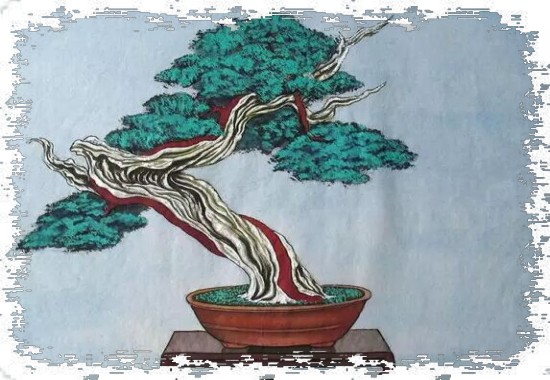
Bonsai is by no means a reduced-scale model of nature, whether it is landscape bonsai, tree-stump bonsai, or flowering plants. In landscape bonsai, a tiny pot can present the wonder of Huangshan, the grandeur of Taishan, the peril of Huashan, and the beauty of Emei, but it is by no means a model of them; rather, through these stones, water, trees and the like, one is led to comprehend their respective characteristics. The same is true of tree-stump bonsai: whether ancient pines and strange cypresses, plum stumps or banyan trees, they can all display a dignified and flowing posture in a small bonsai.
Bonsai should be alive and growing. This is Chinese culture: the so-called taking from nature and following nature, not cutting real flowers and inserting them in a vase, but a living potted flower or tree. In ancient times, potted plants were also given as gifts, as in the play "Yan Lanzhen," where orchids were given. Today flower arranging is popular; flower arrangements are certainly gorgeous, but they do not last long, and once the flowers fade they are discarded, unlike bonsai, which can be preserved for a long time, with deep feeling and sincerity.
Bonsai and gardens have many similarities in technique. Studying bonsai is very beneficial for improving garden techniques and cultivation; in addition, bonsai is also contained within gardens, and whether in garden architecture or outdoors, bonsai is often used as embellishment.
Bonsai design techniques
1. Theme and conception
Bonsai must establish a theme. Landscape bonsai should create artistic conceptions such as the strange, the perilous, the grand, and the beautiful; tree-stump bonsai should create artistic conceptions such as the ancient, the elegant, and the beautiful. How are these themes completed? Generally speaking, it lies in summarizing the concrete "object" into a single word, namely strange, perilous, elegant, beautiful, ancient, and so on. If landscape bonsai is to achieve "strangeness," one must begin with the selection of stones (shape and stone quality), but "strangeness" cannot depart from "mountain," and it must not fail to resemble a mountain; this requires bonsai artistic cultivation. How to improve cultivation? As Shi Tao said: "Search out all strange peaks to make drafts." There must be hills and valleys in the mind, but one must also practice more, observe more, and create more; when the effort is sufficient, success comes naturally.
2. Natural and appropriate
If tree-stump bonsai pursues the bizarre, even twisting tree stumps so that they violate the laws of growth, then it is inevitably cruel; not only is it not beautiful, it is also unkind. How can tree-stump bonsai be made bizarre yet still aesthetically pleasing? Besides learning the rules of plastic beauty (such as change and unity, balance and proportion, rhythm and cadence, etc.), one must also observe ancient trees and old branches more; over thousands of years, having endured wind and frost and struggled tenaciously, they possess such postures, the so-called uneven and serpentine knots, crooked and coiled like a dragon, inspiring endless imagination and inexhaustible aftertaste. If we speak in terms of the aesthetic principle of comparison and association, this is also a kind of beauty of struggle against fate, or the beauty of tragedy. Beethoven's "Symphony of Fate" has the same aesthetic artistic conception as a bonsai with a sense of strong vitality. Being natural and appropriate carries a profound meaning of proud detachment and lofty whistling.
3. Change and unity
Every art has the principle of change and unity. For example, in the architecture of Jiangnan gardens, there is much change: there are halls, chambers, towers, studios, studies, verandas, pavilions, terraces, galleries, and waterside pavilions, and in form there are also overhanging gables, flush gables, gable-and-hip roofs, hip roofs, and pyramidal roofs; but they are also unified: unified in construction, unified in detail treatment, unified in material and tone. In short, harmonious and appropriate, with beauty within. The change and unity in bonsai lies in a single bonsai: stones vary in shape but are unified in texture; tree-stump bonsai is of course a single tree stump, so it seems there is no unity to speak of, but when making it one must also pay attention to its branching, bending tendency, removal or retention, and its high and low scattering, large and small density, and so on; all of these should have a unified style. Whether it is Japanese bush cherry, five-needle pine, plum stump, or various fruit trees, all should combine their forms through change and unity.
4. Primary and secondary, and balance
A scene values having a main focus, and the same is true of bonsai. Landscape bonsai often has one main peak, then adds two or three peaks as foil. Foil, as the name implies, is secondary rather than primary, so it should be small and low. Moreover, it should not be too centered; it is best to offset it slightly, and the spaces on the left and right sides are best in the golden ratio, that is, one side is 1 and the other side is 0.618. In such a main scene, the foil on the side with more should be a little farther from the main peak, while the foil on the side with less should be closer to the main peak, achieving balance and being more vivid. Stones should also be noted for directionality; the direction should be centripetal, that is, toward the center of the pot. How is the directionality of a stone determined? This is a kind of personification; generally speaking, its "face" is its direction. Tree-stump bonsai can also use this technique. But ordinary tree-stump bonsai is not achieved in one go; rather, it must undergo months or even years of work to achieve the effect. Of course, there are many skills involved, which will not be elaborated here.
5. The concept of "plant-pot-stand"
The so-called "plant" is the tree stump or flowering plant itself, "pot" is the flower pot, and "stand" is the rack or table on which the flower pot is placed. The concept of "plant-pot-stand" is the concept of unity. How to unify? It is not sameness of form or material, but unity of style. Style is abstract, but it can be felt. For water-and-stone bonsai, a marble water tray placed on an appropriate mahogany stand feels very unified and elegant; a round purple-clay pot planted with five-needle pine and placed on a tall mahogany stand also feels antique and unified; a blue-and-white porcelain pot planted with Jianlan orchid and placed on a bamboo stand also feels extraordinarily delicate, and so on, too numerous to mention. The pot may be ceramic, purple clay, or even an earthen pot; what matters is not whether the price is high or low, but whether it is appropriate. The same is true of the stands. If there is a suitable stone and the pot is placed on it, it also has a distinctive flavor; this depends on one's artistic cultivation.
6. The relationship between bonsai and gardens
First, bonsai techniques are relatively easy to comprehend and are connected with garden techniques. If bonsai techniques are compared with garden techniques, then garden techniques are easier to understand and grasp. Second, bonsai is a very important small feature in gardens. An elegant garden must also have bonsai as embellishment. In famous Jiangnan gardens, one can always see various bonsai. How to place bonsai is very particular. Generally speaking, bonsai in gardens is mostly placed in courtyards, making them more refined and pleasant to look at, and it often has a unified style with the courtyard. For example, if there is a bamboo grove in the garden, then some plum stumps, five-needle pines, or black pines and the like are placed, giving the environment the scholarly temperament of the "Three Friends of Winter" (namely pine, bamboo, and plum). It must also be pointed out that bonsai cannot be placed in too many numbers. If dozens of identical bonsai are placed together, this is not art but a market selling bonsai, with all elegance lost! One should know that bonsai is silent poetry, and only with a certain literary and artistic cultivation can one grasp it.