An Analysis of the Complexity of Four-Dimensional Space in Penjing Artistic Creation
People know that penjing is a three-dimensional spatial art with length, width, height and depth, and it is praised as a “three-dimensional painting”. In penjing artistic creation, mastering only the three-dimensional space of “solid” is not enough, because any object (a single tree or a single stone) is a three-dimensional space.
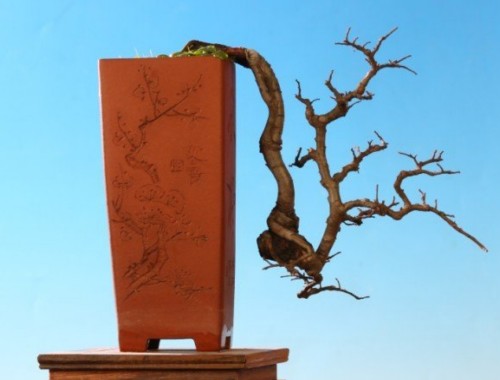
Planting a tree or placing a stone at any point in a penjing container can form a three-dimensional scene, such as ancient-trunk penjing and small and miniature landscape penjing, which use the static focal-point perspective method with a fixed time and a fixed viewpoint to create scenery, that is, viewing and creating through one fixed viewpoint. With the development of penjing art to this day, the method of dynamic scattered-point perspective has appeared, creating dynamic penjing landscapes similar to the horizontal scrolls, handscrolls, hanging scrolls in Chinese painting and the widescreen style in film.
This kind of dynamic landscape pursues the expressive requirements of “a single scroll encompassing ten thousand ravines, a few feet conveying a force of a thousand li” and “a scene within a foot, unfolding the momentum of a thousand hundred li”, and is mostly expressed in giant, large or medium landscape penjing and forest-style tree penjing. This new dimensional space produced by the displacement of the viewing angle of such penjing continuing over time is called “four-dimensional space”, generally a concept of transcending time and space.
The application of four-dimensional space in penjing can achieve what the Song Dynasty painter Guo Xi discussed in “Lin Quan Gao Zhi”: “In the world's discussions of painting, it is said that landscapes may be walkable, may be viewable, may be wanderable, and may be livable; when a painting reaches this, it is all a wondrous work”.
Therefore, a good penjing work is required to look good from every side, or to change scenery with each step, and its creation of four-dimensional space appears especially complex.