How to Achieve the Contrast of Movement and Stillness and a Proper Balance in Penjing Creation
The so-called sense of movement means giving spirit to form, with emphasis on liveliness and the issue of movement and balance. When creating penjing, one must pay attention to movement and balance, for only then can the inner force of the scene be brought out. Of course, this force is infused with the author's thoughts, feelings, ideals and aspirations. If the sense of movement is neglected, the whole composition becomes a tray of dead things, with no charm to speak of. People sit, lie, walk and stand; mountains lean, tilt and slant; peaks, ridges, trees and rocks all have their own bearing and spirit.
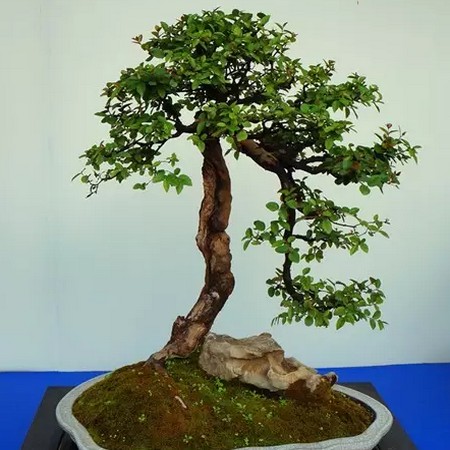
Tang Dai of the Qing Dynasty wrote in Huishi Fawei (Subtle Points in Painting): "Ridges have a smooth and level tendency, peaks have a steep and rugged tendency, rounded peaks have a full and rounded tendency, cliffs have a dangerous tendency, distant ridges and far-off peaks have a layered and stacked tendency, rocks have an angular tendency, trees have a rearing tendency (read as the rising tone of ning, meaning to raise the head) - every blade of grass and every tree has a tendency that resides within it..." Therefore movement and stillness are two states that are both opposed and unified, existing in every aspect of the natural world. For example, a mountain is fundamentally still, but when water flows it reveals movement; a tree is fundamentally still, but when the wind blows it reveals movement.
As for figures, birds and beasts, boats and carts, all of these likewise have movement and stillness. Although some scenes are temporarily in a state of stillness, they nonetheless possess a kind of sense of movement, or can evoke in the viewer an association of movement.
For example, when making a wind-swept style tree-stump penjing, if the main trunk and branch claws are slanted over to one side with the wind, and among them a single broken-arm remnant branch goes against the direction, battling the long wind, then the impression of indestructibility it gives is extremely strong. This is where the sense of movement is applied appropriately. Generally the following methods of arranging the sense of movement are commonly used:
1. Place the main subject on the natural center of gravity, avoiding placement at the geometric center;
2. Shape the tree into leaning, tilted and slanting forms, with postures of bowing, raising, hanging and drooping;
3. Create the shape with a running composition, so that its form resembles a curling, fist-like, dancing posture;
4. Add birds, beasts, figures, boats, bridges, pavilions and terraces as embellishment, seeking movement within stillness;
5. Use personification and metaphor to bring dead things to life, such as Elephant Trunk Hill and Camel Hill in the natural world.
In general, when considering the layout of the sense of movement, the principle of one opening and one gathering should be used. The force of opening extends outward, shaped like radiation, giving people a feeling of movement and of a picture beyond the picture; the force of gathering draws inward, with compact form and layers, giving people a feeling of depth, stillness and a picture within the picture. Therefore the arrangement of the sense of movement ultimately cannot be separated from opening and gathering, gathering and scattering. As for works of the gathering tendency, these are very few. In addition, when setting the sense of movement, one must also pay attention to balance. Seeking only the sense of movement, so that it becomes delicate and contrived, instead gives people a feeling of unnaturalness and instability. One must be able to "reach the extreme of danger and steepness, yet return to level and uprightness." When considering movement and balance, one must take into account various factors such as height, volume and mass. If only one of these factors is considered, the composition must become rigid and stiff, lacking variation. For example, two trees one chi tall, or two rocks one chi tall, though they achieve balance, make the composition rigid. If a tree one chi tall is paired with three fist-sized rocks, it is just right.
In the layout of penjing, the greatest taboo is flatness and stability on all sides; instead one must pay attention to capturing the sense of movement, achieving the contrast of movement and stillness, so that the work avoids rigidity and insipidity, appears lively and full of momentum, and at the same time conforms to natural laws. The contrast of movement and stillness is expressed in many aspects of penjing. In rock penjing there are slanting and upright, danger and stability, following and opposing, as well as the contrasts between other different scenes, and so on. Sometimes, through the title given to the penjing, it plays the role of adding the finishing touch and enhancing the work's sense of movement.
In tree-stump penjing, the slanting-trunk style and the cliff-hanging style are usually the richest in sense of movement. The curved-trunk style often gives people an association of stored-up power of resistance, which is another kind of sense of movement. Sometimes, although the scene is balanced left and right with no slanting, there is nonetheless a difference between empty and solid, light and heavy from top to bottom, and this too is a method of capturing momentum. For example, if the straight-trunk style is handled appropriately, it can express a posture of a towering ancient tree.