Bonsai Creation Techniques: How to Achieve the Extraordinary Within the Ordinary and the Balance of Strength and Softness
The ordinary and the extraordinary are two different artistic styles and expressive techniques. In bonsai art, some works win by the extraordinary, such as strange peaks, strange rocks, strange trees, strange flowers and so on, and these oddities are relatively easy to see; other works appear ordinary but are in fact extraordinary, and they can make the viewer feel as if eating an olive, with endless aftertaste. This is also a kind of extraordinary, an extraordinary within the ordinary, and it can only be discovered through careful observation. Therefore, bonsai art can be neither too ordinary nor too extraordinary.
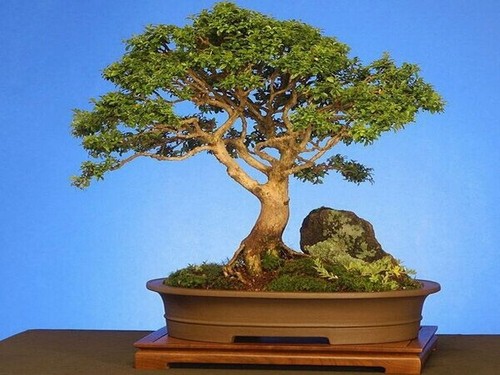
Too ordinary is uninteresting, while too extraordinary loses naturalness. At the same time, the extraordinary must have a foundation in life and a basis in nature. It should be unexpected yet entirely reasonable. It often exists within the ordinary and requires deep exploration and careful observation to discover. Therefore, a solid foundation in life is required, and one must conduct extensive, meticulous and in-depth observation of nature. This is what the painter Monk Shitao said: draft from all the strange peaks. At the same time, one must also have deep artistic cultivation and skilled expressive technique. It should be known that the extraordinary is by no means absurd or bizarre, but must conform to natural laws and be convincing. In addition, the extraordinary within the ordinary also carries the meaning of "miraculous within the decayed," that is, ordinary and commonplace materials, through artistic processing, become a completely new artistic image.
In the scenery of nature, there are both majestic and precipitous peaks and winding, meandering long rivers; there are both vigorous and upright ancient pines and graceful, charming weeping willows. This is the dialectical relationship of strength and softness complementing each other. In bonsai art, strength and softness are reflected in the work's subject matter, artistic style, and the form, texture and lines of the scenery. Whether strength is better or softness is better cannot be generalized. As far as the subject matter of the work is concerned, the strong and the soft each have their own merits, just like the vigorous and the graceful schools in China's literary history over the ages. But as far as the artistic modeling of the work is concerned, the strong should not be strong all the way through, but should contain softness within strength; the soft should not be soft all the way through, but should contain strength within softness. Only in this way can there be variation and contrast, making the strong appear even stronger and the soft appear even softer.
In the relationship of strength and softness in tree stump bonsai, it is mostly reflected between the main trunk and the branches, between the hard angles and soft curves of the branches, and between the accompanying stones and the trees. Generally, the main trunk tends toward strength, while the branches are more soft; hard angles appear strong, while soft curves appear soft; accompanying stones are mostly strong, while trees are mostly soft within. In vigorous pines, the artisic unity of strength and softness complementing each other is usually achieved through the turns of the branches. In landscape bonsai, the complementarity of strength and softness is also reflected in many aspects. Mountain and water are one strong and one soft, while stones and trees are also a contradictory unity of one strong and one soft.