What ranges does proportion cover in the process of shaping bonsai and stump scenery?
Appropriate and harmonious proportion in bonsai art gives people pleasure, thereby producing aesthetic delight; conversely, it is difficult to evoke a resonance of beauty. In bonsai, the "inch" and "foot" in "shrinking a dragon into an inch" and "a vast landscape within a foot" clearly tell us that aesthetic factors of "proportion" are contained within.
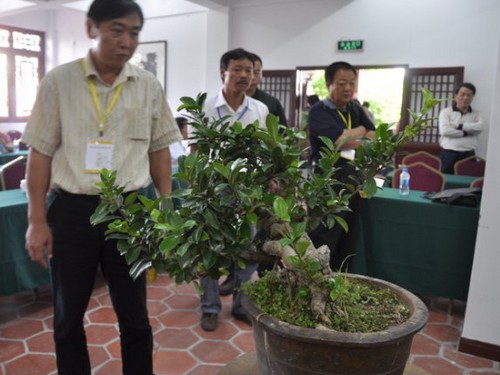
For stump scenery shaping, proportion is a broad concept, covering the entire process of stump scenery shaping and creation.
(1) In terms of time, proportion runs through the entire process of shaping and creation.
From the selection of stump material (including selecting stumps according to an idea and conceiving an idea according to a stump) -- the vertical and horizontal dimensions, height, spacing, combination, root spread area, and the retention or removal and pruning of grafted branches -- stump cultivation, the arrangement and positioning of upper, lower, left and right branches -- pruning and artistic treatment -- potting and final planting -- shaping and maintenance -- accessory display, and so on, proportion runs through every one of these links. This is determined by the growth characteristics of plants and the artistic qualities of stump scenery.
(2) In terms of space, proportion restricts the specifications and types of stump scenery.
Bonsai is praised as "three-dimensional painting" precisely because it occupies a certain space, yet differs from garden landscaping. Different scales determine different specifications and types; beyond a certain scale, it becomes a courtyard tree or garden tree, not a bonsai. For example, classified by crown height: large stump scenery is generally 81cm-15Ocm, medium is 41cm-80cm, small is lOcm-40cm, and miniature is lOcm or below.
(3) In terms of form, proportion acts upon the different styles of stump scenery shaping.
Different shaping forms have somewhat different proportional requirements for trunk thickness ratio, length and extension of curvature, density and dispersion of branches and leaves, and the size of spatial openings. To a certain extent, proportional relationships complement other shaping techniques. They influence the formal style of the work. For example: Lingnan's branch-cultivation and trunk-truncation style is majestic and robust, Suzhou's cloud-like style is elegant and antique, Yangzhou's platform-style cloud shaping is delicate and spectacular, Sichuan's square-bend style is antique and peculiar, Shanghai's combined pruning and wiring style is natural and ancient, Hubei's density-and-spacing style has soaring dynamic momentum, Taiwan, China's short and sturdy tree scenery is orderly and lush, Fujian's ancient banyan style has coiled roots and cascading flow, Jiangsu and Zhejiang's water-and-drought tree-and-stone style blends scene and feeling, and Lingnan's Surcn high-floating style is aloof and free - all reflect differences in structure, technique and compositional layout, yet precisely within these different "techniques" there is a "partner proportion" required by the aesthetic consciousness itself that echoes them, mutually restraining and mutually connected.
(4) In terms of content, proportion deepens the artistic effect of the shaping concept.
We often say that "those who play with bonsai must have a tree in their mind," yet whether the tree in the mind can become the tree before the eyes, and whether the tree before the eyes conforms to the imagined tree - whether it is wild and unrestrained, or tranquil and elegant; whether it is majestic and fierce, or fresh and natural; whether it is dignified and solemn, or graceful and unconstrained; whether it is towering and upright, or lush and graceful, and so on - while emphasizing different shaping techniques, all are permeated with mutual proportional relationships. The same tree species and the same tree structure may all weaken the artistic effect of the work because the proportion is not in place.