What eye-moistening and eye-protecting benefits do Acorus calamus bonsai have?
Nowadays, many people sit in front of computers for long periods every day, and young people especially like to play on their phones constantly, so the phenomenon of “dry eye” caused by excessive eye fatigue has become very common. Ancient scholars who bent over their desks reading and writing also suffered from damage to their eyesight. In response to this situation, traditional life invented a very ingenious solution, namely placing a “calamus-and-stone basin” in the study and using the dew condensed on calamus leaves to moisten the eyes.
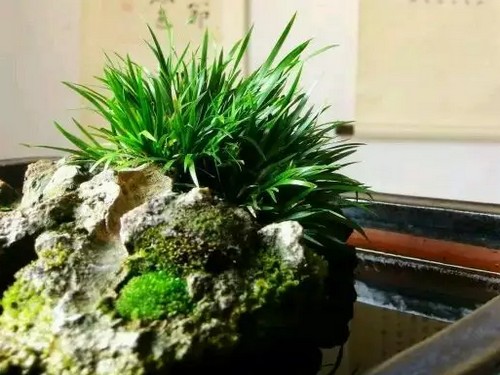
The ancients believed that every early morning, wiping the eyes with dew that had condensed overnight on cypress leaves or calamus leaves could maintain eye health and make eyesight bright. As Li Shizhen said in the Compendium of Materia Medica: “Dew on cypress leaves and dew on calamus can both improve eyesight; wash with them every morning.” However, the night dew on cypress trees is not so easy to collect. By comparison, calamus can be planted in a small pot and kept in the study. Therefore, using the night dew on artificially cultivated calamus as an “eye lotion” after rising in the morning became a trend among scholar-officials.
Calamus became an elegant fixture in the study beginning in the Song Dynasty. Calamus grown in pots is also called “calamus on stone” or “stone calamus”; it grows on stones in water and needs no soil when cultivated. This clean state is not only elegant but also especially suitable for indoor placement, particularly in a study full of books, scholar's implements, and elegant objects. Place a few stones in a pot, fill it with water, sprinkle some cold rice soup over the stones, toss in some calamus seeds, and then put the pot in a cool, damp place; thin leaves will grow from the stones——the ease of cultivating stone calamus is also an important reason it holds first place among indoor potted plants and flowers.
For scholar-officials and literati, calamus does not touch muddy soil and survives only with clean stones and clear water, which seems to carry symbolic meaning, as if it were the incarnation of a lofty scholar unwilling to join the corrupt world, a mirror image of a gentleman's conduct. In addition, the Song Dynasty happened to be a period when the literati fashion for appreciating stones arose, and calamus must rely on stones to grow, which exactly matched the contemporary literati's love of stones. Therefore, the “calamus-and-stone basin,” decorated with stones and full of calamus, became a popular detail in Song Dynasty literati studies. Lu You once described the leisure and calm of reclusive life this way: “With cold spring water I change the calamus water myself; with a live fire I leisurely boil olive tea. Naturally, an idle person has enough idle pleasures; I originally had no intention of learning from the wild monks.” (Miscellaneous Poems on Lake Village in Early Summer) The poet personally replaced the calamus-and-stone basin with newly drawn spring water, then boiled and tasted tea, and mocked himself, saying that this was truly the kind of “idle pleasure” only a typical “idle person” would enjoy.
In fact, from Lu You's poem one can see precisely that the various designs in the traditional study could always combine multiple functions. For example, literati were always encouraged to personally tend flowers and trees, change water for bonsai, burn incense, boil tea, grind ink, and so on. In reality, this encouraged literati to intersperse their desk work with labor that did not consume too much physical strength, in order to move the muscles and bones, relax the mind, ease the eyes, and exercise the flexibility of the hands and feet. It was a very beneficial health regimen. These daily tasks done with one's own hands all required diligence and patience, and therefore were also believed to be able to cultivate the temperament.
After calamus-and-stone basins became popular, people quickly discovered that calamus leaves always condensed moisture from the air at night, forming sparkling dewdrops. The Song Dynasty monk Huiming, in a poem “Ode to Calamus,” exclaimed: “Not a speck of dust or mud beneath the roots; by nature it loves springs and stones, and its affection is solitary. If it had not then stirred the grief of the Xiang River, why would every leaf have teardrops?” Traditional Chinese medicine also held that dew on calamus leaves had the function of improving eyesight. By the Ming Dynasty, wiping both eyes with calamus dew to “moisten the eyes” (Zunsheng Bajian) had become one of the health practices commonly adopted by literati.
Thus, a day of refined elegance for a Jiangnan scholar-official began like this: after waking, he first sat cross-legged on the bed and performed a round of breathing and guided stretching health exercises, then, attended by servants, brushed his teeth, rinsed his mouth, washed his face, and combed his hair. Next, he strolled to the study, used his fingers to strip little drops of dew from the slender leaves of several carefully tended pots of calamus, dabbed them on his eyelids, then closed his eyes and gently rubbed above and below the eyelids, completing the “eye washing” procedure in his health regimen.
Perhaps today everyone can try the ancients' experience: place a pot of calamus beside the computer and gently wipe the eyelids with the clear dew on the leaf surfaces to see whether it really has an eye-moistening effect. In addition, in the Ming Dynasty people also discovered that calamus leaves can absorb the oily smoke of lamps and candles. Through the long night, three or five pots of verdant calamus stood gracefully on the long table beside the desk, quietly gathering the oily smoke given off by the reading lamp and creating a clean environment for literati absorbed in poetry and books. From this point of view, when today's elegant people burn incense, brew herbal tea over candles, or light incense candles, they might as well place several pots of calamus around them and let the clear green calamus leaves gather and hold the smoke and dust.