The Unique Beauty of Sandstone Bonsai in Home Decor
Sandstone is a sedimentary rock formed when grains of stone, washed by water and deposited on riverbeds, were compacted and solidified over thousands of years. Later, movements of the earth's crust created the mines we know today.
Sandstone is one of the most widely used building stones. Buildings decorated with sandstone hundreds of years ago still retain their charm today, such as Notre-Dame de Paris, the Louvre, the British Royal Palace, the United States Capitol, Harvard University and others. The noble, elegant character of sandstone and its hard texture have created one marvel after another in the history of world architecture. In recent years, sandstone, as a natural building material, has been championed by architects who follow fashion and nature, and is widely used in commercial and home decoration. The types that have been mined and used around the world include Australian sandstone, Indian sandstone, Spanish sandstone and Chinese sandstone, among others.
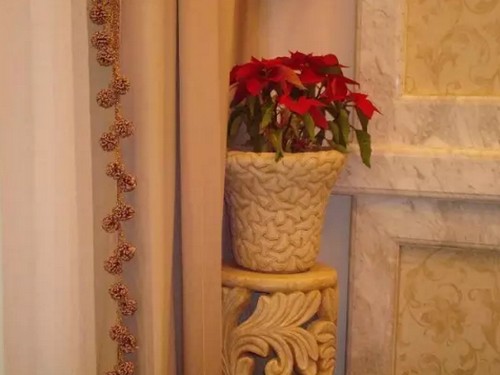
Features of sandstone: sound insulation, moisture absorption, resistance to damage, no weathering outdoors, no dissolving in water, no moss growth, easy to clean, and so on.
Sandstone is a high-quality natural stone with no light pollution and no radiation, causing no radioactive harm to the human body. It is moisture-proof, slip-resistant, sound-absorbing, light-absorbing, odorless, radiation-free and fade-resistant, warm in winter and cool in summer, warm and elegant; compared with wood, it does not crack, warp, rot or fade. Installation of the products is simplified: carved pieces can be fixed to the wall with just screws, and the products can be organically connected with woodwork decoration, giving fuller play to the space of backdrop designs, overcoming the cumbersome traditional installation of stone and reducing installation costs. In a decorated home, carved pieces can be mounted directly on the wall without any additional procedures or paint.
In terms of material, it is a warm-toned decorative material, plain and elegant yet warm, harmonious without losing luxury; it has the texture of stone, the grain of wood, and spectacular landscape scenes, with rich colors, close to nature, simple and elegant, standing out uniquely among the many stones and praised as "beautiful stone."
Sandstone is the most widely used stone by humankind; its noble, elegant character and naturally eco-friendly properties have created one marvel after another in architectural history. The Louvre, the British Royal Palace, the United States Capitol, Harvard University, Notre-Dame de Paris and others, decorated with sandstone hundreds of years ago, still retain their charm today, their classic beauty enduring.
In the past, using sandstone for construction was very laborious, because the cutting machines and processing machinery and equipment at the quarries were relatively backward. In recent years, these conditions have improved, and it has gradually become possible to supply customers with high-quality products according to their color requirements, with the highest level of expertise. Sandstone can be used widely. Some even say, "Anything people can think of, it can be used for."
Artificial sandstone is also called imitation sandstone or composite sandstone. It is made by blending natural colored quartz sand in different proportions to adjust the color, then adding eco-friendly resin, curing agents and other ingredients, and hand-pressing the mixture in silicone molds. Artificial sandstone has realistic shapes and strong plasticity, and products with any pattern and specification can be custom-made freely.
Sandstone is the latest popular natural building material, substantial and grand, with a strong three-dimensional feel, especially suitable for decorating wall art in high-end homes and offices. It feels like fine sand to the touch, and the longer the sandstone lasts, the better it looks; a slightly weathered look is the most beautiful. Most importantly, it is an ecologically friendly stone with no pollution, no radiation, no discoloration, heat absorption and resistance to deformation, causing no harm to the health of household members.
Artificial sandstone is a green, eco-friendly building decoration material that is non-radioactive, resistant to acids and alkalis, long-lasting, good in hardness, non-toxic and odorless, pollution-free and self-waterproofing. The surface of the product is granular like sand, with the natural texture of sandstone; the contrast between light and dark is strong, the three-dimensional effect stands out, and it is all the more decorative. Because the surface of sandstone is rough, it can scatter light, making the lower parts of the product's surface appear darker, giving it a stronger three-dimensional effect than those smooth stone products, so its patterns and lines are especially clear and its decorative quality is excellent.
Artificial sandstone bonsai can fully display the classical cultural style of the East, the passionate and romantic mood of the West and Europe and America, and the style of modern culture and art. It can embody noble and elegant quality and create a rich cultural and artistic foundation for human life. Traditional decorative materials pursue splendor and richness, taking luxury as beauty, which has already made people's eyes weary and indifferent. What artificial sandstone displays is a return to simplicity, with a plain and unadorned beauty that gives people a strong visual impact. This kind of decorative beauty is not magnificent, yet it makes people feel very elegant. Simple and elegant, with endless charm, it is high in class and taste.