How to achieve simplicity amid complexity and apply techniques according to the material in bonsai creation
The creative process of bonsai art is a long, meticulous, and painstaking one. You must not only master the traditional basic knowledge, but also carefully savour the various kinds of knowledge brought by experience through earnest and meticulous work. To put it plainly, it is about seeking a way out within the basic rules and conventions, and definitely not about blindly drawing a gourd ladle by copying a gourd.
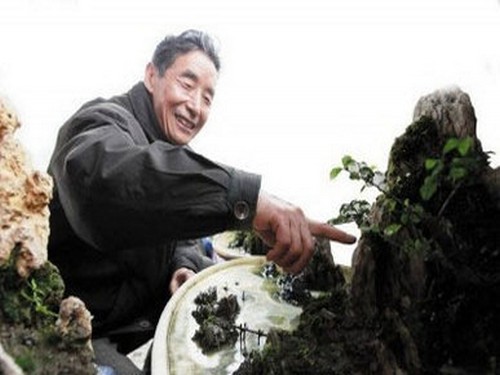
Therefore, we should seek simpler and easier methods of operation within the basic processes and rules. Everything has its own laws of evolution. Whether we can better grasp these laws, whether we can scientifically and effectively change them in practice so that people can grasp them more easily, simplify concepts, and break traditional restrictions - this is precisely the subject that contemporary bonsai practitioners need to study.
When observing nature, one must be good at selecting and discarding. An old saying goes: “How can a thousand-li mountain be wholly wondrous? How can a ten-thousand-li river be wholly beautiful?” It is also said: “A million blossoms meet the eye, but only two or three branches please the heart.” Only with omission can there be emphasis. In order to highlight what should be highlighted, bonsai creation should be like sculpture - removing those useless parts. If one does not select and discard, it is very easy to create the phenomena of unclear emphasis, the secondary overshadowing the primary, or a jumble of scenery. Only by grasping the characteristics of the scenery, cutting the complex and simplifying, or seeking simplicity amid complexity, can one use less to achieve more and see the large within the small, thereby reproducing natural scenery in a concentrated and typical way. For example, if one were to create a landscape bonsai work with the landscape of the Lijiang River as the subject, if one copied nature exactly and completely scaled down the real scene, it would be impossible to express the appearance of all the Lijiang River's wondrous peaks within a basin of mere inches. Even if it were made, it would not have the beauty of a painted scene. Only by depicting one or two wondrous peaks with spiritual charm and accompanying scenery in the basin can one achieve the artistic effect of seeking simplicity amid complexity. Tree stump bonsai are natural strange tree stumps given artificial techniques to make them prominently express the solitary height and uprightness of the trunk, and the elegant, unrestrained, and rich spiritual charm of the branches and leaves. Therefore, one must cut the complex and simplify in order to express their artistic beauty.
Seeking simplicity amid complexity is an important law in artistic creation. Generally speaking, what can be discarded should be discarded, and what can be thrown away should be thrown away. Just as the Qing dynasty painter Zheng Banqiao said when discussing painting: “One or two or three bamboo stalks, five or six or seven bamboo leaves, naturally sparse and light - why must they be layered and piled up…… So simplicity is a means, not an end. As for selecting, discarding, and cutting away, this actually already contains the author's subjective aesthetic feeling, and at the same time the scenery expressed by the work has also gone through the author's processing and transformation. Therefore it is higher, more beautiful, more concentrated, and more typical than the real scenery.
Applying techniques according to the material is one of the important aesthetic characteristics of bonsai. The main materials it uses - plants, rocks, soil, water, and so on - belong to the same category as the objects they express. These materials themselves already possess a certain natural form and colour, and among them plants also have the characteristics of life. Thus they can endow bonsai with natural beauty, which is something painting and other plastic arts cannot achieve. However, the characteristics of bonsai materials also limit bonsai shaping to a certain degree. Painting can freely depict all kinds of landscapes and trees on a blank sheet of paper, whereas making bonsai must follow the different characteristics of the materials, guide according to the situation, and follow nature in determining how to shape and how to express the theme according to the material. This is the handling method of ”applying techniques according to the material“. In tree bonsai, for pine, it is appropriate to express its vigour and strength; for cypress, it is appropriate to express its ancient simplicity; plum can express its sparse shadows slanting across, and bamboo its elegant and spreading form. If pine and cypress were used to express graceful charm, or vines to express vigour and strength, this would not conform to the principle of applying techniques according to the material, and therefore the work would not be successful.
In landscape bonsai, one can express different themes according to the natural beauty contained in different kinds of stone - such as differences in texture, shape, wrinkles, and colour - and make various artistic forms through artificial processing. For example, axe-cut stone with a slender body and upright veins can be used to express steep peaks; sandy accumulation stone, pumice, chicken-bone stone, and so on, which are loose in texture and easy to carve, can be used to express various peaks with shallow wrinkles; round and smooth pebbles can express seaside scenery; white Xuan stone and sea-white stone can express snow scenes, landscapes, and so on.
Whether plant materials or rock materials, in the process of processing and shaping, one must carefully examine them, and according to the natural beauty of the material, decide what theme to express, and then carry out the shaping. Therefore, handling according to the material can make bonsai works possess both appropriate artificiality and natural wild charm. Artificiality is important; if everything were left entirely to nature, there would be no talk of bonsai art. But if the traces of artificial cutting and chiselling are too excessive, then naturalness is lost. Therefore one must neither completely let nature take its course nor rely entirely on artificiality, so that bonsai works can truly achieve an organic combination of natural beauty and artistic beauty.