What are the naming methods for bonsai? A detailed explanation of common naming approaches
The naming of bonsai is also something we often take pride in, and at the same time it is often used as an excuse to belittle others, claiming that without a name it lacks artistic conception, and so on. Is that really so? Laozi said: “The Dao that can be spoken is not the eternal Dao; the name that can be named is not the eternal name.” It is clear that having no name is not a problem at all. Without a name, everything can be its name; imagine as you will: the scene shifts with the mind, and the meaning arises from the heart. But with a name, one is sometimes instead constrained, that is, the name does not match the reality. Therefore, for a bonsai work, what harm is there in occasionally leaving it unnamed? It may even achieve the effect of the unnamed surpassing the named.
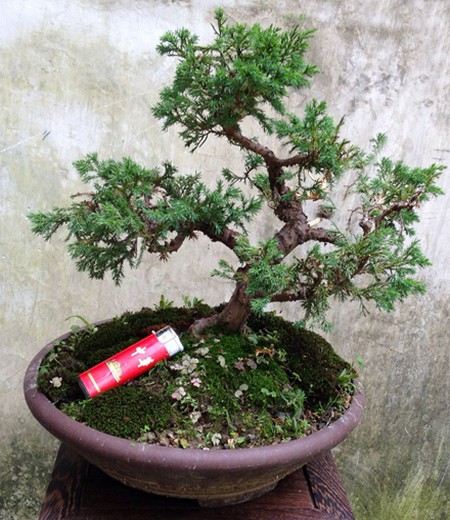
I feel that when we name bonsai, in terms of wording, we rather one-sidedly use overly exaggerated, glorious and mystifying vocabulary, and lack plain, simple and apt expressions. Just as in writing poetry, one needs a line that brings the dragon to life by dotting its eyes, so it is with bonsai: with a good title, the theme of the bonsai stands out at once. In naming bonsai, the author, through actual practice in making them, has arrived at the following three insights.
Naming by using famous lines and figures of people:
This naming method is relatively simple and convenient, and the key lies in being perfectly apt. For example, if one uses Li Bai's poetic line “The light boat has already passed ten thousand mountains,” then the landscape bonsai created must have continuous great mountains and a ceaselessly rushing great river, with a boat on the river, highlighting the image of distant mountains and waters and a small boat flying across; only with such a bonsai is the naming just right. If one uses Wang Zhihuan's famous line “The Yellow River rises far into the white clouds,” the bonsai scene should have the image of distant mountains, white clouds and the Yellow River. If one uses “Spring is at the shepherd's purse flowers by the stream” from Xin Qiji's “Written on Behalf of Another” in Song ci poetry, the bonsai created must have a small stream at the foot of the mountain, with several shepherd's purse plants already blooming white flowers clustered with green leaves growing at the stream's head, and even willow twigs already tinged with goose-yellow by the stream bank. There are also quite a few bonsai named after figures of people, for example, a bonsai titled “Fishing Alone in the Cold River Snow,” in which the figure on it can be seen to be the image of Jiang Taigong; then changing it to “Jiang Taigong Fishes” would be more exact and vivid. “Du Fu Chanting While Walking,” “Zhaojun Departs Beyond the Frontier,” “Mi Fu Worships the Stone,” and others are all named according to figures of people, with profound artistic conception and a fresh and elegant style, often of a higher class than names one creates oneself.
Naming after the images of natural scenery:
Bonsai is inherently a miniature of natural landscape, so naming must be based on the characteristics of the landscape and crowned with the name that best embodies its spirit, such as “Goddess Peak,” “A Ten-Thousand-Li Journey on the Yangtze,” and “The Winding Great Wall.” For those belonging to the category of distant villages and nearby countryside, pastoral scenery, although they lack the bold spirit of great mountains and rivers, they have exquisite small scenes and rustic charm; such bonsai should be named with greater novelty: “A Small Bridge, Flowing Water, and a Household,” “A Chorus of Frogs,” “A Touch of Red Among Ten Thousand Greens,” “New Grace of an Old Mulberry,” “A Red Chamber of a Farmhouse in the Misty Rain,” and so on are all named after natural scenery, mostly blending scene and emotion, with profound meaning and much to ponder. Images combining natural scenery with animals and plants are also highlights in bonsai naming, such as “Greeting-Guests Pine of Mount Tai,” “Ancient Cypress of Mount Song,” and “Tang Scholar Tree of an Old Temple”; such bonsai titles are relatively popular, and they are extremely numerous in bonsai gardens; the drawback is that they make people feel insufficiently novel and distinctive. There are also many named by combining natural scenery with animals: “Three Bears in the Bamboo Grove” (pandas), “Birds Singing in Empty Mountains,” “Golden Fish Sporting in the Dragon Spring,” “Flying Fox of the Strange Mountain,” and so on. For bonsai named after natural scenery, it is not so easy for creative and excellent names to appear; one must carefully observe and study, and only when a witty and delightful inspiration is born can one obtain an excellent bonsai name of strong artistry.
Naming according to the bonsai's form and imagery:
The form of a bonsai is an important basis for giving it a name. Bonsai makers already have the “form” in mind when making the bonsai, so once it is finished they immediately come up with a name. However, some also neglect this matter, and afterward need to ask someone to name it. Those who are cultured and knowledgeable, who can write poetry and paint, after careful observation, will generally work out an elegant name. Fine names for formed bonsai, such as “Chang'e Flies to the Moon,” “The Peacock Flies Southeast,” “Magpie Alights on a Branch,” “The Great River Flows East,” “The Carp Leaps Over the Dragon Gate,” “Dogs and Cats Frolic in Spring,” “Tiger Crouches on a Craggy Rock,” “Bamboo Shadows: Rain, Dew, Wind, Clear Sky” (four pots), “Cloud-Green and Fruit-Red,” and so on; these bonsai names belong to the popular category. If one seeks something more subtle and profound, then one must name according to the bonsai's imagery, not linking name and scene obviously at a glance, but rather, after viewing, thinking of something one yearns for. For example, if the bonsai scene is an old tree, with a cicada lying on a tree burl among the branches, and it is named “Autumn Sound,” the viewer does not actually hear autumn sounds; seeing this scene, people think of “silent as a cicada in cold weather,” and thus associate it with autumn. Another example is the bonsai “Moon Shines on the Bamboo Grove,” in which only through the gaps of a clump of green bamboo do threads of silvery light flicker, and the moon cannot be seen at all; this may make one ponder that the moon is just beyond the grove, with light slanting over, which is much better than having the moon right on top of the grove. This is how the name of a bonsai can be very far from the actual scene of its form, yet meaning and scene are closely linked; with a bit of thought, one can delightedly decipher it, and only such bonsai names are truly of a high class.