In bonsai creation, establishing the concept comes first and must be carried through from beginning to end.
The so-called "establishing the concept" means that before creation, after the author obtains the tree stock, or regarding the method of working the rocks and stones, based on their morphological characteristics and the features of the material itself, and combined with the author's own artistic cultivation, a general conception of the work is formed. This thinking process includes the work's outward form, size, use of branch techniques, and the design of the matching pot, and serves as the basis for later creation. Therefore, establishing the concept focuses on handling the work's "spirit," while composition focuses on handling the work's "form." The two are a dialectical unity, both distinct and closely connected. Thus, while establishing the concept and composing, one must handle the relationship between the two well in order to obtain a work with a fresh concept, beautiful composition, and unique charm.
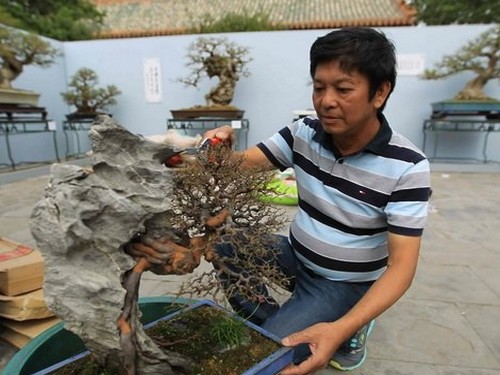
What theme the concept is to express is the most important thing. Theme is artistic conception, that is, poetic feeling. How well the theme's artistic conception is realized is the first standard for judging the quality of a bonsai work. The concept should be elegant and novel, and the work should have dynamic spirit and charm; it should oppose being bland and unremarkable, "a scene with no danger or surprise," and rigid and formulaic, and it should also not be merely realistic or a direct copy of nature. The relationship between the unusual and the real must be handled correctly. The unusual is also real; it is simply something drawn from nature and real life that is unexpected, captivating, vivid and interesting, and yet reasonable.
The second matter is material selection. In the case of stump bonsai, one must not only consider the characteristics of the tree species, but also pay attention to the individual's "appearance" and posture. Tree species selection requires such characteristics as a bizarre root crown, roots that are easy to train and expose, a trunk tolerant of training and pruning, fine branches and dense leaves, fragrant and colorful flowers and fruit, strong adaptability, tolerance of poor soil, tolerance of transplanting, and ease of potting. These are the general requirements, but different themes have different requirements. If one insistently uses vines and the like to express ancient ruggedness and grandeur, or uses pines and cypresses to express graceful charm... the result will be twice the effort for half the result, or even wasted effort. At the same time, in selecting materials for water-and-stone bonsai, one should also grasp the characteristics of the stone's texture, color, form, and grain, shaping according to the material or selecting material according to the idea. For example, using sharp and elegant sandstone slabs or ax-cut stones to make steep and extraordinary peaks; using hollow, transparent stalactite or cliff-pulp stone to make tiger dens and dragon pools is just right. One should be familiar with the stone forms' characteristics of "leak, transparency, thinness, and wrinkles." Thinness gives uprightness and extraordinary grandeur; wrinkles give rich layered variation; leak and transparency give deep and unfathomable mystery, avoiding crampedness, each with its own wonderful use.
The third matter is what form to use. Is it to be a landscape bonsai or a stump bonsai? If a landscape scene is chosen, one must first decide whether it is a water basin, a dry basin, or a water-and-dry basin; if a stump bonsai is chosen, is it to be boldly and freely natural style, or finely carved and meticulously regular style like fine-line painting; is it to be pruning, training with wire, or otherwise distinguishing primary and secondary while applying both.
The fourth matter is the arrangement of primary and secondary elements in the pot, their near and far positions, and so on; all must revolve around the theme and be considered as a whole, using various artistic means to serve the creation of artistic conception. If before starting creation one cannot grasp the correct idea and proceeds aimlessly, arranging trees and placing stones by random patchwork, with each element in the pot taking no account of the others, then one cannot create a good work. An excellent work must have a fresh concept and elegant style. Chinese bonsai artists place great emphasis on the creation of artistic conception, and every new work opens a new face; this is a fine tradition that should be well inherited and carried forward. In the short preface to the poem "Small Emei" by Fan Shihu of the Song Dynasty, he said: "Recently I obtained an ancient Lingbi stone, exceedingly like the main peak of Mount Emei, and named it 'Small Emei.' Dongpo once used the name for Mount Lu, but I fear it is not as lifelike as this stone. I wrote the 'Song of Small Emei' to praise it." The poem also says, "The Three Emei stand across, the Great Emei is high, rushing cliffs and slanting force lean against half the sky. Dragon steps, tiger crouches, rising and then lying down, glancing sideways at the Mo River and Tuo River paying court. Yu passed below it from Min and Bo, enshrining mountains and recording names, called a hero..." Facing the ancient Lingbi stone, the poet captured the true essence of Emei's landscape, and from this associated it with the great deeds of ancient Yu below Mount Emei, governing the waters for the people and turning harm into benefit, making the work rich in poetic and pictorial charm and deeply captivating.
Before making a bonsai, there must first be a conception. After the overall plan is set, in the actual creative process one must still repeatedly examine the material and only then modify and supplement it. In Chinese painting this is called "the brush arrives and the idea is born." This is the continuation of establishing the concept, and its important significance in bonsai creation far exceeds that in Chinese painting. This is because bonsai materials cannot be like brush and ink, which the painter can freely wield at will, but must accommodate the material's natural beauty. Therefore, only by carrying the established concept through the entire process of bonsai creation can it reach a state of perfection.