What are the differences between Chinese and Japanese bonsai? My thoughts
Speaking of Japanese bonsai, I have some thoughts. Of course, differences among peoples and regions mean that standards of beauty and habitual aesthetic concepts need not be exalted or disparaged, nor forced into uniformity; rather, they should be continually elevated through mutual respect.
Art has no right or wrong, only superior and inferior. Japan is a nation very skilled at borrowing, but as far as its borrowing and imitation of bonsai goes, it has probably remained stuck in China's Tang Dynasty.
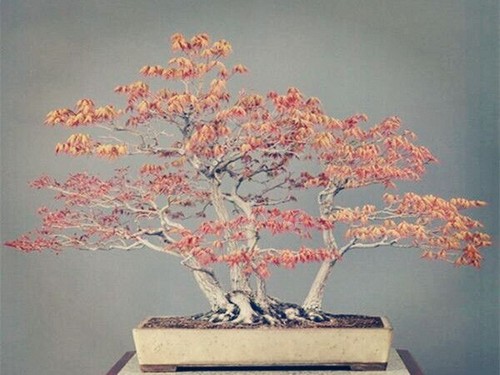
Scientific cultivation and meticulous care, mainly an adherence to aesthetic concepts, have produced the basic characteristics of Japanese bonsai: thick and glossy, rounded and over-layered, strictly following convention. While it shows us nobility and gorgeousness, roundness and plumpness, it also lets us faintly detect an atmosphere of leisurely indolence and bloated sluggishness, like viewing paintings of palace ladies from China's Tang Dynasty.
The track of historical development has followed the same course for a thousand years unchanged; this is an unexpected continuity, and also a deep-level feeling difficult to convey completely. But one absolutely cannot say it is not beautiful, nor that it lacks a thickness of beauty.
Chinese bonsai, walking all the way from the Tang Dynasty, though at times faltering and ill-fated, has after all moved from tender youth to steadiness, and will undoubtedly carry, more or less, the ever-advancing and enriching aesthetic colors of each era. To this day it has finally grown into something as supremely wonderful as poetry.
The forces of nature, pluralistic aesthetic trends, and the infiltration of multiple cultural elements laid the foundation of Chinese bonsai while also forging its colorful cultural soul. Its ultimate aesthetic direction is the broad and profound Chinese culture; a pattern that keeps its wildness yet carries a wafting immortal air reflects a worship of nature, while the freely unfurling, nimble and ever-changing branch techniques give off a charm of immortal grace and Daoist elegance.
It is hard to imagine in what form an art stripped of its cultural soul would appear before the world. If Chinese bonsai were placed alongside the bonsai of many other lands for comparison, anyone with even a slight grasp of the meaning of Chinese culture would surely understand without being told.